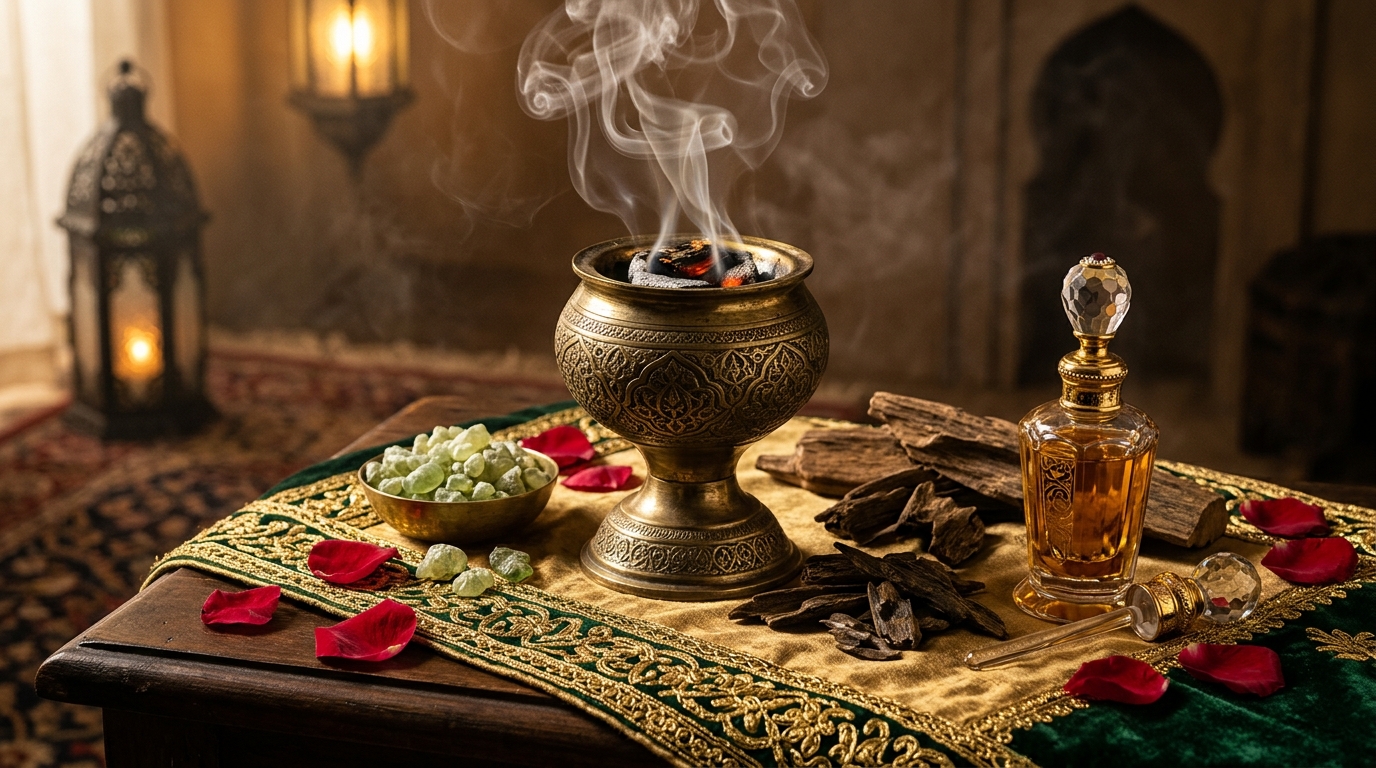
Long before the sun rises over the shifting sands of the Empty Quarter, the scent of burning agarwood and frankincense drifts through the quiet stone courtyards of the Arabian Peninsula. In the Islamic world and the ancient kingdoms that preceded it, perfume has never been a cosmetic accessory or an occasional luxury. It is a spiritual devotion, a sacred pillar of hospitality, a marker of royal distinction, and the very foundation upon which modern chemistry was born.
To the classical Greco-Roman world, the southern reaches of the Arabian Peninsula were known by a reverent Latin title: Arabia Felix—“Fortunate Arabia” or “Fertile Arabia.” This was not because the harsh desert was lush with rivers, but because its mist-shrouded southern mountains held the world’s most fiercely guarded botanical monopoly: the sacred trees of Frankincense (Boswellia sacra) and Myrrh (Commiphora myrrha).
Yet Arabia’s contribution to global perfumery reaches far beyond harvesting ancient gums. During the Islamic Golden Age, scholars and polymaths in Baghdad, Damascus, and Cairo orchestrated a profound scientific revolution. By marrying the natural philosophy of Classical Greece with Persian court traditions and Indian spices, Arab alchemists invented true steam distillation, designed the cooling coil, and gave the world the word and apparatus that still defines the craft: the alembic (al-anbiq).
Without ancient Arabia, the modern art of perfume—from Grasse’s rose fields to contemporary niche perfumery—would simply not exist.
1. Arabia Felix & The Incense Route (Darb al-Bakhur)
Two thousand years before the Common Era, an invisible web of trade routes stitched together the remote plateaus of Southern Arabia with the great empires of the Nile, the Tigris, and the Mediterranean. This was Darb al-Bakhur—the legendary Incense Route.
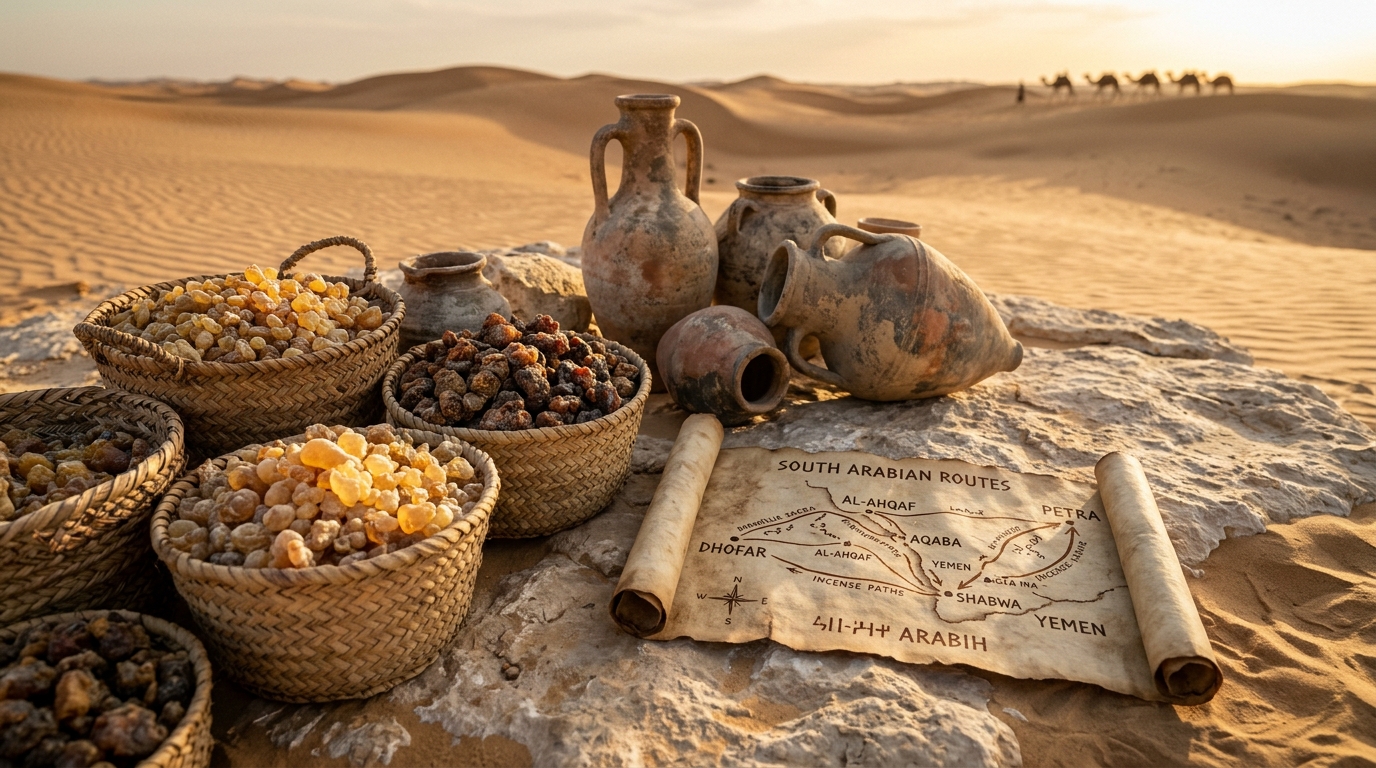
The Ancient Incense Trade Network (~1000 BCE – 200 CE):
┌─────────────────────────┐          ┌─────────────────────────┐
│  Dhofar & Hadhramaut    │          │  The Nabataean Kingdom  │
│  (Oman & Yemen)         │ ───────► │  (Petra & Hegra)        │
│  Harvesting Luban & Murr│          │  Caravan Monopoly       │
└─────────────────────────┘          └─────────────────────────┘
             │                                    │
             ▼                                    ▼
┌─────────────────────────┐          ┌─────────────────────────┐
│  2,000-Mile Desert Trail│          │  Mediterranean Ports:   │
│  Qataban, Saba (Sheba), │ ───────► │  Gaza, Alexandria,      │
│  Najran, Yathrib        │          │  Rome, Athens, Babylon  │
└─────────────────────────┘          └─────────────────────────┘
The Monopoly of Dhofar and Saba
In the rugged coastal mountains of Dhofar (modern-day southern Oman) and the wadis of Hadhramaut (Yemen), a unique microclimate created by the summer monsoon (khareef) allowed gnarled, limestone-clinging Boswellia sacra trees to weep their milky resin. The local tribes harvested the hardened tears:
- Green Hojari Frankincense (Al-Luban al-Hojari): Gathered in the dry, arid northern slopes of Dhofar’s Samhan mountains, this translucent lime-tinted gum was considered the purest incense on Earth. It was reserved exclusively for royal temples, pharaonic embalmers, and imperial altars.
- Myrrh (Al-Murr): Tapped from thorny Commiphora trees in Yemen and the Horn of Africa, prized for its bitter, balsamic medicinal unctions.
The ancient South Arabian kingdoms of Saba (the biblical Sheba), Qataban, and Ma’in grew unimaginably wealthy by controlling the harvest. Roman historian Pliny the Elder wrote with envy in his Naturalis Historia that the Arabs were the richest people on Earth, as the wealth of Rome and the Persian Empire flowed steadily into their desert sands in exchange for fragrant smoke.
The Nabataean Camel Masters
To transport thousands of tons of resin across 2,000 miles of waterless desert, the Nabataeans—a nomadic Arab people who carved their rose-red capital of Petra out of the Jordanian sandstone cliffs—built an invincible caravan network:
- Engineered Survival: The Nabataeans survived by engineering hidden underground cisterns (al-birkeh) across the desert, carved into limestone and disguised with natural sand, allowing their camel caravans to cross arid expanses where foreign armies perished.
- The Route to Gaza: Heavily guarded caravans of up to a thousand camels traversed sixty-five designated stages between Shabwah in Yemen, through Najran, Hegra (Mada’in Salih), and Petra, terminating at the Mediterranean port of Gaza.
- Gold for Smoke: At its zenith in the 1st century BCE, an imperial Roman pound of prime green frankincense commanded a price equivalent to several months of a legionary’s wages. Emperors burned tons of it annually; Nero was recorded to have incinerated more than a year’s entire Arabian frankincense harvest at the funeral of his wife Poppaea.
2. The Hellenistic, Persian & Indian Crossroads: Baghdad’s Translation Movement
When the rise of Islam unified the Arabian Peninsula in the 7th century CE and established the Abbasid Caliphate in Baghdad (founded in 762 CE), the Arab relationship with scent underwent a monumental intellectual transformation.
Baghdad's House of Wisdom (Bayt al-Hikma) Synthesis:
┌───────────────────────┐   ┌───────────────────────┐   ┌───────────────────────┐
│  GREEK HERITAGE       │   │  PERSIAN COURT        │   │  INDIAN OCEAN SPICES  │
│  Theophrastus, Galen, │   │  Rosewater (Golab),   │   │  Agarwood (Oud),      │
│  Dioscorides: Botanics│   │  Saffron, Musk Unction│   │  Sandalwood, Camphor  │
└───────────────────────┘   └───────────────────────┘   └───────────────────────┘
            │                           │                           │
            └───────────────────────────┼───────────────────────────┘
                                        ▼
                    ┌───────────────────────────────────────┐
                    │  ISLAMIC ALCHEMICAL REVOLUTION        │
                    │  Al-Kindi, Jabir ibn Hayyan, Avicenna │
                    │  Birth of True Steam Distillation     │
                    └───────────────────────────────────────┘
Under Caliphs Harun al-Rashid and his son Al-Ma’mun, the legendary House of Wisdom (Bayt al-Hikma) was erected in Baghdad. Scholars embarked on the greatest cross-cultural intellectual translation project in history, gathering scientific, medical, and botanical manuscripts from across the known world.
Translating the Greeks
Arab scholars did not simply copy ancient Greek texts; they rigorously interrogated, tested, and corrected them:
- Pedanius Dioscorides: His encyclopedic De Materia Medica (Kitab al-Hasha’ish) was translated into Arabic by Hunayn ibn Ishaq and Stephanus, providing Arab physicians with standard Greek pharmacological classifications for hundreds of Mediterranean plants.
- Theophrastus of Eresos: His treatise De Odoribus (Concerning Odours) introduced Arab scholars to the mechanics of carrier oils and stypsis (astringent priming). But whereas Theophrastus operated in an era without distillation, Arab naturalists immediately saw the chemical limitations of Greek lipid maceration and sought to surpass it.
- Galen of Pergamum: Galenic humoral medicine (the balance of Hot, Cold, Wet, and Dry humors) was adopted into Arabic medicine (Tibb al-Unani). Arabian polymaths classified every perfume note by its energetic temperature: Frankincense and Cinnamon were deemed Hot & Dry, warming the brain and dispelling lethargy, while Rose and Sandalwood were classified as Cool & Moist, soothing fiery fevers and headaches.
The Persian and Indian Influx
Baghdad’s strategic location along the Silk Road and the Indian Ocean maritime routes brought unprecedented aromatics into the alchemical laboratory:
- Persian Sasanian Traditions: The Persian mastery of floral maceration and golab (raw infused rose petal water), along with their reverence for royal animalic pastes.
- The Indian Ocean Spice Trade: Arab dhows sailing from Basra and Muscat to the Malabar coast and the Strait of Malacca brought Indian Sandalwood (Santalum album), pungent dried Cloves from the Moluccas, Nutmeg, and precious Camphor crystals (Kafur) from Sumatra.
- The Arrival of Agarwood: For the first time, dark, fungal-infected resinous Aquilaria heartwood from the jungles of Assam and Southeast Asia was imported into the Gulf, where it received its immortal Arabic name: Al-‘Ud (العُود, literally “the branch” or “the wood”).
3. The Islamic Alchemical Revolution & The Invention of the Alembic
The fatal flaw of ancient Egyptian, Greek, and Roman perfumery had always been physical: they did not know how to distill alcohol or separate volatile essential oils. Classical perfumes were thick, perishable unctions made by soaking petals in olive or balanos oil, which turned rancid within months and could never yield a pure, crystalline aroma.
Between the 8th and 11th centuries, Arab alchemists solved this millennium-old puzzle, transforming perfumery from a kitchen maceration craft into a rigorous quantitative chemical science.

1. Jabir ibn Hayyan (Geber) and the Al-Anbiq
Known to the West as Geber (c. 721–815 CE), Jabir ibn Hayyan is universally recognized as the father of early chemistry. Operating in Kufa (modern Iraq), Jabir pioneered the physical concepts of crystallization, calcination, evaporation, and above all, distillation.
He perfected the primary apparatus of the alchemical laboratory:
- The Cucurbit (al-qar’): The lower heating chamber containing the botanical mash and water.
- The Alembic Head (al-anbiq, from the Greek ambix, meaning cup or beaker): The domed copper cap that captures volatile vapors, cools them slightly, and channels the liquid down an angled beak into a receiving flask. The word alembic entered Latin, French, Spanish (alambique), and English directly from Jabir’s Arabic nomenclature.
2. Al-Kindi: The First Perfume Chemist
In 9th-century Baghdad, the philosopher-polymath Abu Ya’qub ibn Ishaq al-Kindi (c. 801–873 CE) wrote what remains the single most important founding text of historical perfumery: Kitab Kimiya’ al-‘Itr wa al-Tas’idat (The Book of the Chemistry of Perfume and Distillations).
Unlike mystical alchemists who guarded their secrets in riddles, Al-Kindi wrote as an analytical scientist:
- 107 Authentic Recipes: His book preserved over a hundred detailed formulations for royal perfumes, scented salves, and medicinal Waters.
- Apparatus Engineering: He provided detailed illustrations of laboratory stills, retorts, and double-boiler water baths (balneum Mariae / hammam ma’i).
- Solvent Chemistry: Al-Kindi was among the first to distill wine to concentrate volatile alcohol vapors, recognizing its power as a carrier for aromatic botanicals centuries before Western Europe learned the technique.
- Substitution Science: He designed cost-effective formulas mimicking exorbitant imported Indian aromatics (such as synthetic musk and artificial saffron oils), democratizing fragrance throughout the caliphate.
3. Ibn Sina (Avicenna) & The Refrigerated Condensing Coil
Despite the brilliance of Jabir and Al-Kindi, early alembic distillation suffered from thermal degradation: delicate flowers like the Damask rose scorched when heated over open flames, leaving the distilled water with an acrid, burnt odor.
Around 1000 CE, the Persian-Arab polymath Ibn Sina (known in the West as Avicenna) made the crowning engineering breakthrough: the refrigerated spiral condensing coil.
Avicenna's Refrigerated Condensing Innovation:
┌────────────────────────┐      ┌─────────────────────────┐
│ Cucurbit Boiler        │ ───► │ Alembic Swan-Neck Pipe  │
│ (Roses & Spring Water) │      │ (Carries Hot Vapor)     │
└────────────────────────┘      └─────────────────────────┘
                                             │
                                             ▼
                                ┌─────────────────────────┐
                                │ Cold-Water Jacket Coil  │
                                │ Rapid cooling condenses │
                                │ vapor into liquid drops │
                                └─────────────────────────┘
                                             │
                                             ▼
                                ┌─────────────────────────┐
                                │ Receiver Flask:         │
                                │ Rosewater (Hydrosol)    │
                                │ + Floating Attar Oil    │
                                └─────────────────────────┘
By passing the copper swan-neck pipe through an extended, coiled tube submerged in a continuous bath of cold running water, the hot botanical vapors condensed instantaneously back into liquid before thermal decomposition could occur.
With this invention, Avicenna successfully extracted pure Rosewater (Mayward) and concentrated Rose Essential Oil (Attar) from the Damask rose (Rosa damascena). The resulting floral hydrosols were crystalline, shelf-stable, and retained the fresh, sweet, true-to-nature scent of blooming petals. Rosewater immediately became the sovereign export of Islamic Persia and Syria, sent by the shipful to China, Byzantium, and Moorish Spain.
4. The Four Pillars of Arabian Fragrance
Across millennia of desert trade and alchemical refinement, Middle Eastern perfumery coalesced around four majestic raw materials. Known collectively as the Four Pillars, these ingredients form the fragrant DNA of oriental perfumery:
┌────────────────────────────────────────────────────────────────────────┐
│                   THE FOUR PILLARS OF ARABIAN PERFUMERY                │
├─────────────┬──────────────────────────┬───────────────────────────────┤
│ Pillar      │ Arabic Name & Source     │ Sensory Architecture          │
├─────────────┼──────────────────────────┼───────────────────────────────┤
│ Frankincense│ Al-Luban (اللُّبَان)     │ Balsamic, green citrus, pine, │
│             │ Boswellia sacra (Oman)   │ clean incense smoke, spiritual│
├─────────────┼──────────────────────────┼───────────────────────────────┤
│ Agarwood    │ Al-'Ud (العُود)          │ Deep resinous wood, animalic, │
│             │ Aquilaria agallocha      │ dark leather, balsamic honey  │
├─────────────┼──────────────────────────┼───────────────────────────────┤
│ Ambergris   │ Al-'Anbar (العَنْبَر)    │ Salty marine, velvet amber,   │
│             │ Physeter macrocephalus   │ warm skin radiance, fixative  │
├─────────────┼──────────────────────────┼───────────────────────────────┤
│ Deer Musk   │ Al-Misk (المِسْك)        │ Intimate powdery animalic,    │
│             │ Moschus moschiferus      │ sensual warmth, supreme depth │
└─────────────┴──────────────────────────┴───────────────────────────────┘
1. Frankincense (Al-Luban / اللُّبَان)
Derived from the Arabic root laban (meaning “white” or “milky,” referring to the fresh resin sap). The premier grade, Royal Hojari, harvested exclusively in the Dhofar governorate of the Sultanate of Oman, contains over 200 chemical constituents dominated by alpha-pinene, limonene, and incensole acetate.
Unlike Catholic temple incense, which often smells heavy and dark, fresh Omani frankincense burns with an intoxicatingly clean, citrusy, sparkling top note reminiscent of green lime zest, crushed pine needles, and cool limestone smoke. It is burned daily in Omani homes to purify indoor air, banish insects, and elevate the spirit.
2. Agarwood / Oud (Al-‘Ud / العُود)
No aromatic material is more intimately identified with Arabian luxury than Oud. Formed when the pale, scentless heartwood of the Southeast Asian Aquilaria tree is pierced by insects and infected by the parasitic mold Phialophora parasitica, the tree defends itself by saturating its fibers with a dense, pitch-black oleoresin.
In the Arabian Gulf, Oud is consumed in two primary forms:
- Khamra / Bakhour: Splinters of the raw resinous wood placed directly over burning coconut charcoals in a Mabkhara.
- Dahn Al-Oud: Pure oil obtained through hydrodistillation of fermented wood chips, boasting a complex olfactory profile that transitions from pungent barnyard leather to sweet, smoky balsamic wood that lasts on skin for over twenty-four hours.
3. Ambergris (Al-‘Anbar / العَنْبَر)
Floating upon the waves of the Arabian Sea, lumps of whale ambergris were collected by coastal fishermen along the shores of Oman and Yemen. After years of exposure to saltwater and ultraviolet sunlight, the precursor chemical ambrein oxidizes into ambroxan and ambrinol.
Ambergris was revered in early Islamic perfumery for its warm, salty, marine-animalic radiance and its supernatural ability to “fix” volatile floral waters. It was also consumed as an aphrodisiac and blended into hot coffee by Gulf aristocrats.
4. Musk (Al-Misk / المِسْك)
Harvested from the abdominal pod of the musk deer roaming the Himalayan trade corridors, natural deer musk was considered the king of fragrances by medieval Arab perfumers. Prophet Muhammad praised musk as the “choicest of all perfumes” (Atyab al-Tib). It imparted an intimate, velvety animalic warmth that magnified human skin chemistry, serving as the base upon which all royal oils were formulated.
5. Sacred Sunnah, Majlis Etiquette & The Art of Attar
In Islamic society, scent is elevated to an act of spiritual virtue. The Prophet Muhammad famously stated in a celebrated Hadith: “Beloved to me from your world are women and perfume, and the coolness of my eyes is in prayer.”
Fragrance is an integral part of al-tayyib—a comprehensive concept denoting ritual purity, ethical cleanliness, and sensory refinement. On Fridays (Yawm al-Jumu’ah), before gathering at the mosque for congregational prayers, Muslims are religiously encouraged to perform ritual ablutions (ghusl) and anoint themselves with the finest perfume available.
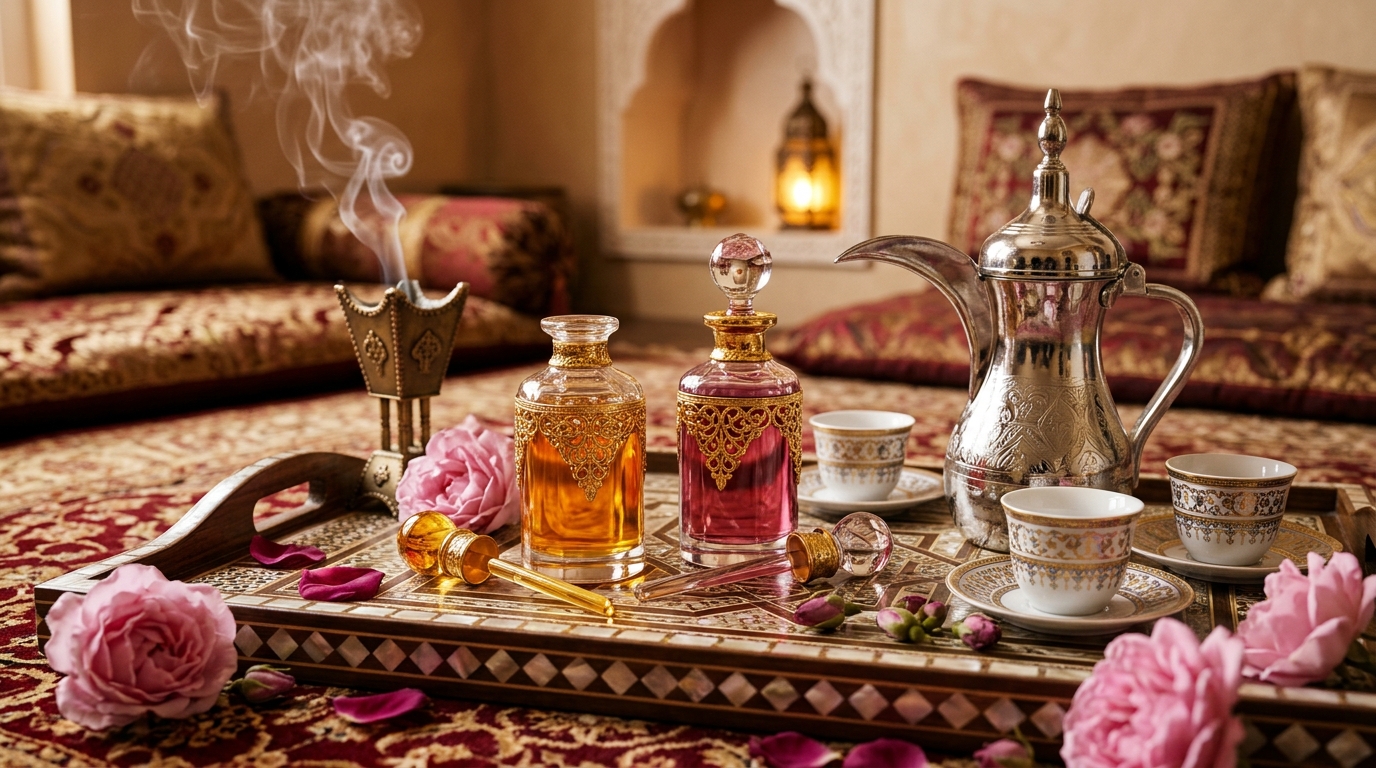
The Ritual of the Mabkhara & Bakhoor
In the Arabian home, the olfactory greeting begins the moment a visitor steps across the threshold:
- The Mabkhara (المِبْخَرَة): An architectural incense burner crafted from pierced brass, carved soapstone, or brightly painted pottery.
- Bakhoor (بَخُور): Fragrant wood chips (primarily agarwood or cedar) that have been soaked for months in secret family recipes combining rose absolute, amber resin, musk, sandalwood oil, and sugar syrup.
- The Scenting Ritual: The host places glowing charcoal tablets into the Mabkhara and sprinkles a pinch of bakhoor atop the embers. Thick, fragrant white smoke billows through the chambers. Guests hold the burner beneath their garments—letting the smoke permeate the folds of their thobe (tunic), shemagh (headdress), or abaya—and cup their hands to direct the fragrant smoke into their hair and beards. The porous wool and silk fabrics trap the heavy aromatic molecules, releasing the scent for days afterward.
The Code of the Majlis & Attar Gifting
The Majlis (the formal Arabian reception salon) is governed by an ancient code of hospitality (Karam):
- The Greeting: Guests are seated on low divans, welcomed with cardamom-scented Arabic coffee poured from an ornate silver dallah, and presented with sweet dates.
- The Parting Unction: In traditional Bedouin and Gulf custom, the Mabkhara is circulated a final time at the end of the gathering. A famous Arabic proverb remarks: “Ba’d al-bakhur, ma fi julus” (“After the incense, there is no more sitting”)—signaling with exquisite politeness that the reception has reached its honored conclusion.
- The Attar Flacon: Before departure, the host presents a lacquer box filled with crystal tolah flacons (a traditional unit of weight equal to approximately 11.66 grams). Using a slender glass wand, the host dabs concentrated pure Attar (Ittar)—traditionally distilled without a single drop of alcohol—onto the guest’s pulse points, inner wrists, and behind the ears, sending them into the world enfolded in an invisible mantle of honor.
6. From Moorish Al-Andalus to 21st-Century Haute Parfumerie
The fragrant wisdom perfected in the laboratories of Baghdad and Damascus did not remain confined to the East. It became the technological catalyst that sparked the modern European perfume industry.
The Andalusian Bridge to Europe
During the centuries of Islamic rule in the Iberian Peninsula (Al-Andalus, 711–1492 CE), cities like Córdoba, Seville, and Granada became the intellectual and sensory capitals of Europe:
- The Gardens of the Alhambra: Moorish landscape architects designed hydraulic irrigation systems nourishing vast terraced orchards of bitter orange trees (Citrus aurantium), jasmine, and Damask roses.
- The Transmission of Distillation: While medieval Western Europe viewed bathing and scent with ecclesiastical suspicion, Islamic Córdoba boasted over nine hundred public hammams and hundreds of registered perfume distillers (al-Attarin).
- The Medical Faculties: Alchemical manuscripts by Jabir, Al-Kindi, and Avicenna were translated into Latin by scholars like Gerard of Cremona in Toledo. These texts directly seeded the curriculum of Europe’s first medical and pharmaceutical faculties at Salerno in Italy and Montpellier in southern France. Montpellier’s alchemists used Andalusian alembics to distill local lavender and rosemary, eventually birthing the artisanal perfume hub of Grasse.
The 21st-Century Gulf Renaissance
In the late 20th and early 21st centuries, the global perfume trade witnessed a dramatic geographic reversal. Rather than Western fashion houses dictating olfactory tastes to the Middle East, the Middle East revolutionized global luxury.
In 1983, the late Sultan Qaboos bin Said of Oman issued a royal decree to establish Amouage—a royal perfume house intended to revive the authentic aromatic heritage of Arabia Felix. By commissioning master French perfumers (beginning with Guy Robert) to blend native Omani green frankincense and rockrose with French floral absolutes without budget restrictions, Amouage created legendary benchmarks like Gold and Interlude Man.
Simultaneously, historic family-owned Gulf houses—including Ajmal (founded 1951), Rasasi, Swiss Arabian, and Arabian Oud—expanded internationally, proving that consumers worldwide craved the opulent longevity, heavy projection, and complex woods characteristic of the Arabian aesthetic.
The Western “Rose-Oud” Obsession
In 2002, visionary designer Tom Ford and master perfumer Alberto Morillas released YSL M7, the first mainstream designer fragrance to spotlight agarwood. Five years later, Ford launched Tom Ford Oud Wood in his Private Blend collection, triggering an unprecedented global avalanche.
Within a decade, virtually every storied European luxury house was compelled to create an oriental oud collection to remain competitive in Paris, London, and New York:
- Dior Privée: Oud Ispahan (the definitive Parisian interpretation of the Middle Eastern Rose-Oud accord).
- Guerlain: Les Absolus d’Orient (celebrating Oud, Santal Royal, and Encens Mythique).
- Maison Francis Kurkdjian: Oud Satin Mood (blending Laotian agarwood with Bulgarian rose and rich violet).
The Global Conquest of Mukhallat (Fragrance Layering)
Perhaps the most enduring gift of Arabian fragrance culture to the contemporary world is the philosophy of layering (al-tadawoq / mukhallat):
- In traditional Western perfumery, a wearer sprays a single bottle from a French designer and considers their routine finished.
- In the Arabian tradition, scent is a three-dimensional ritual: first, washing with scented soap; second, applying a base layer of concentrated non-alcoholic Attar oil on the pulse points; third, fumigating the skin and clothing with smoldering Bakhoor; and fourth, misting a contrasting floral or citrus Eau de Parfum over garments.
Today, niche fragrance houses across the globe design modular perfume wardrobes explicitly tailored for layering—a direct homage to an art form practiced in Arabian desert tents for over two thousand years.
7. Master Reference Matrix: The Arabian Olfactory Lexicon
To understand the core botanical, chemical, and ritual vocabulary of Arabian perfumery, consult this comprehensive reference matrix:
| Arabic Term & Script | English Transliteration | Material / Botanical Classification | Historical Innovator & Extraction Method | Sacred & Social Function | Modern Niche Olfactory Profile |
|---|---|---|---|---|---|
| اللبان | Al-Luban | Boswellia sacra gum resin | Ancient Dhofar tribes; incision tapping & air curing | Sacred fumigation; medical masticatory; purification | Green balsamic, sparkling citrus zest, pine, cool mineral smoke |
| العود | Al-‘Ud | Aquilaria fungal heartwood | Indian Ocean maritime trade; steam hydrodistillation | Aristocratic hospitality; Friday prayers; Majlis fumigation | Deep woody, dark animalic leather, sweet tobacco, balsamic earth |
| العنبر | Al-‘Anbar | Physeter macrocephalus ambergris | Arabian Sea coastal collection; marine solar oxidation | Royal perfume fixative; aphrodisiac tonic in coffee | Salty marine, velvet amber warmth, radiant human skin glow |
| المسك | Al-Misk | Moschus moschiferus deer musk pod | Silk Road caravan imports; tincture in alcohol / oil | Prophetic Sunnah favorite; ultimate base unction | Powdery sensual warmth, velvety skin scent, clean animalic |
| الإنبيق | Al-Anbiq (Alembic) | Copper distillation apparatus | Jabir ibn Hayyan (Geber); vapor cooling & collection | Foundation of pure essential oil & hydrosol extraction | Solvent separation technology defining modern perfumery |
| عطر | Attar / Ittar | Pure concentrated perfume oil | Avicenna & Al-Kindi; hydrodistillation over sandalwood | Non-alcoholic pulse-point oil; hospitable parting gift | Dense, viscous, intimate sillage, 24-hour skin longevity |
| بخور | Bakhoor | Scented agarwood/cedar woodchips | Traditional artisanal home compounding in syrup/oils | Garment & domestic fumigation; hospitality greeting | Rich resinous smoke, caramelized sugar, floral-amber cloud |
| المبخرة | Al-Mabkhara | Carved brass/ceramic charcoal burner | Pre-Islamic South Arabia & Bedouin camp life | Sacred hearth for releasing aromatic incense smoke | Ceramic/metallic vessel iconic of Middle Eastern hospitality |
| ماء الورد | Mayward (Rosewater) | Rosa damascena floral hydrosol | Avicenna (Ibn Sina); refrigerated cooling coil distillation | Welcome ablution for guests; confectionery flavoring | Crystalline dewy floral, fresh crisp petals, honeyed green |
| مخلط | Mukhallat | Bespoke multi-oil perfume blend | Master Gulf perfumers; hand compounding | Personal signature scent; festive wedding celebrations | Complex multi-layered bouquet of rose, oud, amber, and saffron |
Conclusion: The Eternal Caravan of Scent
From the dawn of antiquity when camel trains carried frankincense tears across the sands of Arabia Felix, to the alchemical laboratories of Baghdad where Avicenna coaxed the soul from the rose, the Arabian Peninsula has served as the beating heart of world perfumery.
Arabia did not merely preserve fragrance; it revolutionized it. It transformed smoke into liquid, unction into chemistry, and everyday hygiene into a sacred art of transcendent beauty. Every time a contemporary perfume lover sprays a modern Eau de Parfum, delights in the golden warmth of an amber base, or marvels at the complex majesty of Oud, they are paying homage to the alchemists, merchants, and poets of ancient Arabia—an eternal caravan of scent that continues to encircle the globe.