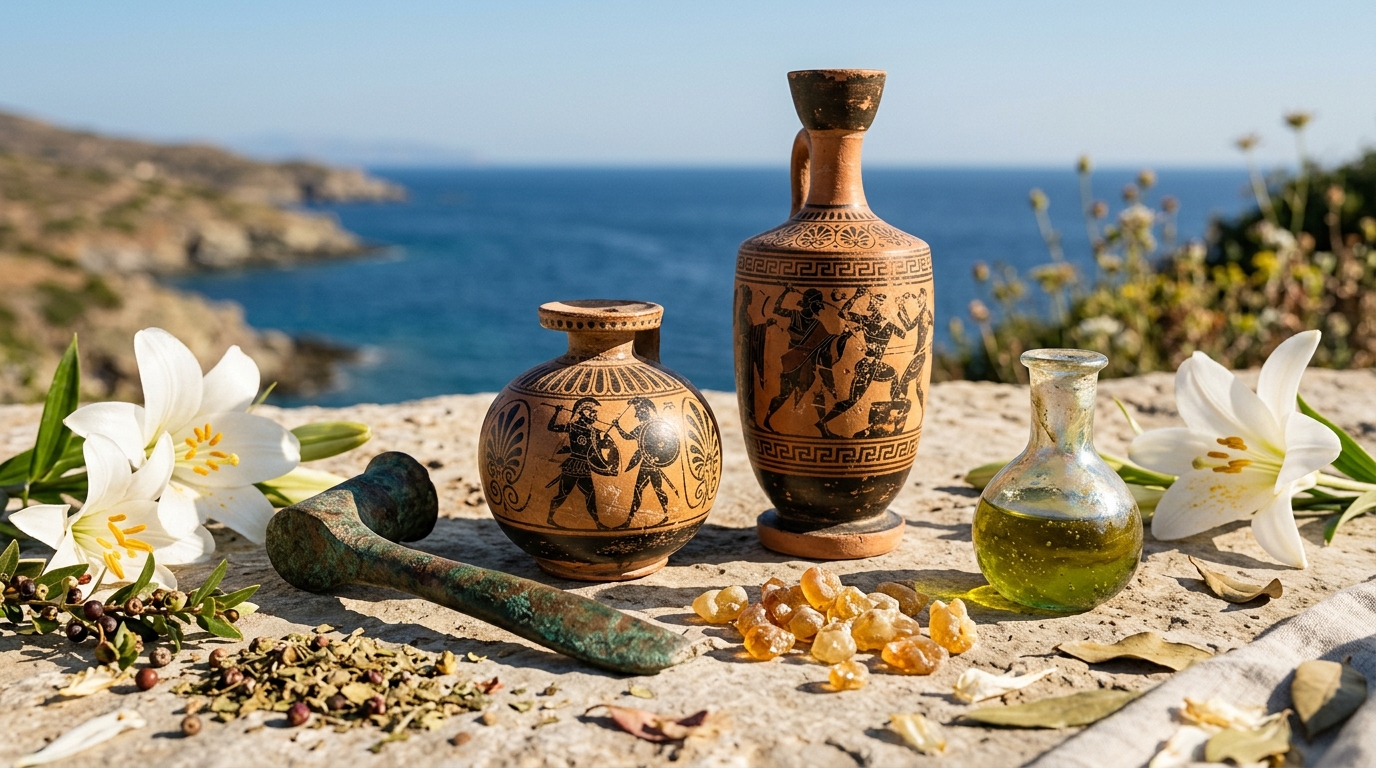
Long before perfume became an invisible mist dispersed from atomizers, it was a tangible, sacred substance in the ancient Aegean—thick with golden olive oil, smoldering with resinous tears, and intimately intertwined with myth, athletic prowess, and civic philosophy. In Ancient Greece (Hellas), aroma was never merely an aesthetic vanity; it was the tangible breath of the gods (theoi), a medical shield against corruption, and a vital marker of human civilization.
When the epic poet Homer described the gods descending from Mount Olympus in the Iliad, their presence was invariably heralded not by sound or vision, but by an overpowering olfactory epiphany: an “ambrosial fragrance” that filled palaces and battlefields alike. To the ancient Greeks, foul odors signaled decay, disease (miasma), and death, while sweet, aromatic plumes denoted holiness, vigor, and divine favor.
Yet beneath this mythical veil lay a remarkably sophisticated botanical and chemical industry. Spanning from the clay inventory tablets of Bronze Age Mycenaean palaces to the pioneering scientific treatises of Aristotle’s successor, Theophrastus of Eresos, ancient Greek perfumers developed lipid extraction techniques, fixation principles, and vessel designs that formed the foundational bedrock of Western perfumery.
1. The Bronze Age Dawn & Mycenaean Palace Workshops
The roots of Greek perfumery stretch deep into the Mediterranean Bronze Age. In 2003, Italian archaeological teams at Pyrgos-Mavroraki in Cyprus unearthed the remains of an industrial-scale perfumery complex dating back to approximately 1850 BCE. Spanning over 4,000 square meters, the site featured large olive presses, copper distillation stills, settling basins, and dozens of storage amphorae preserving traces of pine resin, bay leaf, coriander, anise, and myrtle. Cyprus, revered in antiquity as the mythical birthplace of Aphrodite, was the earliest industrial export hub of fragrant oils to the Greek mainland.
Bronze Age Aegean Olfactory Trade Network:
┌───────────────────────┐          ┌───────────────────────┐
│  Pyrgos-Mavroraki     │          │  Mycenaean Palaces    │
│  (Cyprus, ~1850 BCE)  │ ───────► │  (Pylos, Knossos)     │
│  Industrial extraction│          │  Linear B Ledgers     │
└───────────────────────┘          └───────────────────────┘
            │                                  │
            ▼                                  ▼
┌───────────────────────┐          ┌───────────────────────┐
│  Raw Botanicals:      │          │  Master Perfumers:    │
│  Labdanum, Pine Resin,│          │  Thyestes & Eumedes   │
│  Coriander, Bay Laurel│          │  (Myrepsoi)           │
└───────────────────────┘          └───────────────────────┘
By the late 14th century BCE, the Mycenaean civilization had transformed the compounding of aromatic unguents into a tightly controlled palatial monopoly. In the subterranean archives of the Palace of Nestor at Pylos and the palace at Knossos on Crete, archaeologists deciphered clay tablets inscribed in Linear B—the earliest deciphered Greek dialect—that recorded detailed recipes, ingredient allocations, and the names of the master perfumers themselves.
The Royal Myrepsoi
The tablets name individual royal perfumers, known in Linear B as myrepsoi (μυρεψοί, literally “perfume-boilers”):
- Thyestes: A palace unguent boiler documented at Pylos receiving vast palatial rations of virgin olive oil, sweet sedge root, and spices.
- Eumedes: Another named master perfumer who managed dedicated workshops compounding aromatic preparations for royal religious festivals.
The Linear B accounting tablets (notably the Fr and Un series at Pylos) record ingredients with meticulous precision:
- ku-pa-ro (Cyperus rotundus or sweet rush / cyperus tubers): Prized for its earthy, violet-like rhizomes.
- ko-ri-ja-do-no (coriander seeds): Employed both as a delicate top-note aromatic and an astringent binding agent.
- wo-do-we (rhodowen): “Rose-scented” olive oil, crafted by infusing mountain roses into warm oil.
- pa-ko-we (sphakowen): “Sage-scented” oil, utilized in sacred cleansing rituals.
- Honey and Red Wine: Used as solvents, fermentation catalysts, and binders during the boiling process to extract scent components from wood and root fibers before the oil maceration.
These perfumed oils were packaged into distinctive stirrup jars (amphorae) with false spouts, sealed with clay stoppers bearing the royal seal, and exported across the Aegean, Egypt, and the Levant as luxury diplomatic currency.
2. The Botanical Chemistry of Antiquity & Theophrastus’ De Odoribus
With the dawn of the Classical and Hellenistic eras, perfumery transitioned from palace mystery to rigorous natural philosophy. Around 300 BCE, Theophrastus of Eresos—Aristotle’s prized student and the father of Mediterranean botany—wrote Concerning Odours (Περὶ ὀδμῶν, De Odoribus), the ancient world’s first systematic scientific treatise on olfaction.
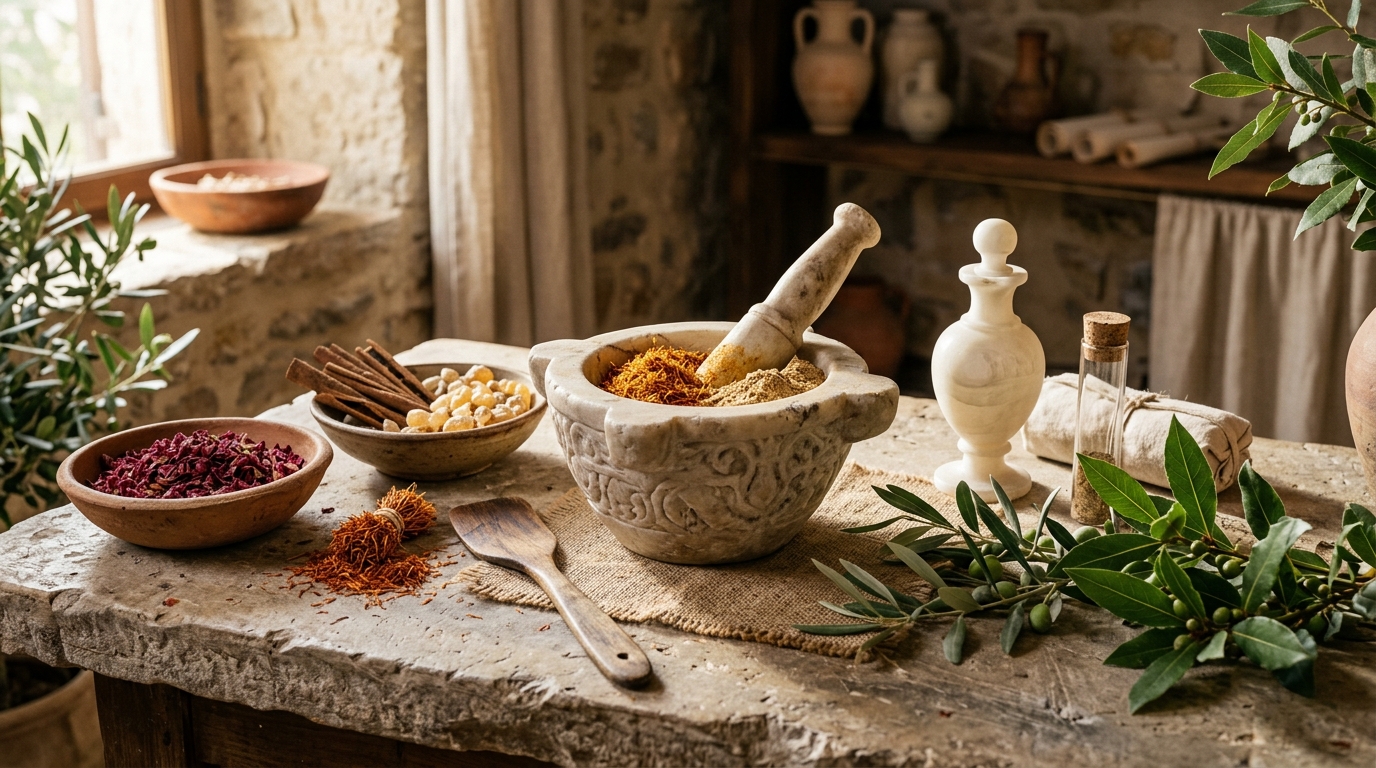
Theophrastus approached fragrance with analytical clarity. Unlike modern perfumery, which relies on ethyl alcohol ($C_2H_5OH$) as a volatile solvent carrier, alcohol distillation was unknown to Classical Greece. Ancient perfumers operated entirely within the realm of fixed lipids and vegetable oils. This physical reality dictated the entire chemistry of Hellenic perfumery.
The Non-Evaporating Lipid Matrix: Carrier Oils
Theophrastus observed that not all vegetable oils are equal in perfumery. A superior carrier oil required three fundamental physicochemical attributes:
- Odorlessness: It must not overpower or alter the delicate scent of the infused botanicals.
- Low Viscosity: It must absorb easily into human skin without leaving a greasy, suffocating film.
- Oxidative Stability: It must resist rancidity (rancor) under the intense Mediterranean heat.
Greek artisans categorized carrier oils into distinct tiers:
- Omphakion (Ὀμφάκιον): The undisputed king of Greek base oils. It was cold-pressed strictly from early-harvest, unripened green olives in late autumn. Because the olives contained minimal sugars and high polyphenols, the resulting oil was light, astringent, pale green, virtually odorless, and exceptionally resistant to oxidation.
- Balanos Oil (Oil of Ben): Cold-pressed from the seeds of Balanites aegyptiaca (or Moringa peregrina). Celebrated by Theophrastus as the least viscous and most neutral of all oils, holding volatile top notes far longer than olive oil.
- Bitter Almond Oil (Amygdalinum): Pressed from crushed wild bitter almonds, offering a subtle marzipan undertone that harmonized beautifully with rich resins.
The Principle of Stypsis (Astringent Priming)
One of Theophrastus’ most remarkable chemical insights was the protocol of stypsis (στύψις), meaning “constriction” or “priming.”
Greek perfumers discovered that raw, untreated oil is poor at absorbing delicate floral scents: its lipid chains are saturated, and aqueous plant juices cause premature spoil. Before the prized fragrant flowers (such as rose, lily, or jasmine) were introduced, the base oil underwent stypsis:
- The oil was gently warmed with mildly astringent botanical agents—such as date palm spathes, sweet bay leaves (Laurus nobilis), cyperus rhizomes, and alkanet root (Alkanna tinctoria).
- Sea salt was added to draw out moisture and coagulate mucilaginous impurities, which were then skimmed away.
- The astringents “tightened” the oil, creating a purified, receptive lipid substrate that locked volatile essential oil molecules into the triglycerides and tinted the oil a rich crimson or amber hue.
Cold vs. Hot Maceration
Theophrastus categorized extraction methods into two distinct thermal pathways:
- Cold Maceration (Enfleurage in Oil): Delicate flowers whose volatile esters are destroyed by heat (particularly Madonna lilies and violets) were steeped in cold, primed oil. The petals were strained out with linen cloths and replenished with fresh petals over dozens of successive cycles until the oil was fully saturated.
- Warm Digestion (Chytrismos): Hard barks, roots, and resins (myrrh, cinnamon, labdanum, calamus) were pounded into coarse powders, macerated in astringent wine or water, and gently simmered with oil in double-bottomed ceramic vessels over water baths (balneum) to prevent scorching the precious resins.
3. The Four Legendary Formulations of Antiquity
Throughout the Classical and Hellenistic periods, individual Greek cities and master perfumers became renowned across the known world for signature compound perfumes (syntheta). These formulas were so famous that naturalists including Theophrastus, Pliny the Elder, and Dioscorides (De Materia Medica) preserved their exact compositions for posterity.
┌────────────────────────────────────────────────────────────────────────┐
│                   THE FOUR LEGENDARY HELLENIC ACCORDS                  │
├─────────────┬──────────────────────────┬───────────────────────────────┤
│ Perfume     │ Key Ingredients          │ Olfactory Profile             │
├─────────────┼──────────────────────────┼───────────────────────────────┤
│ Megaleion   │ Burnt Labdanum, Myrrh,   │ Warm, spicy, deeply balsamic, │
│ (Megallos)  │ Cinnamon, Cassia, Balanos│ smoky resinous, enduring      │
├─────────────┼──────────────────────────┼───────────────────────────────┤
│ Susinum     │ Madonna Lily, Calamus,   │ Luminous, narcotic white-     │
│ (Royal Lily)│ Saffron, Myrrh, Cinnamon │ floral, spicy-honeyed         │
├─────────────┼──────────────────────────┼───────────────────────────────┤
│ Kypros      │ Henna Blossom, Cardamom, │ Fresh green-narcotic, herbal, │
│ (Cyprus)    │ Aspalathos, Balanos Oil  │ subtly balsamic               │
├─────────────┼──────────────────────────┼───────────────────────────────┤
│ Rhodinon    │ Damask Rose, Omphakion,  │ Radiant dewy floral, green    │
│ (Corinth)   │ Gingergrass, Honey, Salt │ tea nuances, sun-warmed petal │
└─────────────┴──────────────────────────┴───────────────────────────────┘
1. Megaleion (Τὸ Μεγαλεῖον)
Created by the Athenian master perfumer Megallos, Megaleion was universally regarded as the pinnacle of luxury perfumery in ancient Greece. It was the most intricate, laborious, and expensive formulation of antiquity:
- The Formula: Prepared from balanos oil, raw myrrh, wild cassia bark, Indian cinnamon, sweet flag (Acorus calamus), and a curious ingredient that Theophrastus describes as “burnt resin”—purified rockrose labdanum boiled to caramelize its natural terpenes.
- The Chemical Odyssey: Theophrastus notes that Megaleion required continuous boiling over several days; the perfumer had to stand over the cauldron stirring unceasingly, as a single moment of scorching would ruin the batch.
- Sensory Character: Intensely warm, spicy, and deeply ambery. Unlike floral perfumes, Megaleion had exceptional tenacity; Greek writers noted that a single drop applied to the wrist remained fragrant for weeks and could mask any foul odor. It was also prescribed by Hippocratic physicians as an anti-inflammatory ointment for muscular exhaustion and chest ailments.
2. Susinum (Σούσινον)
Susinum was the celebrated lily perfume of the Hellenistic courts, named after the Persian royal city of Susa (Shushan, meaning “lily”):
- The Formula: Crafted using a base of balanos oil or omphakion, layered with thousands of freshly gathered petals of the Madonna lily (Lilium candidum), blended with sweet rush, myrrh, saffron crocus stigmas, and a hint of cinnamon.
- Sensory Character: Luminous, intoxicating, and aristocratic. Madonna lily possesses a heavy, indolic, honeyed sweetness with spicy clove undertones. Saffron added a rich, golden leathery shimmer, while myrrh fixed the delicate floral heart to the skin.
3. Kypros (Κύπρινον)
Named in honor of the island of Aphrodite, Kypros showcased the exotic botanicals of the eastern Mediterranean:
- The Formula: The star ingredient was the fragrant white blossom of the henna shrub (Lawsonia inermis), which emits an intensely sweet, herbaceous, narcissus-like perfume. This was blended with crushed green cardamom pods, sweet aspalathos, and southernwood in cold-pressed balanos oil.
- Sensory Character: Airy, herbaceous-green, and hypnotically floral. Pliny later noted that the best Kypros was compounded on the island of Rhodes and in the Phoenician ports.
4. Rhodinon (Ῥόδινον)
The quintessential rose perfume of Classical Greece, with Corinth and Rhodes serving as the primary centers of production:
- The Formula: Fresh petals of the Damask rose (Rosa damascena) and the multi-petaled cabbage rose (Rosa centifolia) were harvested at dawn before the sun could evaporate their volatile geraniol. The petals were layered into salted omphakion olive oil, steeped in warm sunlight, strained through horsehair sieves, and recharged with fresh petals up to five times.
- Sensory Character: Crisp, dewy, and naturally astringent. The green bitterness of the unripened olive oil tempered the lush sweetness of the rose, creating an aroma reminiscent of wild coastal Mediterranean rosebushes kissed by sea breezes.
4. Scent in the Polis: Gymnasia, Symposia, and Sacred Rites
In the democratic city-state (polis), fragrance was present in every domain of public and private life, defining social status, gender roles, and civic etiquette.
The Palaestra & The Athletic Ritual
No institution was more central to Greek civic life than the gymnasium and the palaestra (wrestling school). Here, free Greek citizens trained in the nude (gymnos), and scent played a fundamental hygiene and physiological role:
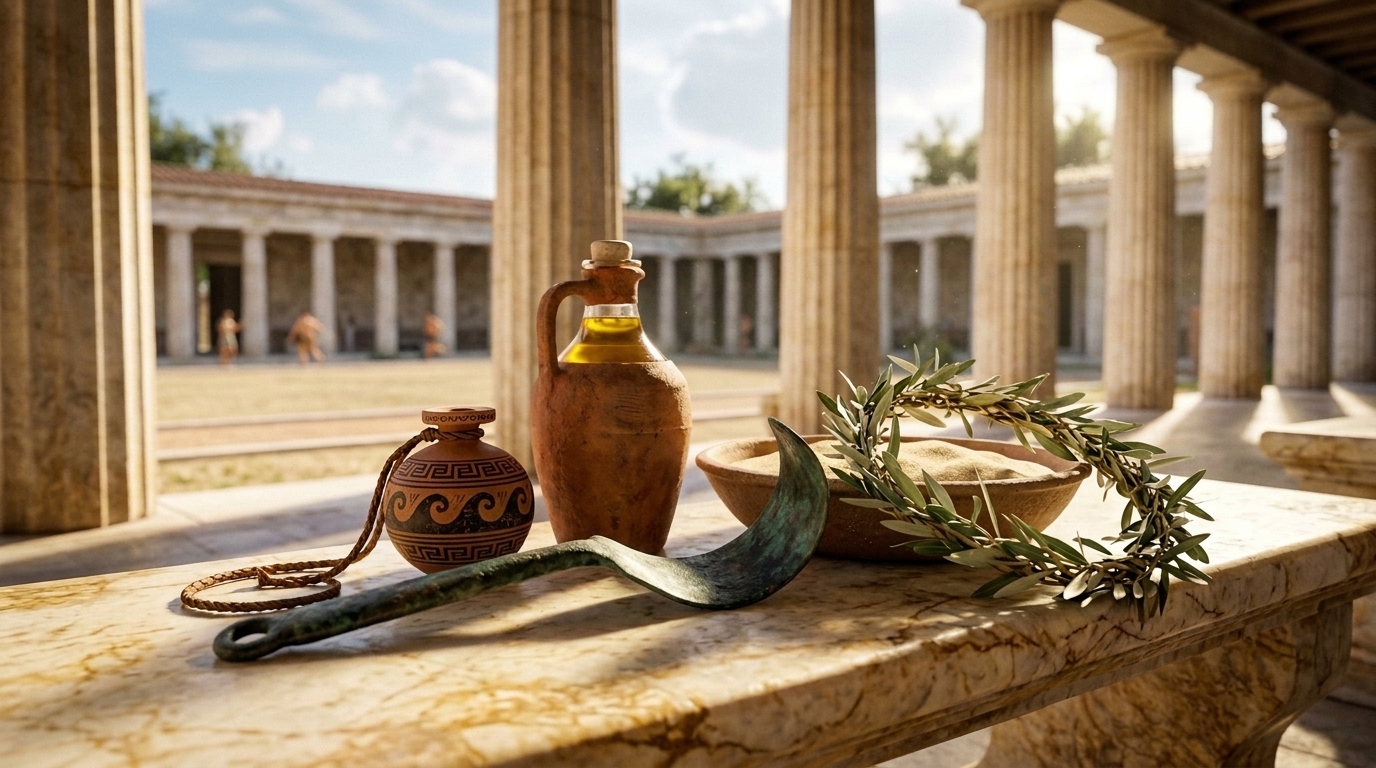
- The Pre-Training Unction: Before entering the sandy wrestling ring, athletes thoroughly massaged their bodies with plain, unperfumed olive oil. This formed an insulating barrier against sunburn, sealed moisture into the skin, and made the athlete slippery and difficult for opponents to grip. Fine dust or sand was then dusted over the body to restore just enough friction for wrestling.
- The Bronze Strigil (Stlengis): Following hours of rigorous exertion under the Aegean sun, the athlete used a curved bronze tool called a strigil (στλεγγίς) to scrape away the thick paste of sweat, dust, sand, and oxidized oil from their limbs.
- The Strange Medicine of Gloios: The scraped residue—a murky emulsion known as gloios (γλοιός)—was not discarded. Slaves collected it into bronze jars, and it was sold on the public market as an expensive therapeutic balm! Physicians believed gloios, charged with the vital heat and sweat of prime athletes, possessed remarkable curative powers for joint stiffness, sprains, and cutaneous ulcers.
- The Post-Bath Anointing: After bathing in cold water plunge pools, athletes anointed themselves with exquisite scented oils—most commonly sweet marjoram (amarakinon) or rose oil—stored in specialized vessels.
The Symposium & Scent Etiquette
At the symposium (the elite Greek evening drinking and philosophical banquet), the consumption of wine and the inhalation of perfume were governed by strict rules of etiquette:
- The Welcoming Libation: Upon arrival, slaves washed the guests’ feet and adorned their brows with woven garlands of ivy, myrtle, and violets (ion—the civic flower of Athens). Scented waters were splashed over their hands.
- The Cooling Strategy: Guests did not perfume their hair or noses indiscriminately. Greek medical treatises warned that heavy perfumes applied directly to the head would trap hot wine vapors in the brain, provoking severe morning migraines. Instead, the philosopher Anacreon and later Hellenistic hosts advocated applying cooling unguents (such as rose or water-lily) to the chest and the soles of the feet. As body heat warmed the oil, the scent rose gently through the dining hall without deadening the palate or interfering with the bouquet of the vintage Chian wine.
- Atmospheric Fumigation: Slaves tossed pellets of frankincense and dried mastic resin onto glowing charcoal braziers (thymiateria) stationed in the corners of the andron (men’s dining chamber) to maintain a refined, cloud-like atmosphere throughout the night’s philosophical debates.
Sacred Altars & The Epiphany of the Gods
To the ancient Greek, scent was the primary medium of communion with the divine:
- Sacrificial Smoke: When animal offerings were burned upon open-air altars outside temples, aromatic herbs (thyme, oregano, bay leaves) and imported frankincense were thrown into the flames. The gods on high Olympus did not consume the earthly meat; rather, they nourished themselves on the fragrant smoke (knise) ascending into the ether.
- Aphrodite’s Sacred Groves: Sanctuaries dedicated to Aphrodite (such as the temple at Knidos or Paphos) were lush with myrtle, pomegranate, and Damask roses, continually perfumed with burning storax and labdanum.
- The White Lekythos & Funerary Rites: At death, the deceased was washed, clothed in white linen, and generously anointed with scented oils to mask the stench of mortality and preserve the dignity of the body during the prothesis (wake). Slender, painted vessels known as white-ground lekythoi were filled with perfumed unguents and placed within the tomb. It was believed that the sweet scents accompanied the psyche on its perilous descent past Charon and into the dark realm of Hades.
5. Ceramic Engineering: Aryballos, Alabastron & Lekythos
The Greeks understood that exquisite botanical oils were chemically fragile. Heat, oxygen, and ultraviolet light rapidly oxidized delicate monoterpenes, turning radiant floral essences rancid and murky.
To solve this physical challenge, Athenian, Corinthian, and East Greek potters engineered specialized ceramic forms that represent a triumph of functional ergonomic design:
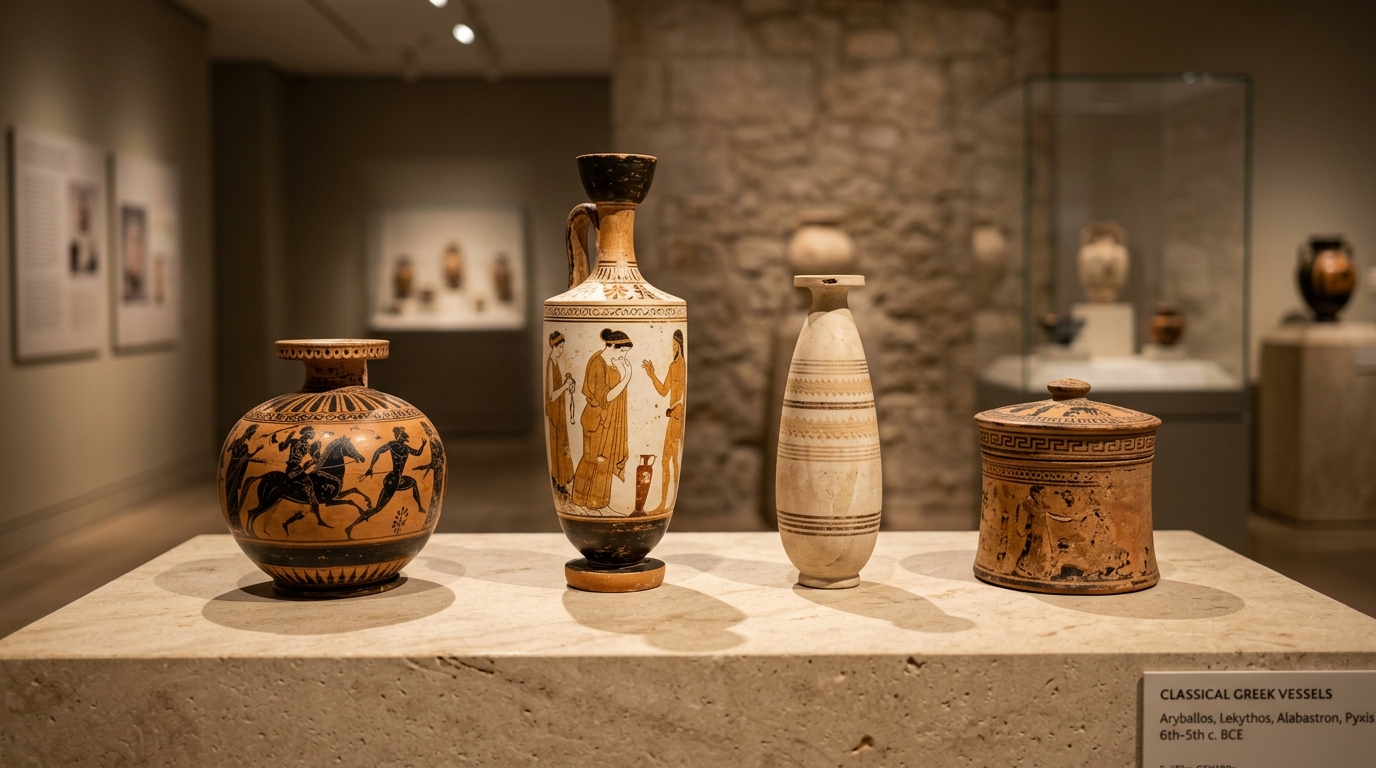
┌────────────────────────────────────────────────────────────────────────┐
│                   CLASSICAL HELLENIC PERFUME VESSELS                   │
├───────────────┬────────────────────────────┬───────────────────────────┤
│ Vessel        │ Physical Architecture      │ Ergonomic & Functional    │
│ Type          │                            │ Engineering Purpose       │
├───────────────┼────────────────────────────┼───────────────────────────┤
│ Aryballos     │ Spherical globular body,   │ Athlete's wrist flask.    │
│ (Ἀρύβαλλος)   │ narrow neck, flat disk lip │ Wide lip controls drops;  │
│               │ with strap handle.         │ thick terracotta blocks UV│
├───────────────┼────────────────────────────┼───────────────────────────┤
│ Alabastron    │ Elongated teardrop shape,  │ Drop-by-drop dispenser.   │
│ (Ἀλάβαστρον)  │ rounded base, no handles,  │ Minimal internal headspace│
│               │ flat broad rim.            │ prevents oxidation.       │
├───────────────┼────────────────────────────┼───────────────────────────┤
│ Lekythos      │ Tall slender cylinder,     │ Ritual & funerary pourer. │
│ (Λήκυθος)     │ narrow neck, cup-mouth,    │ False interior cups saved │
│               │ single vertical handle.    │ expensive aromatic oil.   │
├───────────────┼────────────────────────────┼───────────────────────────┤
│ Pyxis         │ Cylindrical lidded box,    │ Air-tight storage for     │
│ (Πυξίς)       │ flat base, fitted lid.     │ solid pomades, animal-fat │
│               │                            │ cerates, and powders.     │
└───────────────┴────────────────────────────┴───────────────────────────┘
1. The Aryballos (Ἀρύβαλλος)
The iconic companion of the Greek athlete. Originating in Corinth in the 7th century BCE, the aryballos was designed for rigorous kinetic mobility:
- The Globular Reservoir: The spherical shape provided maximum structural strength, making it nearly impossible to shatter if dropped on the stone gym floor.
- The Disk Lip: The wide, flattened circular mouth allowed the athlete to pour oil directly against the skin without spillage. When tilted, oil pooled on the disk, allowing the athlete to dab individual fingers into the oil before spreading it over their shoulders.
- The Leather Strap Handle: The narrow neck featured a single looped handle through which a braided leather thong (himas) was threaded, enabling athletes to tie the flask around their wrist or hang it from the gymnasium wall pegs alongside their strigil.
2. The Alabastron (Ἀλάβαστρον)
Originally imported from Pharaonic Egypt and carved from smooth, pale banded calcite (alabaster), the form was quickly adopted by Athenian potters in glazed terracotta.
- The Teardrop Geometry: The slender, elongated cylinder lacked a flat base; it was designed to be held gracefully in the hand or laid horizontally on a dressing table.
- Headspace Reduction: Its narrow internal diameter minimized the liquid surface area exposed to ambient air inside the vessel. This dramatically slowed down aerobic oxidation and evaporative loss of precious top notes.
3. The Lekythos (Λήκυθος)
The majestic tall jug synonymous with Athenian funerary culture:
- Controlled Pouring: Its narrow cylindrical neck and cup-shaped mouth allowed precise, steady pouring during sacred libations without splashing or gushing.
- The Clever “False Interior” Cup: Because pure aromatic oils were immensely costly, Athenian potters engineered a brilliant economic deception: many white-ground funerary lekythoi were crafted with a small, hidden internal cup suspended inside the neck! When oil was poured in, only the top few milliliters were filled, giving the illusion that the entire grand vase was brimming with precious perfume while using only a fraction of expensive unguent.
4. The Pyxis (Πυξίς)
For solid formulations—such as fragrant pomades made from beeswax and purified sheep’s tallow, or powdered iris rhizome (orris root)—the Greeks crafted the pyxis. Fitted with snug, overlapping lids, these boxes shielded delicate aromatic pomades from moisture and airborne contaminants.
6. Modern Olfactory Echoes: The Hellenic Palette in Contemporary Niche Perfumery
The aromatic raw materials that perfumed the marble temples and sun-bleached shores of ancient Greece did not vanish with antiquity. Today, the native Mediterranean flora of the Aegean continues to inspire some of the most evocative masterpieces in modern haute parfumerie.
Modern niche perfumers frequently return to the Hellenic botanical archetype—a scent profile defined not by syrupy synthetic vanillas or industrial aldehydes, but by sun-baked herbs, dry mineral sea breezes, ancient resin tears, and golden balsamic warmth.
Ancient Hellenic Botanical DNA in Modern Niche Perfumery:
┌──────────────────────────┐          ┌──────────────────────────┐
│  Ancient Hellenic Note   │          │  Modern Niche Expression │
├──────────────────────────┼──────────┼──────────────────────────┤
│  Cistus Labdanum         │ ───────► │  Amouage, Serge Lutens   │
│  (Cretan Rockrose)       │          │  (Ambre Sultan)          │
├──────────────────────────┼──────────┼──────────────────────────┤
│  Chios Mastic Resin      │ ───────► │  Sisley (Eau d'Ikar),    │
│  (Pistacia lentiscus)    │          │  Chanel (Paris-Biarritz) │
├──────────────────────────┼──────────┼──────────────────────────┤
│  Aegean Fig Leaf & Wood  │ ───────► │  Diptyque (Philosykos),  │
│  (Ficus carica)          │          │  L'Artisan Parfumeur     │
├──────────────────────────┼──────────┼──────────────────────────┤
│  Orris Root (Iris)       │ ───────► │  Dior Homme,             │
│  (Illyrian Iris)         │          │  Papillon (Dryad)        │
└──────────────────────────┘          └──────────────────────────┘
1. Cistus Labdanum (Cistus ladanifer): The Soul of Crete
In ancient Crete, shepherds combed the sticky resin of the rockrose bush from the beards of goats that grazed upon mountain hillsides—a method documented by Herodotus in the 5th century BCE. This precious resin, ladanon (λάδανον), was the foundational fixative of Megaleion.
Today, labdanum absolute remains the irreplaceable, pulsating heart of the modern amber accord: warm, leathery, ambery, subtly honeyed, and carrying the unmistakable scent of sun-warmed Mediterranean scrubland. Masterpieces like Serge Lutens Ambre Sultan and Papillon Artisan Perfumes Dryad channel this ancient resinous heat with extraordinary fidelity.
2. Chios Mastic (Pistacia lentiscus var. chia): The Green Tears
Cultivated exclusively on the southern slopes of the Greek island of Chios, the mastic lentisk tree secretes crystalline, ivory-colored tears of resin. Known since antiquity as a chewing gum, breath freshener, and sacred incense, mastic oil possesses an electrifying olfactory profile: intensely green, sharp like crushed pine needles, subtly citrusy, and drying down to a cool, crystalline mineral warmth. Modern niche fragrances like Sisley Eau d’Ikar and Marc-Antoine Barrois Tilia utilize mastic to evoke Mediterranean sunlight filtering through rocky pine forests.
3. The Aegean Fig Tree: Shade in the Noon Heat
While the Greeks did not extract oil from fig leaves (as their sap contains phototoxic furocoumarins), the sensory experience of resting under a wild fig tree (syke) in the heat of midday was woven into Greek pastoral poetry from Hesiod to Theocritus. In 1996, master perfumer Olivia Giacobetti synthesized the modern Mediterranean pastoral with Diptyque Philosykos—pairing milky fig sap, sun-warmed green leaves, and dry cedarwood, capturing the exact atmosphere of an ancient Peloponnesian afternoon.
4. Orris Root (Iris germanica / pallida): The Illyrian Treasure
Theophrastus praised the iris of Illyria and Macedonia as the finest in the world, noting that its rhizomes required three full years of slow curing in dry cellars before their delicate, powdery, violet-like odor developed. Today, orris butter (beurre d’iris) remains the single most expensive natural ingredient in modern perfumery, costing upwards of $50,000 per kilogram, providing an aristocratic, velvet-like texture to high-niche compositions.
7. Master Reference Matrix: Ancient Greek Botanical Lexicon
To understand the full spectrum of ingredients documented in Linear B tablets, Theophrastus’ De Odoribus, and Dioscorides’ De Materia Medica, consult this comprehensive botanical and historical reference matrix:
| Greek Term & Script | Botanical Name | Part Used | Preparation Technique | Primary Ancient Role | Modern Olfactory Profile |
|---|---|---|---|---|---|
| Omphakion (Ὀμφάκιον) | Olea europaea | Unripened fruit | Early-harvest cold pressing | Neutral lipid carrier; astringent base | Green, slightly bitter, peppery, non-greasy |
| Ku-pa-ro / Kyperos (Κύπειρος) | Cyperus rotundus | Dried rhizomes | Maceration in wine; boiling in oil | Stypsis (priming agent); fixes florals | Earthy, woody, violet-nuanced, dry spicy |
| Ladanon (Λάδανον) | Cistus ladanifer | Leaf oleoresin | Water separation from goat fleece / ladanisterion | Base fixative; key in Megaleion | Balsamic, rich leather, ambery, dried fruit |
| Smurna / Myrrha (Σμύρνα) | Commiphora myrrha | Stem gum-resin | Powdered digestion in warm oil | Sacred incense; preservative; wounded skin balm | Bitter balsamic, cooling woody, medicinal warm |
| Rhodon (Ῥόδον) | Rosa damascena | Fresh petals | Multi-cycle cold maceration in salted oil | Heart of Rhodinon; cooling unctions | Luminous dewy floral, sweet honeyed, crisp green |
| Krinos (Κρίνον) | Lilium candidum | Fresh flower heads | Delicate cold extraction in balanos oil | Star note of Susinum; royal floral | Heavy indolic white-floral, spicy clove, narcotic |
| Kinnamon (Κίνναμον) | Cinnamomum verum | Inner bark | Powdered decoction in wine and oil | Warming spice in Megaleion; luxury import | Sweet pungent spice, woody, intensely radiant |
| Krokos (Κρόκος) | Crocus sativus | Stigmas (threads) | Infusion in warm oil; solar maceration | Luxury colorant & note in Susinum | Warm bittersweet leather, hay-like, golden medicinal |
| Schinos / Mastikhe (Μαστίχη) | Pistacia lentiscus | Trunk resin tears | Crushed cold maceration; incense braziers | Civic fumigation; oral hygiene; top fixative | Crystalline green, fresh pine needle, dry mineral |
| Iris (Ἶρις) | Iris germanica | Cured rhizome root | Multi-year aging; powdered maceration | Stypsis primer; powder unguent | Velvety powdery, dry earthy, delicate violet suede |
Conclusion: The Enduring Breath of Hellas
In ancient Greece, perfume was never an afterthought or an artificial mask. It was an essential philosophy of life—a sacred link uniting mortal bodies with the immortal Olympians, an indispensable discipline of the athletic palaestra, and a crowning triumph of Mediterranean botanical chemistry.
From the clay tablets inscribed by Mycenaean scribes in the smoke of Bronze Age palaces to Theophrastus’ meticulous observations on carrier oils and stypsis, the ancient Greeks laid the foundational grammar of fragrance. The next time you apply a fragrance enriched with Cretan labdanum, Chios mastic, or orris butter, you are not merely wearing a modern scent; you are participating in an unbroken olfactory ritual that has captivated humanity for over three thousand years.