No single note in global fragrance history inspires as much fascination, mystical reverence, and financial speculation as oud (also known as agarwood, aloeswood, eaglewood, jinkō in Japan, or gaharu across Southeast Asia). Revered for millennia across the sacred scriptures of Hinduism, Buddhism, Christianity, and Islam, this olfactory treasure has spearheaded the most influential aesthetic revolution in contemporary Western perfumery over the past two decades.
Yet beneath the golden marketing narratives of luxury fashion houses promising “liquid Middle Eastern gold,” lies an astonishing chasm between botanical reality and modern cosmetic chemistry. What exactly is agarwood? How does authentic oud smell depending on its geographical terroir? And why does virtually no designer or mainstream niche fragrance contain a single drop of pure, wild agarwood oil?
In this definitive monograph, we venture into the biological heart of the Aquilaria tree, trace the ancient trade routes of sacred incense, and deconstruct modern perfume formulation to reveal how perfumers engineer the illusion of oud using synthetic captives, cypriol, safraleine, and leather molecules.
1. The Biological Miracle: Heartwood Born from Pathogenic Infection
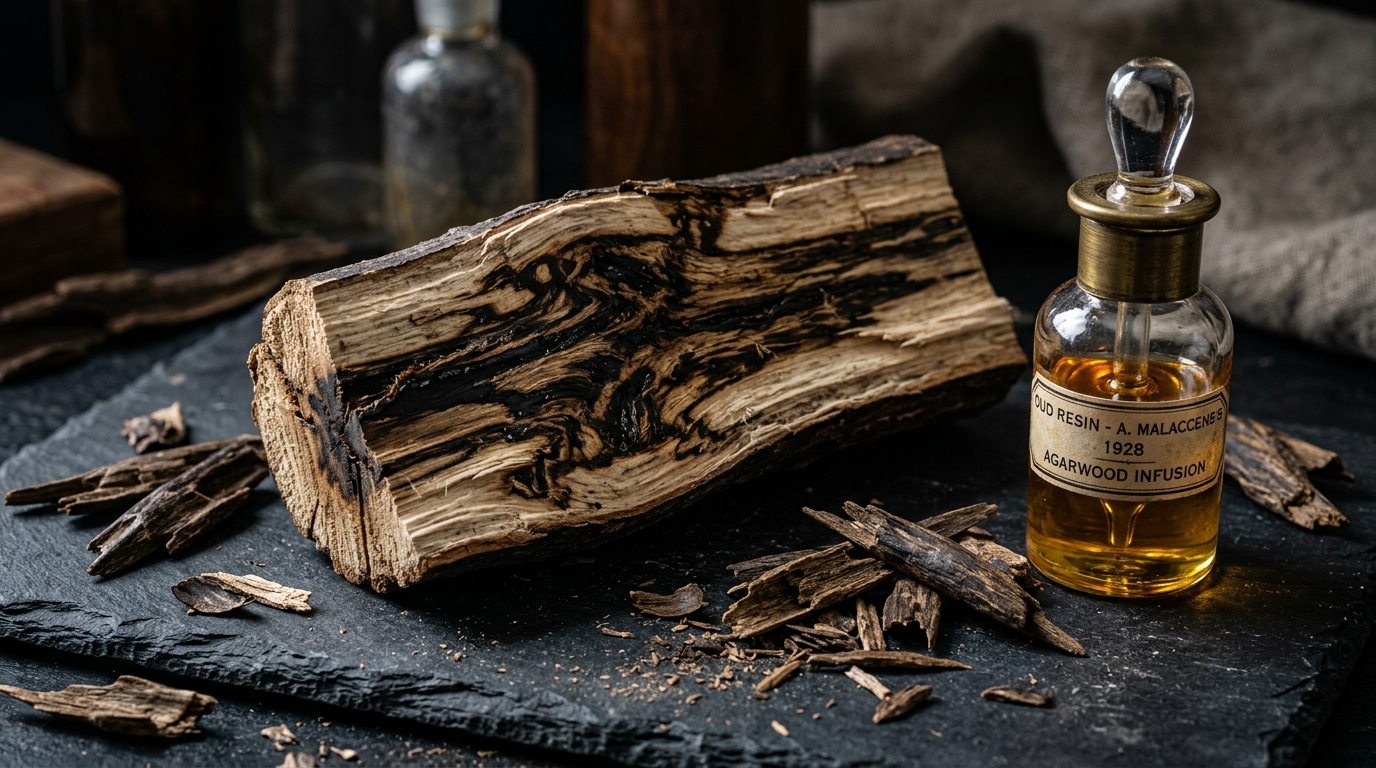
Unlike sandalwood, cedarwood, or vetiver, the tree that yields oud possesses zero fragrance in its natural, pristine state. Trees belonging to the genera Aquilaria and Gyrinops—members of the botanical family Thymelaeaceae, native to the dense tropical rainforests of Southeast Asia and Northeast India—produce pale, soft, lightweight, and completely odorless timber. If you were to harvest a healthy, uninfected Aquilaria tree, its wood would hold no aromatic or commercial value whatsoever.
The genesis of oud is, paradoxically, a desperate immunological defense mechanism triggered by disease.
The Pathology of Agarwood Formation
When an Aquilaria tree suffers physical trauma—from monsoon storms, lightning strikes, falling branches, or burrowing insects such as the trunk borer (Zeuzera conferta)—endophytic mold and fungal species (Phialophora parasitica, Aspergillus, Fusarium, and Chaetomium) penetrate its vascular system.
To arrest the fungal spread and seal its compromised cambium conduits, the tree secretes a dense, heavy, dark protective oleoresin laden with aromatic sesquiterpenes and chromone derivatives. Over months, decades, and sometimes centuries, this fragrant resin saturates the fibrous heartwood, turning pale timber into a deep brown or pitch-black, rock-hard resinous core.
The Wood That Sinks (Jinkō)
This resinous impregnation fundamentally alters the wood’s physical density. Healthy heartwood has low specific gravity and easily floats on water. In contrast, top-grade agarwood (known as jinkō, “sinking wood,” in Japan, and chenxiang in China) becomes so densely saturated with hardened oleoresin that it immediately sinks to the bottom of a water vessel.
In the wild, this transformation is exceptionally rare: fewer than 1% to 2% of mature wild Aquilaria trees naturally develop rich agarwood resin. This scarcity led to centuries of relentless wild poaching that brought wild populations to near extinction, culminating in strict protection under CITES Appendix II (Convention on International Trade in Endangered Species of Wild Fauna and Flora). Today, legal trade relies almost exclusively on sustainable agroforestry plantations where young trees are artificially inoculated using fungal cultures and deliberate mechanical wounding.
2. Olfactory Geography: Terroirs & Profiles Across Asia
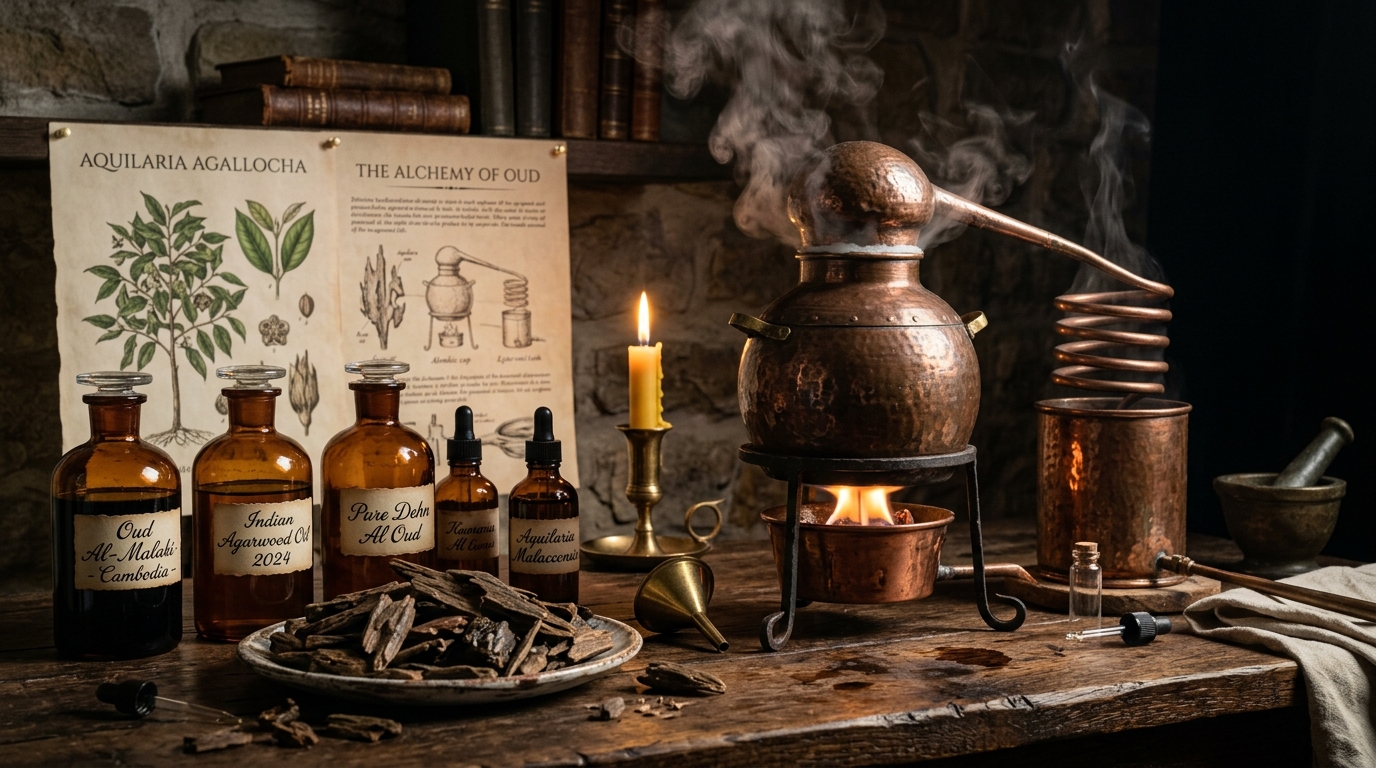
Just as a grand cru Burgundy wine mirrors the soil minerals and climate of its slope, the olfactory profile of pure agarwood oil varies dramatically depending on tree genetics, jungle ecology, and regional distillation traditions:
India / Assam (Aquilaria agallocha) — The “Hindi” Archetype
- Sensory Profile: Animalic, dense, fermented, barnyard, aged leather, goat cheese, damp peat, and balsamic medicinal undertones.
- Olfactory Signature: The most polarizing and visceral profile for Western palates. This distinctive barnyard facet stems not only from the tree itself, but from the centuries-old Assamese technique of soaking wood chips in stagnant water fermentation vats for two to four weeks prior to distillation. This anaerobic steeping generates butyric and indolic acids that create its legendary feral, carnal warmth.
Cambodia / Pursat & Koh Kong (Aquilaria crassna) — The Royal Sweetness
- Sensory Profile: Sweet, balsamic, dark fruit compote, dried plums, figs, sun-warmed apricots, honeyed pipe tobacco, and velvety red wood.
- Olfactory Signature: Historically the gold standard preferred by royal families throughout the Arabian Gulf. It completely lacks the aggressive fecal edge of Hindi oud, delivering a luminous gourmand warmth and aristocratic polish reminiscent of macerated dates and fine suede.
Vietnam / Nha Trang (Aquilaria crassna / A. sinensis) — The Spiritual Zenith
- Sensory Profile: Ethereal, crystalline, cooling mint, sweet spice, sacred incense smoke, and transcendent woods.
- Olfactory Signature: The ancestral home of the rarest agarwood grade on earth: Kynam (or Kyara in Japan). Unlike other varieties, high-grade Kynam exudes its sublime fragrance at room temperature without direct heat, possessing a numbing, meditative purity. Sinking wild Kynam commands astronomical auction prices exceeding $100,000 per kilogram of raw wood.
Borneo, Sumatra & Papua (Aquilaria microcarpa / Gyrinops) — The Virgin Rainforest
- Sensory Profile: Deep green, peat moss, humid earth, cooling camphor, herbal clarity, and primeval jungle timber.
- Olfactory Signature: Distillations from Borneo and West Papua celebrate the wild canopy. They open with an invigorating botanical and medicinal brightness that resolves into a remarkably serene, clean, swamp-free woody drydown.
Thailand (Trat & Prachinburi) and Laos — Accessible, Fruity & Modern
- Sensory Profile: Golden amber, juicy stone fruit, sweet bark, wildflower honey, and soft blond leather.
- Olfactory Signature: The engine of modern sustainable plantation cultivation. Thai oils are golden, friendly to beginners, and exceptionally versatile for contemporary hybrid formulations.
3. Sacred History & Millenary Rituals: The Smoke of the Divine
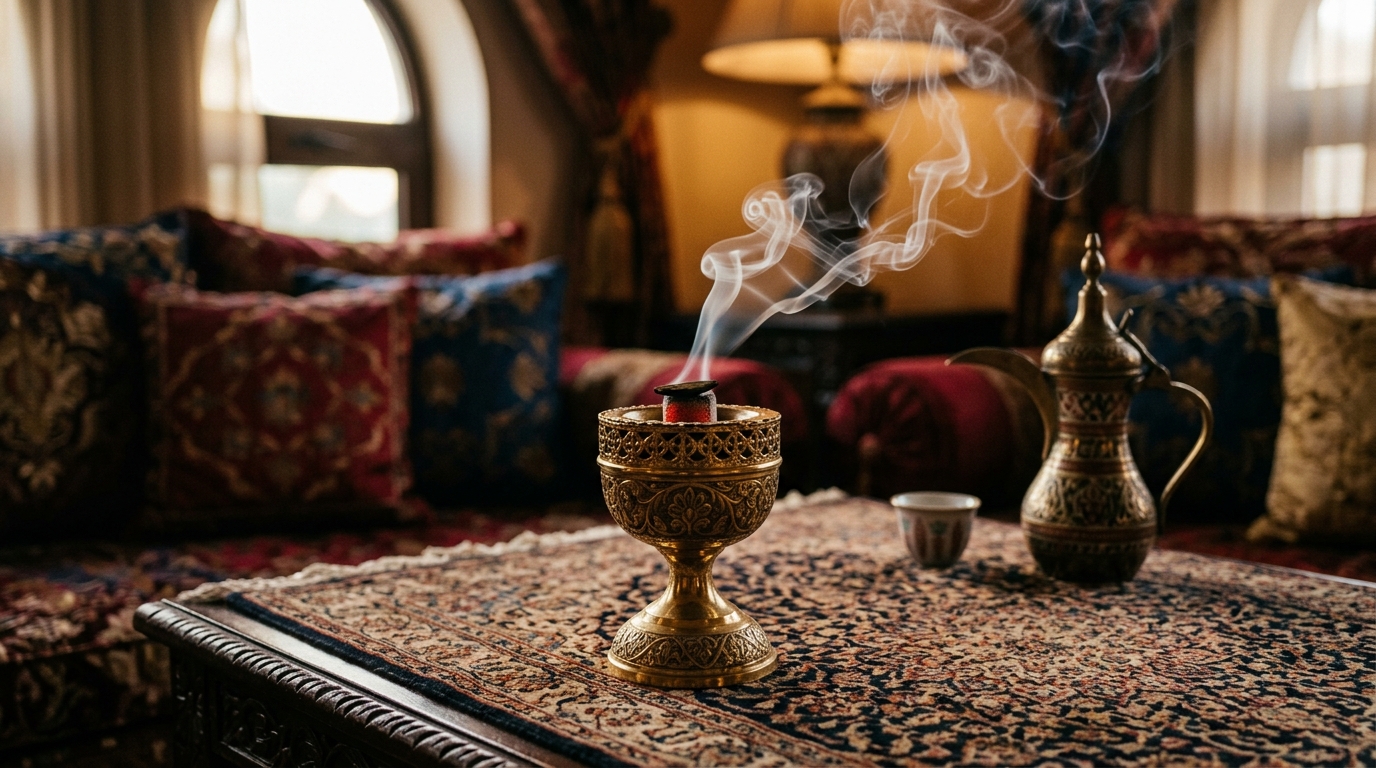
Long before agarwood was ever distilled into aromatic oil, its primary spiritual vehicle was fire. Indeed, the Latin etymology of perfume—per fumum (“through smoke”)—reaches its absolute zenith when an agarwood sliver meets glowing charcoal.
Sacred Literature
- Vedic India: Sanskrit scriptures composed over 3,000 years ago celebrate aguru as the supreme fumigant of royal palaces and temples, believed to purify spiritual sanctuaries and elevate human consciousness.
- Buddhist Sutras: The Mahāparinirvāṇa Sūtra records the ritual use of aloeswood to embalm and honor enlightened masters. To this day, Buddhist prayer beads (japa mala) carved from agarwood release subtle aromatics during rhythmic meditation.
- Biblical Texts: In the Hebrew Tanakh and Christian Old Testament, the Song of Songs (4:14) pairs aloes (the historic name for agarwood) alongside myrrh and frankincense. In the Gospel of John (19:39), Nicodemus brings a royal mixture of roughly one hundred pounds of myrrh and aloes to prepare the body of Jesus for burial.
- Islamic Traditions & Hadiths: The Prophet Muhammad praised Indian agarwood (al-oud al-hindi) as an exceptional healing substance and noted that the dwellers of Paradise would perfume their censers with agarwood.
Kōdō in Japan: “Listening” to Incense
During Japan’s Muromachi period (14th–16th centuries), the appreciation of aromatic woods evolved into a refined aristocratic ritual comparable to the tea ceremony (chanoyu): Kōdō (香道, “The Way of Incense”).
Kōdō masters formulated the Rikkoku-Gomi (六国五味, “Six Countries, Five Tastes”) classification system:
- Six wood categories: Manaka, Sasora, Manaban, Rakoku, Sumotara, and the supreme Kyara.
- Evaluated through five sensory flavor metaphors: sweet (amai), bitter (nigai), pungent/spicy (karai), sour (suppai), and salty (shioharai). Crucially, in Kōdō one does not casually “smell” incense; rather, one is said to “listen to the incense” (monkō), quieting the rational mind to receive the wood’s whispered spirit as a microscopic sliver heats gently atop a thin mica plate over glowing charcoal ash.
Bakhoor & Hospitality Across the Arabian Peninsula
In the Arabian Gulf, oud represents the ultimate expression of social respect and generous hospitality (karam):
- The Mabkhara: At the conclusion of a formal gathering or family feast, the host circulates an ornate brass or ceramic censer (mabkhara) loaded with glowing coals and fragrant agarwood chips (bakhoor).
- Personal Scenting: Guests cup the billowing white smoke with their palms, perfuming their hands, beards, traditional headdresses (ghutra), and robes (kandura). The aromatic smoke locks into the wool and silk fibers, radiating for days.
- Dehn al Oud: Pure distilled agarwood oils (dehn al oud) and complex concentrated perfume oils (mukhallat, marrying oud with Taif rose and amber) are touched onto the pulse points behind the ears and on the wrists before Friday communal prayers and celebratory weddings.
4. The Distillation Alchemies & The Economic Reality
How does a gnarly, resinous piece of timber become the most prized oil in global perfumery?
Extraction Techniques
- Traditional Hydrodistillation (Deg & Bhapka): Finely shredded agarwood chips are submerged in copper cauldrons with water and boiled over direct flame. The steam carries heavy sesquiterpene molecules through a bamboo or copper delivery tube into a condenser flask submerged in cool water. Prolonged copper contact and boiling water round off harsh edges, creating unmatched viscous depth.
- Modern Steam Distillation: Conducted in temperature-regulated stainless steel stills across modern facilities in Thailand and Vietnam. By avoiding long soaking periods and direct wood scorching, it yields lighter, crisper, cleaner woody oils free from feral indoles.
- Supercritical $\text{CO}_2$ Extraction: An advanced technique using pressurized carbon dioxide at low temperatures. It extracts heavy, heat-sensitive molecules without thermal degradation, capturing an olfactory portrait nearly identical to unburned raw wood.
The Raw Material Math: Dissecting the Luxury Economy
Understanding the economics of natural agarwood instantly shatters marketing mythology:
- Tiny Yields: It takes between 20 and 50 kilograms of high-grade infected heartwood to produce just 10 to 12 milliliters (one traditional tola) of pure essential oil.
- Astronomical Bulk Costs: A single kilogram of legally farmed, mid-grade plantation oud oil sells wholesale for $15,000 to $25,000. Wild artisanal distillations from aged Indian or Cambodian forests effortlessly fetch $35,000 to over $60,000 per kilogram.
The Reality Check: A standard 100ml luxury designer fragrance retailing for $150–$200 operates on a raw fragrance concentrate (jus) budget that rarely exceeds $2 to $5 per bottle (with the remainder absorbed by packaging, marketing, licensing, and retail margins). It is economically and mathematically impossible for any fragrance in this price bracket to contain a meaningful percentage of authentic natural agarwood oil.
5. The Western Revolution: The 2002 Turning Point
For decades, European master perfumers avoided agarwood, considering it too pungent, fecal, and discordant with the classical French school of citrus, white florals, aldehydes, and polished woods like cedar and vetiver.
Everything shifted in 2002.
The Arrival of Yves Saint Laurent M7
Under the visionary creative direction of Tom Ford at YSL, master perfumers Jacques Cavallier and Alberto Morillas were commissioned to create a boldly carnal, dark, and masculine statement.
The result was M7: a trailblazing fragrance combining vibrant mandarin and rosemary with an enigmatic, resinous heart and an unprecedented base of medicinal agarwood accord, vetiver, myrrh, and amber. Its provocative advertising campaign—featuring French martial arts champion Samuel de Cubber in full frontal nudity—ignited an international media sensation.
While M7 was a commercial misfire upon its release—European shoppers in 2002 were unaccustomed to medicinal balsamic woods—it sparked an aesthetic wildfire. When Tom Ford established his own private blend line years later, he perfected the concept in 2007 with Oud Wood, domesticating the note into a creamy, ultra-chic, cosmopolitan benchmark.
By 2010, every major luxury brand—from Christian Dior’s La Collection Privée and Guerlain to Kilian, Montale, and Roja Dove—unveiled dedicated Oud collections, driven both by wealthy Middle Eastern clientele and by Western collectors craving uncompromised intensity.
6. The Chemical Reality: Deconstructing Synthetic “Oud” Accords
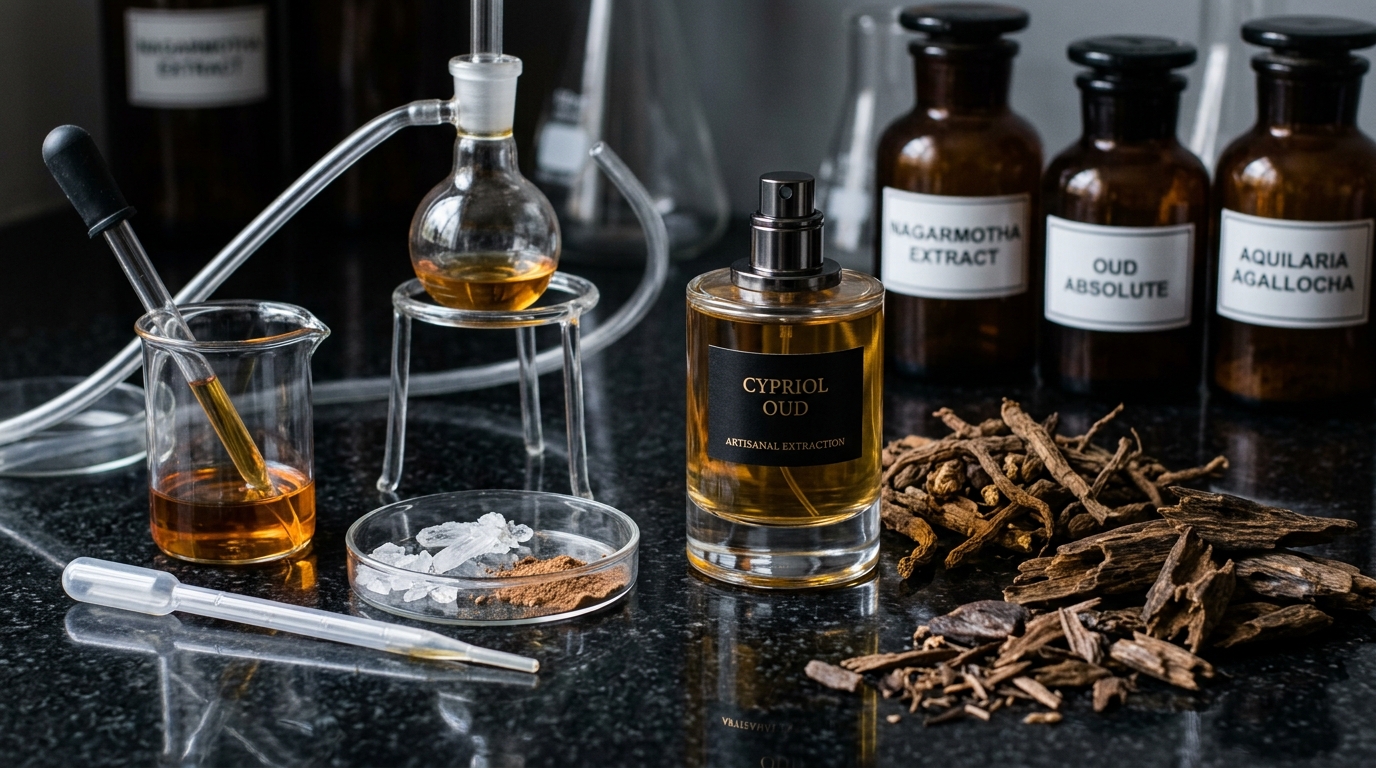
If over 99% of fragrances labeled “Oud” contain no actual Aquilaria oil, what are you actually smelling? How do perfumers construct that dark, woody, hypnotic signature?
The answer lies in the brilliant alchemy of modern aroma-chemistry: a sophisticated assemblage of secondary natural botanicals, high-impact synthetic molecules, and proprietary captive bases developed by flavor and fragrance titans such as Firmenich, Givaudan, IFF, and Symrise.
The Modern Perfumer’s Reconstruction Palette
flowchart TD
    subgraph Botanicals["Secondary Natural Extractions"]
        A["Cypriol / Nagarmotha<br/>(Smoky, earthy, papyrus-woody)"]
        B["Fractionated Patchouli<br/>(Damp, rich, dark woods)"]
    end

    subgraph Molecules["High-Impact Synthetic Molecules"]
        C["Safraleine<br/>(Warm leathery saffron, medicinal)"]
        D["Norlimbanol / Timberol<br/>(Bone-dry, ultra-radiant amberwood)"]
        E["Isobutyl Quinoline (IBQ)<br/>(Bitter tanned leather)"]
        F["Cashmeran / Cedrol<br/>(Velvety smooth cashmere texture)"]
    end

    subgraph Captives["Industrial Captive Bases"]
        G["Oud Maloki (Firmenich)"]
        H["Agarwood Base (Givaudan)"]
        I["Black Agar"]
    end

    Botanicals --> Output["Commercial 'Oud' Accord"]
    Molecules --> Output
Captives --> Output- Cypriol / Nagarmotha (Cyperus scariosus): The true unsung hero of commercial oud perfumery. The distilled root of this Indian river grass delivers a smoky, earthy, papyrus-like, dry-woody, and slightly leathery aroma that accounts for 70% of the dark woody illusion in Western fragrances at a microscopic fraction of the cost.
- Safraleine (Givaudan): A legendary synthetic molecule providing warm, metallic saffron facets, fine tobacco nuances, and a medicinal leather punch. It supplies the signature radiant opening of modern luxury oud releases.
- Norlimbanol (Firmenich) and Timberol (Symrise): Hyper-radiant dry amber-woody super-molecules. Described in the trade as “pure dry timber,” they deliver staggering sillage and tenacity that clings to wool and skin for days.
- Isobutyl Quinoline (IBQ) and Synthetic Castoreum: Recreate the pungent, saddle-leather, animalic bite characteristic of fermented Assamese Hindi oud without relying on restricted animal products.
- Cashmeran, Cedrol & Vetiveryl Acetate: Used to round, cushion, and civilize the blend, softening rough edges into a creamy texture palatable to global consumers.
- Proprietary Captive Bases: Pre-engineered commercial specialties like Firmenich’s Oud Maloki and Givaudan’s Agarwood Base. These turnkey formulas allow perfumers to dose a reliable, batch-consistent, and fully IFRA-compliant oud character with zero supply chain volatility.
Case Studies from Our Fragrance Catalog
Let’s dissect four benchmark fragrances from our review catalog to see these chemical accords in action:
1. Tom Ford Oud Wood — The Civilized Western Icon
- The Olfactory Illusion: The textbook example of modern refinement. Oud Wood bypasses any feral barnyard nuance entirely. Instead, it weaves Brazilian rosewood, aromatic green cardamom, and Sichuan pepper over a silky foundation of synthetic sandalwood, vetiver, and cashmeran.
- Technical Verdict: Zero animalic funk, 100% polished boardroom elegance. The definitive gateway woody fragrance for anyone hesitant about traditional Middle Eastern oils.
2. Dior Leather Oud & Amouage Interlude Man — The Smoky Animalic & Resinous Dimension
- The Olfactory Illusion: In opulent benchmarks like Amouage Interlude Man, the illusion of pitch-dark agarwood is forged through a fortress of materials: piquant oregano, billowing frankincense, opoponax resins, birch tar, cypriol, and a rich leather chord.
- Technical Verdict: Delivers all the majestic gravity of an Omani palace, demonstrating that expertly blended sacred resins and dry woods can match or surpass the emotional drama of single-note wild distillations.
3. Penhaligon’s Halfeti — The Aristocratic Rose, Spice & Leather Alchemy
- The Olfactory Illusion: Named after the mystical black roses of the Euphrates, Halfeti opens with crisp citrus and green artemisia before sinking into a velvet Turkish rose infused with saffron, cypriol, leather, and cedar.
- Technical Verdict: The quintessential British luxury interpretation of the Middle Eastern rose-oud archetype: opulent, tailored, and exceptionally long-lasting without ever feeling abrasive.
4. Mancera Red Tobacco — The Atomic Cinnamon, Tobacco & Synthetic Oud Monster
- The Olfactory Illusion: Unleashes a volcanic opening of red cinnamon, saffron, and a massive dry-wood synthetic oud accord. Once the initial blast settles, it reveals a rich, addictive heart of pipe tobacco leaves, bourbon vanilla, and golden amber.
- Technical Verdict: An uncompromising demonstration of modern sillage chemistry. Its 14-hour skin tenacity demonstrates the sheer projection power of contemporary woody-amber molecules.
7. Reference Matrix: Natural Artisanal Oud vs. Commercial Synthetic Accords
To help you distinguish between what you encounter in a department store versus what you discover in the world of bespoke artisanal distillations, here is an objective comparison:
| Evaluation Metric | Pure Artisanal Oud Oil (Dehn al Oud) | Commercial Synthetic Oud Accord |
|---|---|---|
| Raw Material Source | Hydrodistilled or steam-extracted infected Aquilaria / Gyrinops heartwood. | Engineered blend of cypriol, safraleine, norlimbanol, IBQ, and captive bases. |
| Evolution on Skin | Living & 3D: Morphs dramatically across hours in direct dialogue with skin temperature and chemistry. | Linear & Predictable: Maintains a reliable, uniform, and stable profile throughout its entire wear. |
| Projection & Sillage | Intimate to Moderate: Sits close as an aura; exceptional persistence but intimate projection. | Loud & Expansive: Engineered for heavy room-filling projection and diffusive trail. |
| Dominant Olfactory Profile | Complex, resinous, animalic barnyard, dried stone fruit, cooling mint, or forest moss. | Clean, dry-woody, smoky, leathery, spicy-saffron, and amberwood warmth. |
| Estimated Price Point | $250 – $1,000+ for 3ml – 12ml pure pure attar. | $70 – $350 for standard 50ml – 100ml spray bottle with alcohol base. |
| Everyday Social Wearability | Polarizing; can be challenging or inappropriate in Western corporate offices. | Highly wearable, universally appealing, and socially versatile. |
| Sustainability & CITES | Regulated by CITES; severe risk of wild poaching fraud in informal markets. | 100% sustainable, cruelty-free, and leaves wild tropical ecosystems untouched. |
8. Navigating the Landscape: The Perfume Guru Verdict
Does the synthetic reality of modern oud perfumery mean commercial fragrances are an inferior compromise? Not in the slightest.
In the realm of fine perfumery, artistic value is not measured solely by raw botanical cost per gram. A masterfully orchestrated synthetic accord—such as the leather depth of Dior Leather Oud, the sophisticated British tailoring of Halfeti, or the cashmere woodiness of Oud Wood—is frequently far more wearable, elegant, and versatile for modern life than a pure Assamese oil with overwhelming barnyard indoles.
- For refined everyday wear and magnetic social sillage: Embrace the Western designer and luxury niche canon. Explore our curated Woody Fragrance Family Guide and consult our dedicated Oud Note Profile.
- For the authentic, meditative botanical experience: Seek out artisanal houses (such as Ensar Oud, Bortnikoff, or Areej Le Doré), or sample certified plantation dehn al oud from Trat or Pursat. Place a single drop on the back of your wrist, inhale slowly, and experience an ancient olfactory journey that stretches back across millennia.
Oud is far more than a passing trend in a crystal flacon: it is the aromatic bridge connecting diseased ancient jungle trees, sacred temple fires, and the outer frontiers of modern organic chemistry.