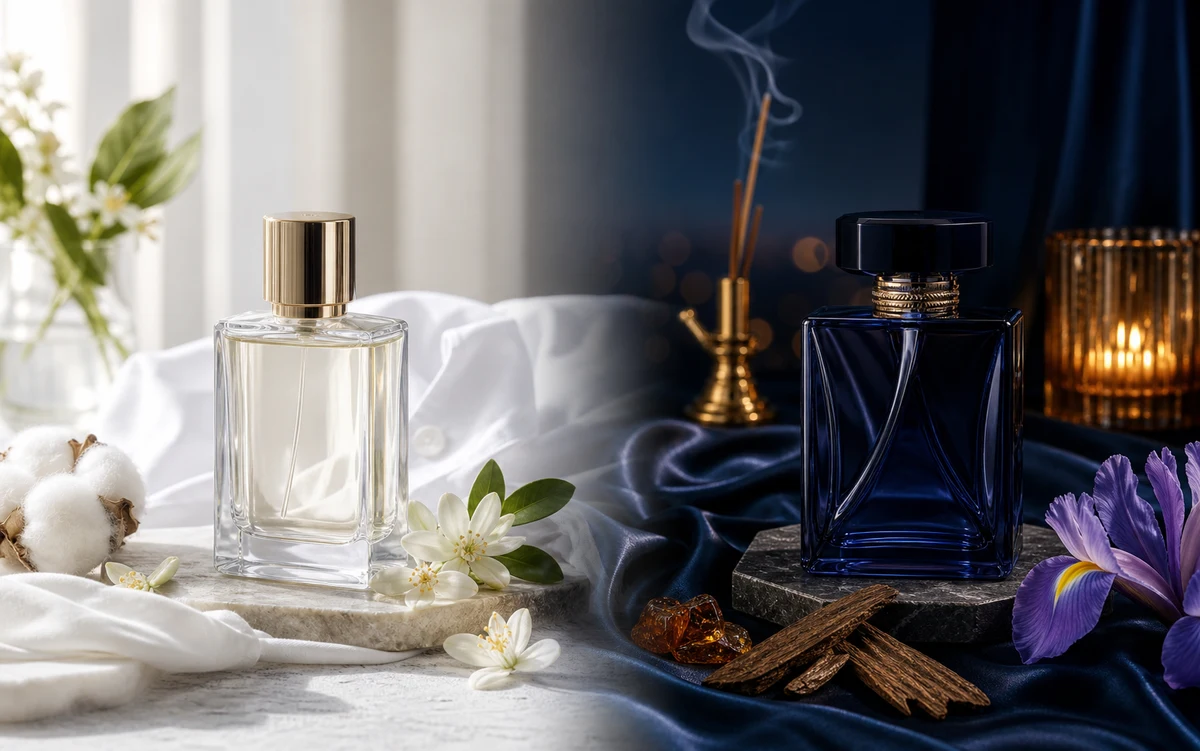
Fragrance layering—the art of applying two or more perfumes together to create a customized olfactory signature—is one of the most rewarding practices in fine perfumery. Far from being a modern social media trend, its heritage stretches back centuries to Middle Eastern perfumery traditions, where pure oils (attars) of oud, sandalwood, or amber are applied to the skin before misting an alcohol-based perfume of Taif rose or rare spices over clothes.
In contemporary fragrance styling, layering allows you to break free from the linearity of standard designer releases and cultivate a bespoke, one-of-a-kind scent profile. It is also the most effective technique for solving common performance issues: anchoring volatile fresh citrus scents for extended longevity or softening dark, hyper-potent resinous bases.
However, successful layering is not about haphazardly spraying multiple bottles. Without a grasp of physical chemistry, notes will clash, creating an abrasive olfactory mess. This guide breaks down the physics of volatility, harmony across olfactory families, and five proven recipes using fragrances from our catalog.
1. The Science of Volatility: Molecular Weights and Layering Order
To understand why certain pairings harmonize while others fall flat, we must examine the physical architecture of perfume and the classic olfactory pyramid.
       ▲  [Top Notes]   ── Citrus, aromatics, aldehydes    (High volatility / Light molecules)
      ▲▲▲ [Heart Notes] ── White florals, spices, tea     (Medium volatility)
     ▲▲▲▲▲[Base Notes]  ── Woods, resins, amber, leather  (Low volatility / Heavy molecules)
The Law of Density (Heaviest Goes First)
The fundamental physical rule of fragrance layering states that the fragrance with the higher molecular density must always be applied first as the anchor layer.
- Base Layer (Anchor / Fixative): Scents built around heavy woods (cedar, oud), balsamic resins (benzoin, myrrh), gourmand vanilla, rich tobacco, or leather. These molecules are large and evaporate slowly.
- Top Layer (Accent / Projection): Bright citrus, aquatic, aromatic herbal, or crisp white floral fragrances. These molecules are compact, lightweight, and volatile.
[!IMPORTANT] The Principle of Non-Suffocation: If you spray a lightweight citrus cologne first and coat it with a dense amber or leather extract, the heavy non-volatile oils will trap and smother the delicate top notes, preventing the citrus from ever projecting or evolving naturally.
Molecular Boosters (Skin Scents as Primers)
A sophisticated way to start layering is by applying minimalist single-molecule fragrances as a base canvas:
- Iso E Super: Imparts a velvety, transparent cedar-like aura that acts as a projection multiplier without altering the true character of your chosen scent.
- Ambroxan: Provides a clean, salty, mineral ambergris foundation that locks in aquatic and citrus accords for extended wear.
To learn more about how synthetic molecules interact with human perception, explore our guide on perfumery molecules and anosmia.
2. Olfactory Family Compatibility Matrix
Not every perfume family combines smoothly. The table below outlines high-synergy combinations and their sensory outcomes on the skin:
| Base Family (Layer 1) | Accent Family (Layer 2) | Olfactory Outcome | Best Occasion |
|---|---|---|---|
| Woody / Vetiver | Citrus / Aquatic | Mineral freshness with refined backbone and staying power | Office, business meetings, daily signature |
| Amber / Gourmand | Smoky Citrus / Dark Fruit | Sweet-sparkling contrast with immense depth | Date nights, autumn/winter evenings |
| Leather / Warm Spice | Iris / Powdery Floral | Tailored cosmetic refinement smoothing raw leather | Black-tie events, formal galas |
| Clean White Musk | Green Floral / Herbal | Crisp luxury soap and freshly pressed linen effect | Spring mornings, post-shower daytime |
| Oriental Vanilla | Aromatic / Frozen Mint | Addictive hot-cold dynamic with modern edge | Casual evenings, social outings |
For a complete breakdown of fragrance categories, consult our guides on olfactory families and perfume ingredients.
3. Critical Mistakes to Avoid
- Layering Two «Beast-Mode» Fragrances: Combining two ultra-dense fragrances with polarizing profiles (such as an animalic smoky leather with a heavy honeyed tobacco) will overwhelm everyone in your vicinity and cause rapid olfactory fatigue. One scent must always play the supporting role.
- Doubling Your Usual Spray Count (The 50/50 Rule): If your standard application is 4 sprays, apply 2 sprays of the base scent and 2 sprays of the accent scent. Layering means blending, not doubling the volume.
- Rubbing Application Zones: Rubbing wrists or neck together crushes the fragile top notes and disrupts the natural atmospheric interaction between both layers.
- Skipping Pre-Hydration: Dry skin quickly absorbs the alcohol base and binds unevenly to perfume oils. Apply an unscented moisturizing lotion before starting your layering routine.
4. Application Techniques: Direct vs. Zonal
There are two primary methods for applying layered fragrances:
A. Direct Layering (Same Pulse Point)
Apply the heavier base fragrance onto primary pulse points (sides of the neck, wrists). Wait 30 to 45 seconds for the initial alcohol to evaporate, then mist the lighter accent fragrance directly on top. Body heat facilitates a seamless blending of the aromatic oils on your skin.
B. Zonal Layering (3D Scent Sillage)
Apply different fragrances to distinct body zones to produce a dimensional projection:
- Base Fragrance (Warm/Dense): Chest, base of the neck, or behind the ears (warmer zones where the aroma radiates continuously in personal space).
- Accent Fragrance (Fresh/Projecting): Wrists, forearms, or collarbones (active zones that push the lighter sillage through movement).
5. The Layering Recipe Book: 5 Tested Formulas
Here are 5 tested combinations formulated by our editorial team using fragrances from our catalog:
Recipe 1: “The Royal Smoke & Amber” (Dates & Special Evenings)
- Goal: Ground a sparkling, smoky pineapple opening with a rich, resinous, sweet amber base.
- Base Layer (2 sprays): Maison Francis Kurkdjian Grand Soir or Kilian Angels’ Share.
- Top Layer (2 sprays): Creed Aventus.
- Why It Works: The warm benzoin and amber of Grand Soir embrace the smoky birch and pineapple of Aventus, elevating a classic daytime fresh-smoky profile into an intoxicating evening masterpiece.
Recipe 2: “Mineral Luxury & Citrus” (Office & Executive Wear)
- Goal: Infuse executive seriousness and earthy longevity into a modern blue-aquatic scent.
- Base Layer (2 sprays): Terre d’Hermès EDT.
- Top Layer (2 sprays): Bleu de Chanel EDP or Armani Acqua di Giò Profondo.
- Why It Works: The flinty mineral accord and cedarwood of Terre d’Hermès anchor the grapefruit and incense in Bleu de Chanel, projecting polished confidence without suffocating a boardroom.
Recipe 3: “Immaculate Linen & Green Garden” (Spring & Clean Summer)
- Goal: Create an ultra-crisp, white-shirt sensation enriched with a lush natural garden backdrop.
- Base Layer (2 sprays): Byredo Blanche.
- Top Layer (2 sprays): Nishane Wulong Cha or Diptyque Philosykos.
- Why It Works: The pure aldehydes and white musk of Blanche form an pristine canvas that makes the green fig leaf or oolong tea burst to life, delivering refreshing cleanliness all day long.
Recipe 4: “Velvet Leather & Iris” (Autumn & Formal Black-Tie)
- Goal: Soften the raw edge of black leather with the aristocratic cosmetic elegance of Tuscan iris.
- Base Layer (2 sprays): Tom Ford Ombré Leather.
- Top Layer (2 sprays): Dior Homme Intense.
- Why It Works: The powdery iris and ambrette seed in Dior Homme Intense line the rugged leather notes like a bespoke silk interior, crafting an irresistible, tailored aura.
Recipe 5: “Hot-Cold Contrast: Icy Mint on Warm Vanilla” (Modern Night Out)
- Goal: Deliver an electric sensory contrast between frosty herbal freshness and cozy gourmand warmth.
- Base Layer (2 sprays): Jean Paul Gaultier Le Male Le Parfum.
- Top Layer (2 sprays): Xerjoff Torino21.
- Why It Works: The icy spearmint and basil of Torino21 supply an exhilarating opening burst, gradually revealing the velvety dark vanilla and cardamom of Le Male Le Parfum as it dries down.
6. Pre-Event Testing Methodology
Before wearing a new combination to work or a social gathering, always follow this safety protocol:
- Test on Blotting Paper: Spray one pump of base and one pump of accent on a paper strip. Assess the scent evolution over 3 hours.
- Skin Patch Test: If you enjoy the blend on paper, apply it to the back of your hand to observe how it interacts with your skin’s unique pH, natural oils, and body temperature.
- Adjust the Ratio: If one fragrance overpowers the other, adjust the ratio (e.g., 3 sprays of the subtler scent paired with 1 spray of the dominant one).
Layering is an art of personal olfactory expression. Armed with molecular fundamentals and accord balance, you have everything you need to forge a signature scent that no one else in the world can replicate.