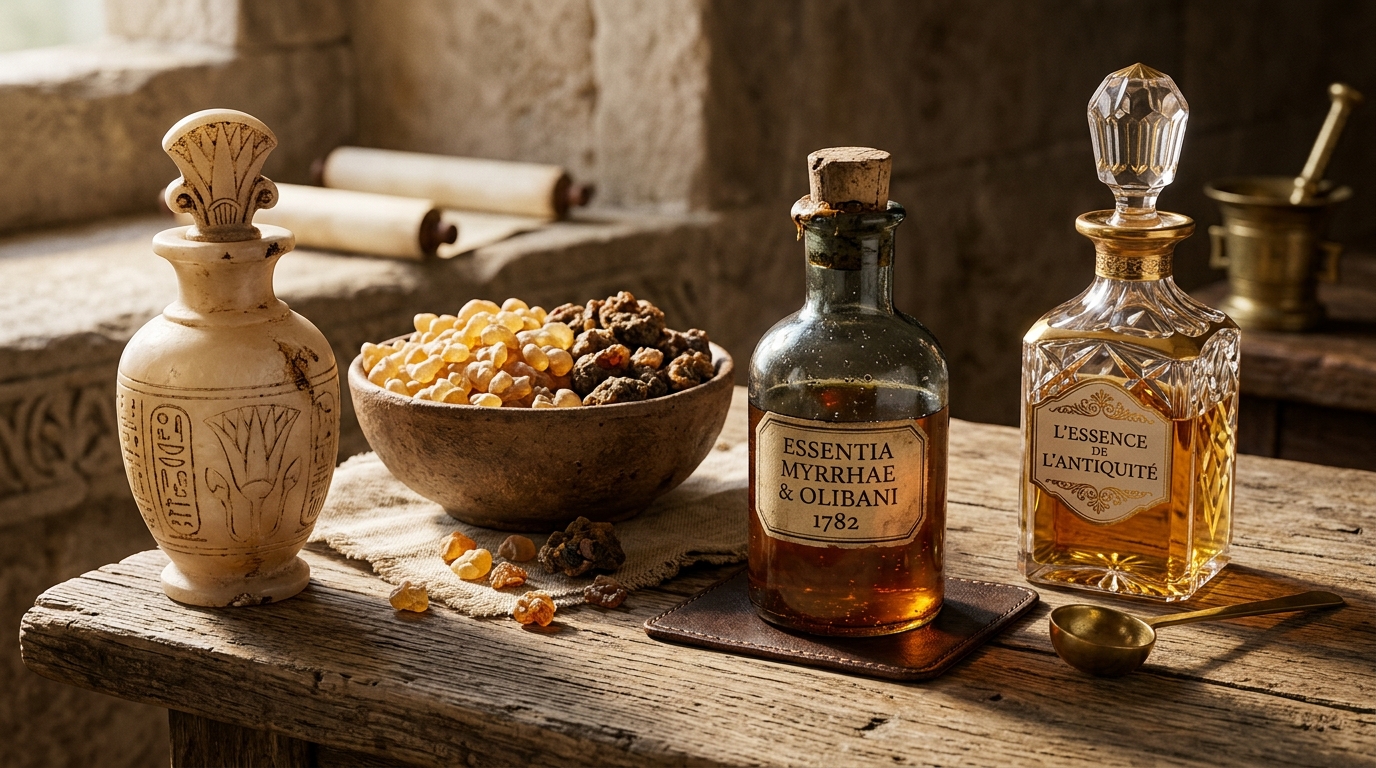
From the burning embers of ancient Egyptian temple braziers to the minimalist glass flacons of modern haute parfumerie, fragrance has accompanied humanity across four millennia. Perfume has served as a sacred bridge to the divine, an aristocratic weapon of seduction, a medical shield against contagion, and the ultimate artistic medium of personal identity.
The word itself reveals its ancient ritual origins: derived from the Latin per fumum, meaning “through smoke.” Long before liquid extracts existed, aromatic plant resins, fragrant barks, and dried blossoms were incinerated upon altars so their scented plumes could carry human prayers toward the heavens.
Yet the story of perfume is far more than a timeline of pleasant smells. It is an enthralling odyssey of chemical breakthroughs, global trade wars, royal court intrigue, and sensory revolutions.
1. Antiquity & Sacred Resins: The Dawn of Olfactory Art (Mesopotamia, Egypt & Rome)
The recorded history of fragrance begins in ancient Mesopotamia around 1200 BCE. Cuneiform tablets unearthed by archaeologists record the name and formulas of history’s first known chemist and perfumer: an overseer at the royal Babylonian palace named Tapputi-Belatekallim. Tapputi utilized cold and warm maceration, repeatedly filtering and refining calamus, myrrh, distilled water, and balsam—establishing laboratory protocols that predated modern chemistry by millennia.
Across the Mediterranean, Ancient Egypt elevated scent to a state religion. The Egyptians believed that fragrant aromas emanated directly from the sweat of the gods, particularly Nefertem, the lotus-crowned god of perfume and healing.
Ancient Sacred Scent Pyramid:
┌────────────────────────────────────────┐
│  Kyphi (Kap-t): Sunset Temple Incense   │  → 16 Sacred botanicals, honey & wine
├────────────────────────────────────────┤
│  Macerated Unguents & Solid Pomades    │  → Animal fats, moringa oil, lotus
├────────────────────────────────────────┤
│  Embalming Resins (The Eternal Shield) │  → Pure Frankincense, Myrrh, Cedar
└────────────────────────────────────────┘
The pinnacle of Egyptian olfactory artistry was Kyphi (kap-t), an intricate ritual blend mentioned in the Ebers Papyrus and temple walls at Edfu and Philae. Consisting of sixteen sacred ingredients—including frankincense tears, myrrh, mastic, spikenard, sweet rush, raisins, honey, and steeped wine—it was burned at dusk to induce serene dreams, purify temple sanctums, and pacify nocturnal anxieties.
Elite Egyptians also wore scented fat cones atop their wigs during festive banquets. As the evening progressed, the ambient heat melted the beef tallow and wax infused with blue water lily (Nymphaea caerulea), cascading a cooling, intoxicating veil of perfume over their shoulders and linens.
The Greco-Roman Extravagance
When Greek botanists like Theophrastus wrote the treatise Concerning Odours in 300 BCE, perfumery transitioned into a personal luxury. In Imperial Rome, the passion for scent surged into unprecedented excess:
- The Thermae Ritual: Roman citizens bathed daily in grand public baths, using strigils to scrape away scented olive oils infused with susinum (a lavish blend of Madonna lily, sweet flag, cinnamon, and saffron).
- Imperial Displays: Emperor Nero was infamous for installing silver pipes inside the dining dome of the Domus Aurea to shower guests with atomized rosewater, while scenting the plumage of live doves that fluttered above banquets to perfume the air.
2. The Islamic Golden Age & The Distillation Revolution
While the fall of Rome plunged Western Europe into an olfactory dark age where cleanliness was viewed with religious suspicion, the Islamic Golden Age (8th to 14th centuries) revolutionized fragrance science forever.
Before Islamic alchemists, extracting botanical aromas was inefficient and perishable: plant matter was pounded and steeped in hot animal fats or vegetable oils, producing heavy unguents that turned rancid within months.
Avicenna and the Refrigerated Alembic
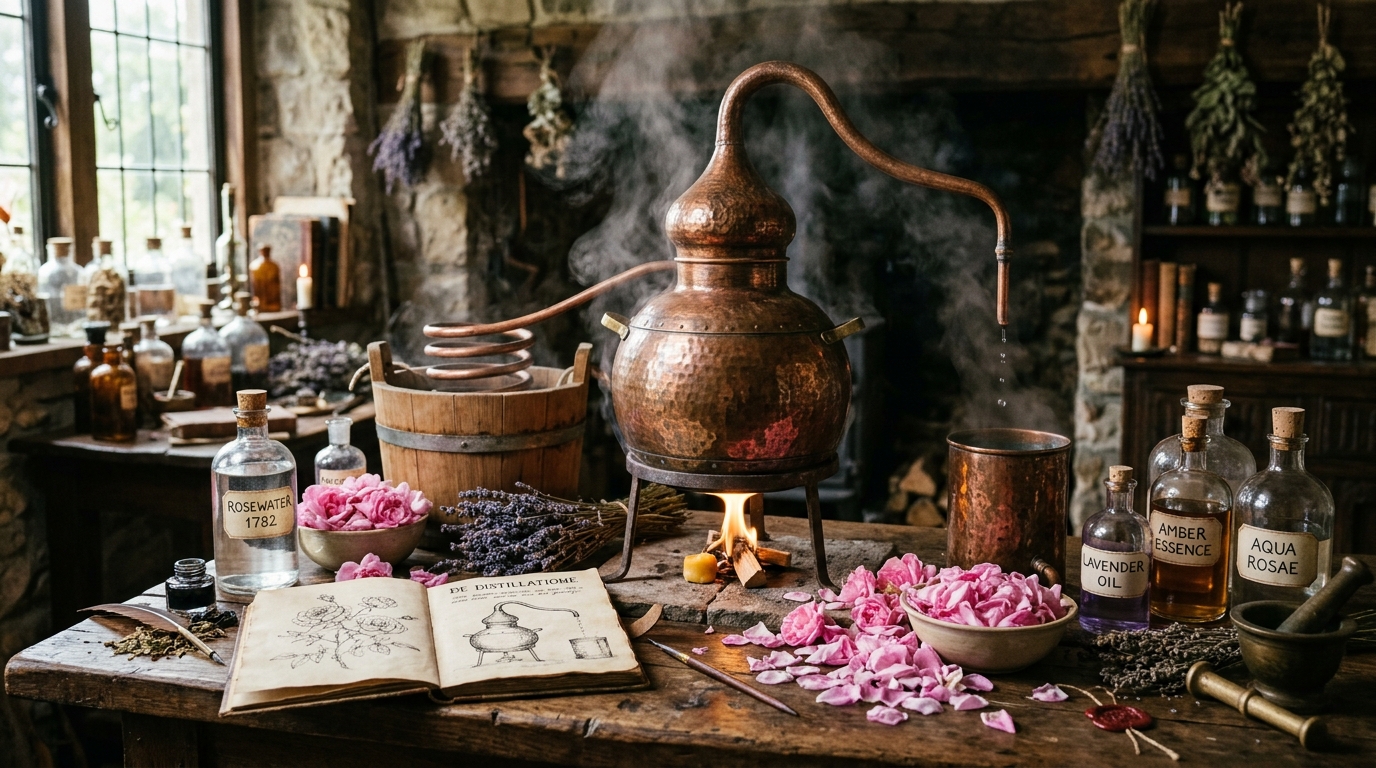
The monumental turning point arrived around the year 1000 CE through the Persian polymath, physician, and alchemist Ibn Sina (known to the West as Avicenna). Avicenna perfected the design of the copper alembic (al-inbīq) by introducing a spiral cooling coil:
- Steam Vaporization: Water boiled beneath fresh flower petals, vaporizing their volatile aromatic compounds without charring the delicate plant tissue.
- Condensation: The rising vapor passed into a curved copper neck cooled with water, condensing back into liquid form.
- Phase Separation: The resulting condensate separated naturally into two precious fluids: a concentrated hydrosol (pure rosewater) and an ultra-pure layer of floating essential oil (otto or attar).
Using this refrigerated still, Avicenna distilled the petals of the Damask rose (Rosa damascena), producing crystal-clear, alcohol-free rosewater that could be transported across vast distances without spoiling.
At the same time, Muslim merchants dominating the Silk Road and Indian Ocean trade networks introduced exotic raw materials that redefined the olfactory palette: Tibetan musk, ambergris gathered from the shores of Yemen, wild camphor from Sumatra, and precious resinous agarwood (oud). In Islamic theology and social life, cleanliness and sweet perfume were celebrated as Sunnah, integrating fragrance into the daily fabric of mosques, homes, and hospitality.
3. The Renaissance, Venetian Spices & The “Perfumed Court” of Versailles
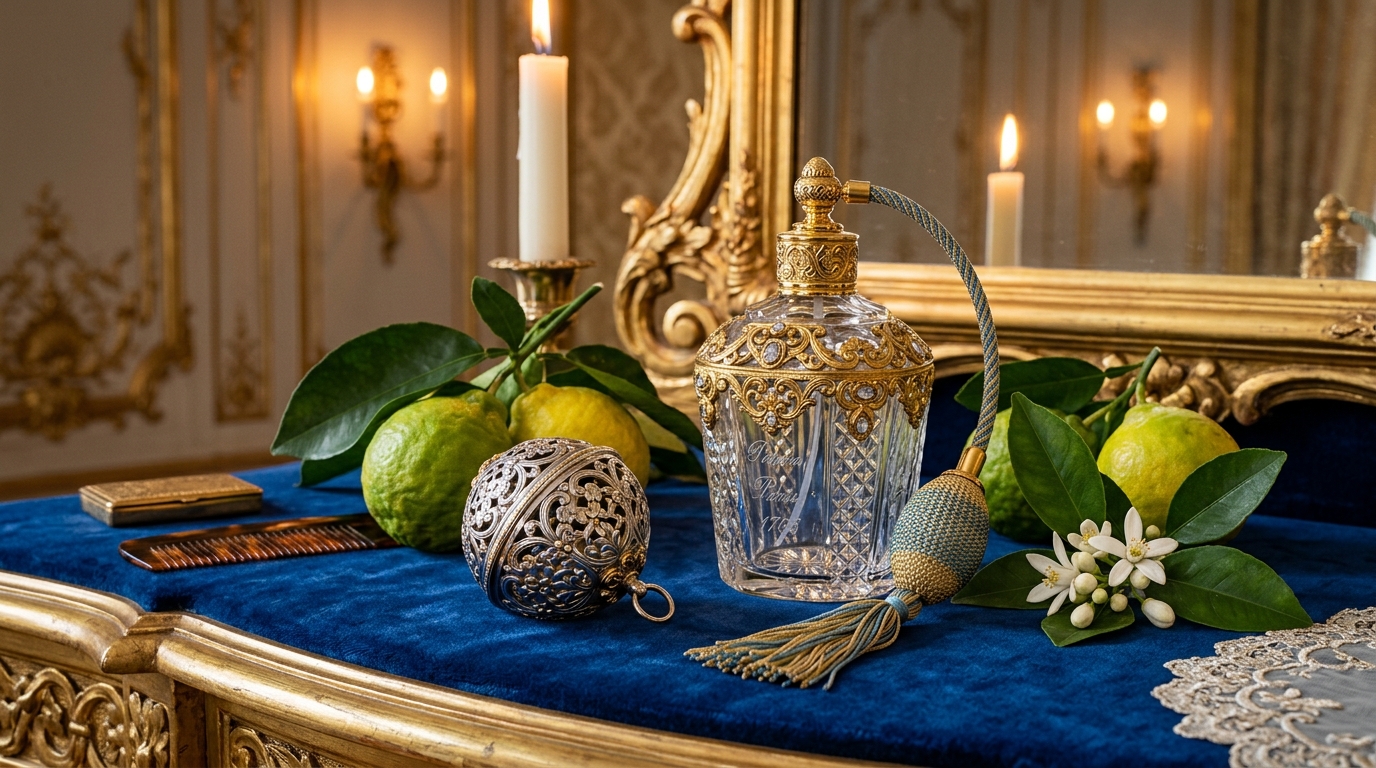
The return of perfume to European soil was driven by Mediterranean maritime commerce. During the 14th and 15th centuries, the Republic of Venice dominated the trade routes connecting Alexandria and Constantinople to Europe, flooding northern markets with cloves, nutmeg, labdanum, and benzoin resin. Wealthy Venetian merchants carried pomanders—hollow, intricately pierced spheres of chased silver or gold filled with solid paste of musk, cinnamon, and ambergris—worn around the neck or waist as both status symbols and shields against disease.
Catherine de’ Medici & The French Connection
In 1533, the fourteen-year-old Florentine noblewoman Catherine de’ Medici traveled to France to marry the future King Henry II. She brought her personal master perfumer, Renato Bianco (known to Parisians as René le Florentin).
Bianco established his perfumery boutique near the Pont Saint-Michel, introducing Italian refinement to the French aristocracy. Most notably, he popularized scented leather gloves (peaux d’Espagne). Untanned animal leather smelled appalling from the tanning process, which utilized urine and animal dung. Bianco steeped the gloves in ambergris, civet, musk, and floral oils, turning an unpleasant necessity into the supreme fashion symbol of European courtly poise.
The European Fragrance Shift:
Renaissance Italy               17th-Century Versailles          18th-Century Enlightenment
┌──────────────────────┐        ┌──────────────────────┐        ┌──────────────────────┐
│  Spices, Pomanders   │   ──→  │ Heavy Animalics      │   ──→  │ Light Citrus Waters  │
│  & Scented Leather   │        │ (Civet, Musk, Amber) │        │ (Bergamot, Neroli)   │
└──────────────────────┘        └──────────────────────┘        └──────────────────────┘
Versailles: “La Cour Parfumée”
Under King Louis XIV (“The Sun King”), the royal court at Versailles earned the moniker la cour parfumée (the perfumed court). The king’s strict etiquette demanded a different bespoke scent for every day of the week, while palace courtiers were expected to immerse their garments, hair powder, walking canes, and even palace furniture in perfume.
Paradoxically, this extreme scent consumption was fueled by a pathological dread of water. Physicians believed that hot water opened the skin’s pores to the invisible “miasmas” of the bubonic plague. Because nobility rarely washed their bodies with water, powerful animalics like Ethiopian civet, deer musk, and beaver castoreum were deployed in heavy doses to mask body odor.
To satisfy Versailles’ insatiable appetite for botanical ingredients, the small town of Grasse in the sunny hills of Provence underwent an extraordinary transformation: its master tanners dismantled their leather workshops and converted the surrounding terraced hillsides into vast fields of jasmine, tuberose, lavender, and May rose (Rosa centifolia), cementing Grasse’s destiny as the perfume capital of the world.
4. The 18th-Century Enlightenment & The Birth of Eau de Cologne
As the 18th-century Enlightenment championed scientific reason, medicine, and bodily hygiene, the heavy, suffocating animalic scents of Versailles fell out of favor. European society craved fresh, clean, and invigorating aromas that evoked vitality rather than covering decay.
Farina and the Aqua Mirabilis (1709)
In 1709, an Italian perfumer named Giovanni Maria Farina living in the German city of Cologne (Köln) wrote a famous letter to his brother:
“I have discovered a scent that reminds me of an Italian spring morning, of wild daffodils and orange blossoms after the rain.”
Farina named his invention Eau de Cologne in honor of his adopted city. Unlike the viscous oily balsams of the past, Farina dissolved volatile Mediterranean citrus essences—Calabrian bergamot, sweet orange, lemon, petitgrain, and neroli—in highly rectified, crystal-pure neutral grape spirit.
The result was an invigorating sensation. Eau de Cologne was hailed not only as a personal scent but as a panacea: monarchs including Napoleon Bonaparte bathed in it, carried pocket flacons into battle, and even drank small doses dissolved in sugar wine.
During the reign of Louis XVI, Queen Marie Antoinette accelerated this shift at Versailles. Disillusioned with suffocating court etiquette, she retreated to the Petit Trianon, cultivating English gardens and popularizing delicate soliflores: sweet violet, iris powder, orange blossom, and dewy rosewaters formulated by her master perfumer Jean-Louis Fargeon.
5. The 19th & Early 20th-Century Synthetic Revolution: Modern Perfumery is Born
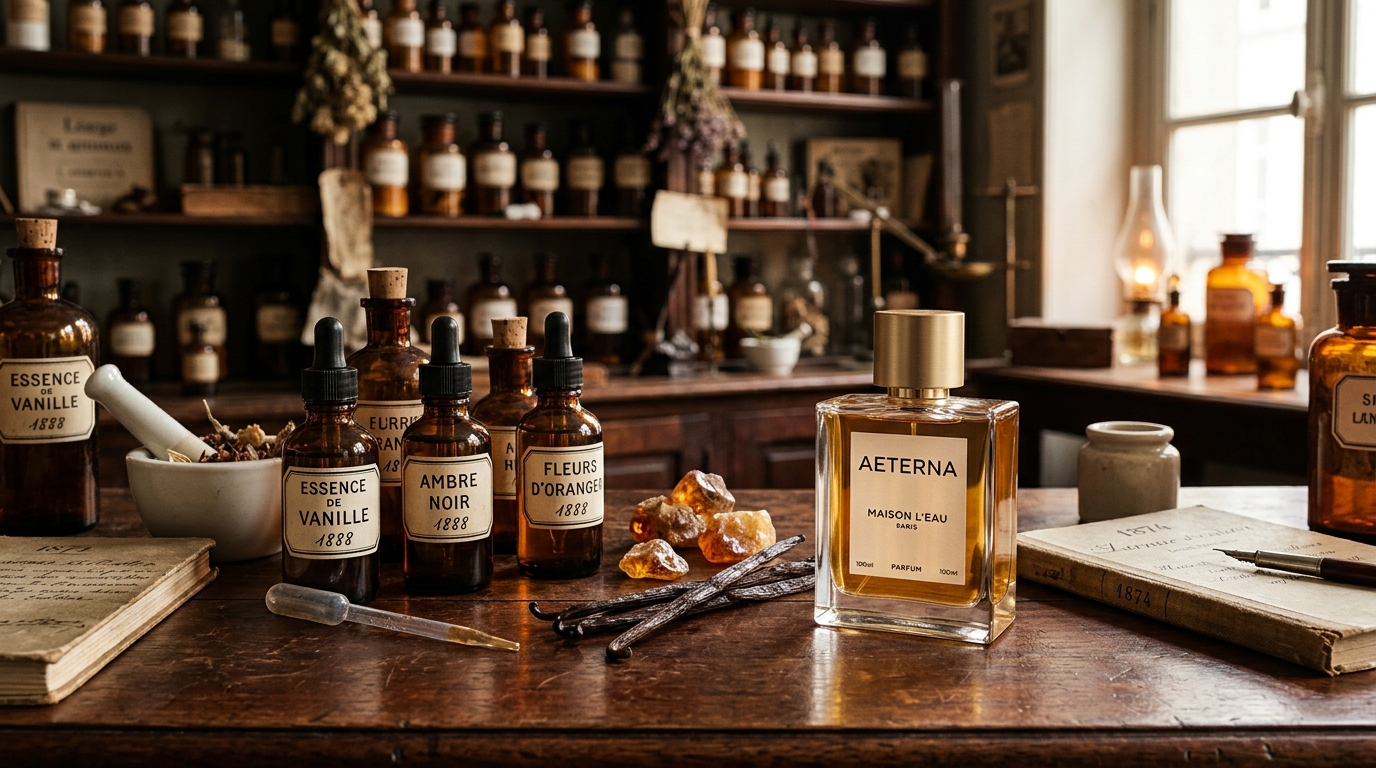
Until the late 19th century, a perfumer was strictly an artisan limited by nature. If a flower yielded no essential oil through distillation or enfleurage (such as lily-of-the-valley, lilac, or gardenia), its scent could not be bottled. Natural extracts were also wildly variable, subject to droughts, frost, and astronomical production costs.
Between 1860 and 1920, the rise of synthetic organic chemistry shattered these boundaries forever, transforming perfumery from a botanical craft into an abstract, high-art form.
The Four Landmark Breakthroughs
The Synthetic Breakthrough Timeline:
1882: Houbigant Fougère Royale ──→ First isolated Coumarin (Paul Parquet)
1889: Guerlain Jicky          ──→ Synthetic Vanillin & Linalool (Aimé Guerlain)
1917: Coty Chypre             ──→ The Chypre Archetype (François Coty)
1921: Chanel Nº 5 ──→ Overdosed Aliphatic Aldehydes (Ernest Beaux)- 1882 — Coumarin & Houbigant’s Fougère Royale: Master perfumer Paul Parquet isolated coumarin (the warm molecule responsible for the aroma of freshly mown sweet hay and tonka beans). By pairing synthetic coumarin with natural French lavender, geranium, and oakmoss, Parquet invented the legendary Fougère accord. Parquet remarked: “If God gave ferns a fragrance, they would smell like Fougère Royale.”
- 1889 — Vanillin & Guerlain’s Jicky: Aimé Guerlain introduced synthesized vanillin alongside linalool and coumarin in Jicky. Rather than imitating a single flower, Jicky was an emotional, multi-layered composition that bridged herbal lavender top notes with an ambery, sensual balsamic base.
- 1917 — François Coty’s Chypre: Industrial genius François Coty blended bergamot with cistus labdanum, patchouli, and raw oakmoss, crystallizing the dramatic light-and-shadow architecture of the Chypre family.
- 1921 — Aliphatic Aldehydes & Chanel Nº 5: Former perfumer to the Russian imperial court Ernest Beaux presented Gabrielle “Coco” Chanel with several numbered scent prototypes. Beaux daringly overdosed synthetic aliphatic aldehydes (C-10, C-11, and C-12)—sparkling, waxy molecules that lifted opulent Grasse jasmine and May rose into an effervescent, champagne-like radiance. Chanel Nº 5 became the most famous perfume in human history.
6. The Modern & Contemporary Era: From Designer Blockbusters to Niche Artistry
The post-war 20th century witnessed the democratisation of fragrance. With the rise of ready-to-wear fashion and mass retail, perfumes transformed into global branding powerhouses:
- The Opulent 1980s: Economic expansion sparked a demand for intoxicating sillage. Powerhouse oriental creations like Yves Saint Laurent Opium and Christian Dior Poison announced their wearer’s arrival before they entered the room, featuring massive concentrations of tuberose, dark spices, and plum resins.
- The Minimalist & Aquatic 1990s: In sensory rebellion against 80s excess, the 1990s embraced pure transparency. The synthesis of Calone 1951 introduced the salty, ozone-kissed aura of ocean breezes in benchmark scents like Giorgio Armani Acqua di Giò and Calvin Klein CK One.
- The 1992 Gourmand Revolution: Olivier Cresp overdosed ethyl maltol (cotton candy and caramelized sugar) alongside patchouli in Thierry Mugler Angel, inventing the irresistible Gourmand family.
The 21st-Century Niche Renaissance & Green Chemistry
In recent decades, fragrance consumers fatigued by focus-grouped designer releases have turned toward independent luxury niche perfumery. Pioneers like Serge Lutens, Editions de Parfums Frédéric Malle, and Le Labo restored the spotlight to master perfumers, uncompromising ingredient quality, and bold unisex narratives.
Concurrently, modern perfumery is undergoing its greatest transformation since the industrial revolution:
- Modern Molecular Isolates: High-tech aroma chemicals like Ambroxan (the radiant ambergris fraction), Iso E Super (velvety cedar aura), and Cashmeran provide crystalline persistence and skin-scent warmth.
- Sustainability & Biotechnology: Advances in green chemistry, enzyme fermentation, and upcycled botanical byproducts allow perfumers to recreate endangered woods (like sandalwood and agarwood) with zero environmental damage.
- IFRA Safety Standards: Rigorous global regulations protect consumers from phototoxicity and allergens, challenging perfumers to continuously reformulate classical masterpieces with breathtaking modern ingenuity.
7. The Chronological Milestone Matrix
| Epoch | Time Period | Key Figures & Pioneers | Signature Ingredients & Breakthroughs | Modern Legacy & Descendants |
|---|---|---|---|---|
| Antiquity | c. 2000 BCE – 400 CE | Tapputi-Belatekallim, Nefertem, Theophrastus | Frankincense, Myrrh, Kyphi, Susinum, animal fats | Sacred incense perfumes, balsamic resin notes |
| Islamic Golden Age | 8th – 14th Century | Ibn Sina (Avicenna), Al-Kindi, Jabir ibn Hayyan | Steam-distilled rosewater, copper alembic, Musk, Oud | Middle Eastern perfumery, attars, rose-oud accords |
| Renaissance & Baroque | 14th – 17th Century | Catherine de’ Medici, René le Florentin, Louis XIV | Scented leather (peaux d’Espagne), Civet, Ambergris, Pomanders | Grasse floral farming, leather-amber accords |
| The Enlightenment | 18th Century | Giovanni Maria Farina, Jean-Louis Fargeon | Bergamot, Neroli, Lemon in wine alcohol (Eau de Cologne) | Modern colognes, fresh citrus-aromatic signatures |
| Synthetic Revolution | 1880 – 1925 | Paul Parquet, Aimé Guerlain, François Coty, Ernest Beaux | Coumarin, Vanillin, Aliphatic Aldehydes, Chypre structure | Birth of abstract modern perfumery, Chanel Nº 5 |
| Designer Golden Age | 1970 – 1999 | Yves Saint Laurent, Olivier Cresp, Alberto Morillas | Ethyl maltol, Calone 1951, massive sillage powerhouses | Aquatic perfumes, iconic designer gourmands |
| Contemporary Niche | 2000 – Present | Frédéric Malle, Quentin Bisch, Francis Kurkdjian | Ambroxan, Iso E Super, biotech upcycling, niche transparency | High-end luxury niche, minimalist skin scents |
Conclusion: The Unbroken Thread of Olfactory Art
When you spritz your favorite fragrance this morning—whether it is a luminous citrus cologne, a velvety woody-amber, or an intoxicating white floral—you are participating in a four-thousand-year-old human ritual.
From the sacred incense braziers of ancient Mesopotamia to the precision laboratory chemistry of today, perfume remains what it has always been: the most intimate, evocative, and enduring form of art humanity has ever created.
Explore more fragrance heritage and artistry in our Guide to Classic Accords: Fougère, Chypre & Gourmand, discover raw materials in our Perfumery Ingredients Guide, or find your perfect historical signature using the interactive Perfume Recommender.