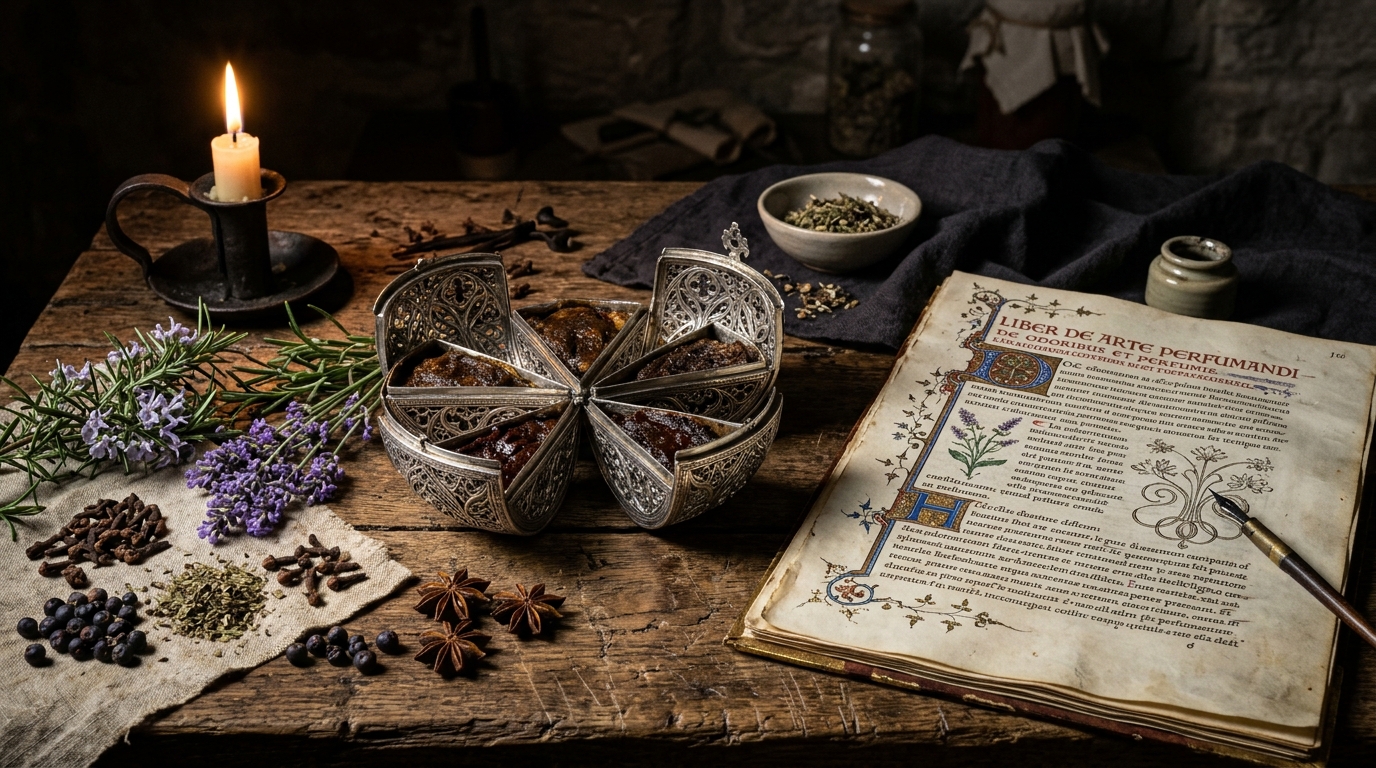
For centuries, a persistent modern myth reduced the European Middle Ages to a bleak, stench-ridden wasteland where personal hygiene was despised, bodily care abandoned, and olfactory pleasure nonexistent. Nothing could be further from historical reality. For medieval men and women, scent was far more than an idle cosmetic embellishment. It was an invisible cosmic threshold: a direct conduit of divine grace, the physical manifestation of spiritual purity over the corruption of sin, and, above all, the most potent medical armor available to human civilization in its desperate struggle against pestilence and death.
In an era without germ theory or synthetic antibiotics, odor was perceived as the tangible essence of matter itself. Foul air—the dreaded miasma—was believed to carry the physical seeds of contagion, while sweet, resinous, and pungent botanicals constituted an impenetrable aromatic fortress capable of neutralizing airborne poisons, rebalancing bodily humors, and shielding the vital organs. Simultaneously, within the quiet stone cloisters of Benedictine abbeys, visionary polymaths such as Saint Hildegard von Bingen systematically cataloged the therapeutic and volatile virtues of medicinal herbs.
It was also in the crucible of medieval Europe that the single most consequential technological leap in perfume history took place: the reception of Islamic alchemical distillation apparatus at southern universities like Salerno and Montpellier, leading Arnaldo of Vilanova and Ramon Llull to isolate high-proof ethyl alcohol (aqua vitae). This discovery liberated fragrance from perishable fatty oils, culminating around 1370 in the creation of the legendary Queen of Hungary’s Water and inaugurating modern alcohol-based perfumery.
In this authoritative masterclass, we explore the complete history of medieval European fragrance: from the cloistered serenity of the hortus conclusus to the terrifying crisis of the Black Death, the jewel-like mechanics of the pomander, Venetian spice fleets, and the rise of the master perfumer-glovers.
1. The Monastic Refuge & The Garden of Simples (Hortus Conclusus)
With the fragmentation of the Western Roman Empire from the 5th century onward, the sprawling Mediterranean trade networks that once supplied imperial baths with Arabian myrrh, Judaean balsam, and Egyptian unguents collapsed. The monumental public thermae, where Roman citizens were lavishly anointed with heavy botanical oils, fell into decay. Yet the ancient art of aromatics did not vanish; it found sanctuary behind the thick stone walls of the most disciplined institutions of early medieval Europe: Christian monasteries.
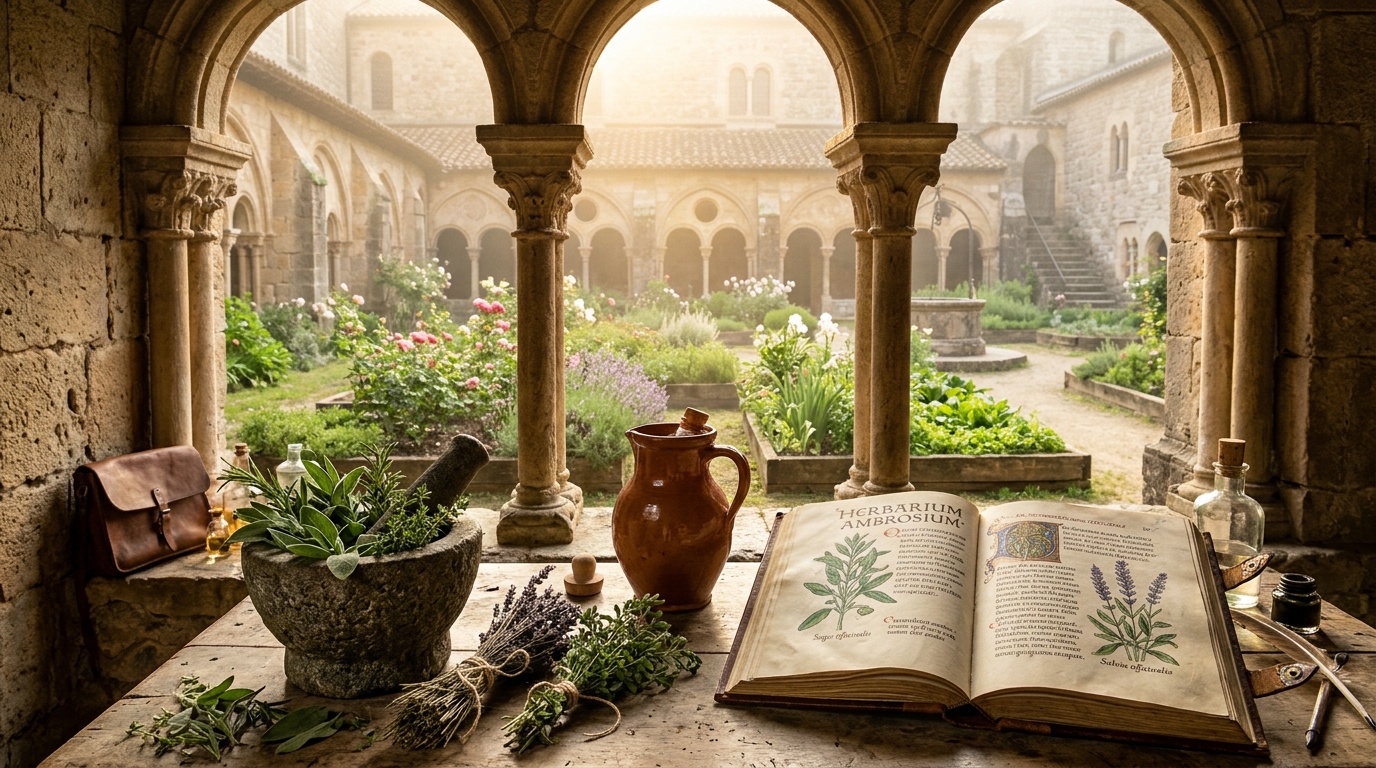
Guided by the Rule of Saint Benedict (Ora et labora), monasteries functioned as self-sustaining islands of intellectual preservation, agriculture, and botanical medicine. Within the abbey precinct, one quadrant held an almost sacred status: the hortus medicus (physic garden) or garden of simples, spiritually allegorized as a reflection of Eden under the concept of the hortus conclusus (enclosed garden).
The Botanical Architecture of the Cloister
Within raised stone garden beds sheltered by Romanesque and Gothic stone arcades, monastic infirmarians cultivated indigenous botanicals whose pharmacological and aromatic potency had been tested across generations:
- Rosemary (Rosmarinus officinalis): Revered as a circulatory stimulant, an invigorator of memory, and a formidable atmospheric antiseptic.
- Sage (Salvia officinalis): Named from the Latin salvare (“to heal” or “to save”), regarded as a universal panacea against infection and bodily decline.
- Rue (Ruta graveolens): A bitter, intensely pungent subshrub cultivated as an insect deterrent and an airborne fumigant against putrid air.
- Lavender (Lavandula angustifolia and Lavandula stoechas): Used to scent and sanitize monastic infirmary linens, relieve cephalic headaches, and perfume cleansing washes.
- Thyme, Mint, and Lemon Balm (Melissa officinalis): Aromatic labiates steeped in medicinal wines, infused in vinegars, or hydro-distilled in rudimentary alembics to yield soothing waters.
Hildegard von Bingen: The Holism of Viriditas
In the 12th century, the visionary German Benedictine abbess Saint Hildegard von Bingen (1098–1179) elevated monastic botany to its philosophical and empirical zenith. In seminal works such as Physica (Liber Subtilitatum Diversarum Naturarum Creaturarum) and Causae et Curae, Hildegard integrated classical Galenic humoral pathology with her mystical doctrine of viriditas—the divine, greening life-force animating all Creation.
Hildegard recognized that a plant’s fragrance was the outward radiance of its inner vitality and thermal complexion. She classified flora systematically by warmth (caliditas) and moisture (humiditas), prescribing aromatic steams of fennel and lavender to lift melancholic humors, and compounding ointments of rosemary and myrtle to invigorate chilled nerves. Her meticulously copied manuscripts ensured that the botanical pharmacopeia survived the turbulent feudal centuries intact.
2. The Miasma Theory, The Black Death (1347–1351) & The Abandonment of Water
In October 1347, Genoese merchant galleys returning from the Black Death-ravaged Crimean port of Caffa docked in Messina, Sicily. Aboard were dying sailors and swarms of black rats carrying oriental rat fleas (Xenopsylla cheopis) infected with Yersinia pestis. Over the next five years, the Black Death swept across Western Europe with unimaginable ferocity, wiping out between 30% and 60% of the continental population.
Confronted with sudden agonizing swellings (buboes), blackened necrotic limbs, and terrifyingly rapid death, medieval medical faculties—anchored in the humoral teachings of Hippocrates and Galen—formulated an explanation that dictated European hygiene for centuries: the Miasma Theory.
                           ┌─────────────────────────────────────┐
                           │      THE MIASMA DOCTRINE & THE      │
                           │     CRISIS OF WATER BATHING (1348)  │
                           └──────────────────┬──────────────────┘
                                              │
                      Atmospheric Corruption (Foul Stench / Decayed Air)
                                              │
                      ┌───────────────────────┴───────────────────────┐
                      ▼                                               ▼
          WARM WATER (MORTAL PERIL)                      AROMATICS (SHIELD)
         Dilates cutaneous pores                  Penetrating balsamic botanicals
        (*pori cutis*) and opens path               neutralize airborne venoms
         for pestilence into organs.               and seal the respiratory gate.
                      │                                               │
                      ▼                                               ▼
          Collapse of Bathhouses                      Rise of Solid Pomanders,
          and Rise of "Dry Cleansing"                 Herbal Vinegars, and Spirits
The Paris Medical Faculty Decree & The Demonization of Water
In the autumn of 1348, King Philip VI of France commissioned the medical masters of the University of Paris to investigate the catastrophe. Their formal report, the Compendium de Epidemia, determined that a planetary conjunction of Saturn, Jupiter, and Mars in the sign of Aquarius had drawn up toxic vapors from oceanic depths, generating a continent-wide cloud of corrupt, pestilential air (miasma).
Crucially, the Parisian masters issued a dire warning that dismantled European bathing culture: hot water was inherently dangerous. Physicians argued that warm water and steam softened the skin and dilated the cutaneous pores (pori cutis). This pore dilation destroyed the body’s natural envelope, opening direct anatomical pathways for lethal miasmas to infiltrate the bloodstream and strike the heart and lungs.
This medical consensus triggered an epochal transformation:
- The Closure of Public Bathhouses: The thriving public baths (étuves in France, Badehäuser in Germany), which had served as vibrant social and hygienic hubs throughout the High Middle Ages, were outlawed and shuttered.
- The Era of “Dry Cleansing” (Toilette Sèche): Immersion in water was replaced by dry friction using white linen cloths (believed to absorb toxic perspiration) dampened with rosewater, distilled lavender hydrosols, or herbal vinegars.
- Perfume as the Primary Disinfectant: Fragrance was elevated from a luxury to an indispensable medical shield. Foul stench meant contagion; sweet, pungent, volatile aromatics meant life and biological defense.
3. The Aromatic Shield: Pomanders (Pommes d’Ambre) & Plague Vinegars
To navigate streets choked with decaying waste and plague victims, European elites devised sophisticated portable olfactory weapons. The pinnacle of this prophylactic engineering was the Pomander (derived from the Old French pomme d’ambre, meaning “apple of amber”).
The Mechanics and Composition of the Pomander
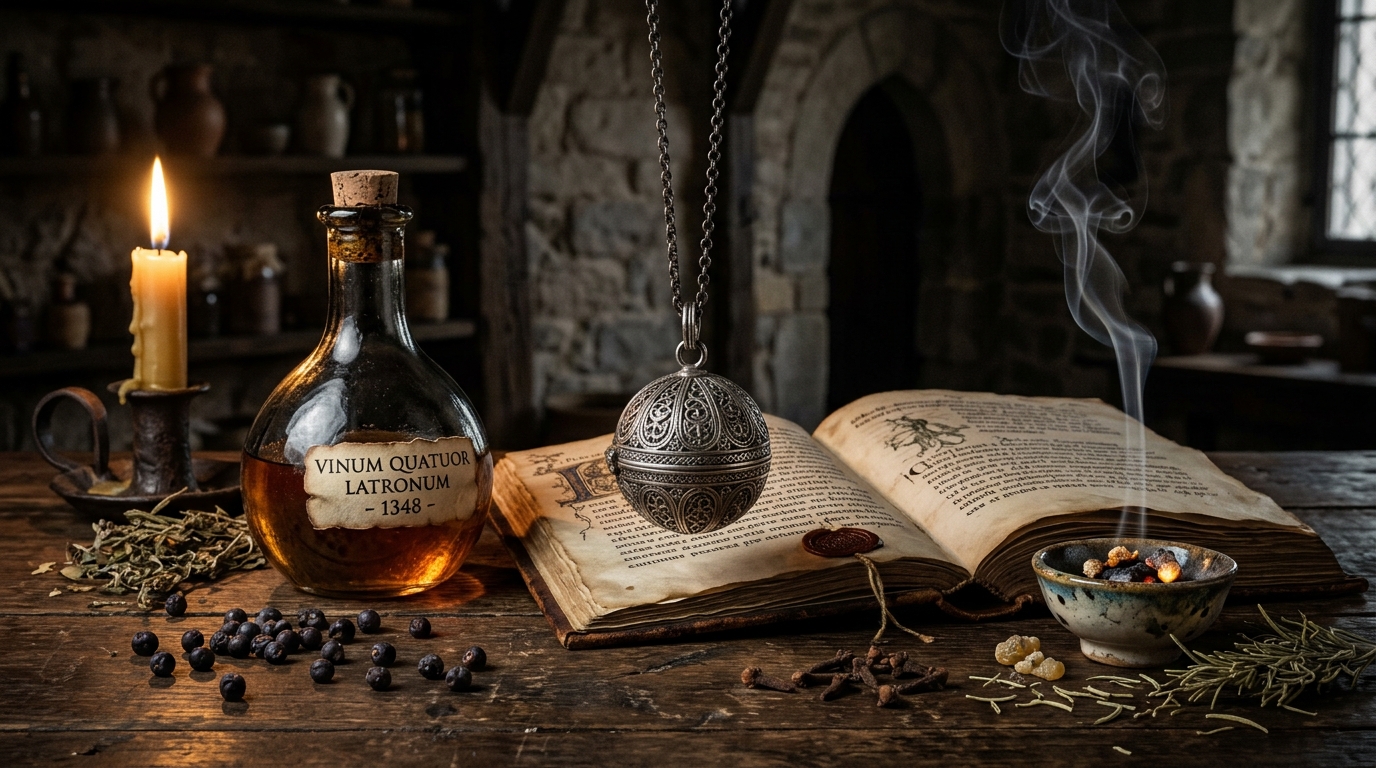
The pomander was an exquisite spherical or pear-shaped vessel fashioned from silver, vermeil, or gold, intricately pierced with openwork Gothic arabesques. Its mechanical genius lay in its segmental interior: turning a top finial caused the sphere to fall open into segmented hinged compartments resembling orange slices, each sealed with a sliding inner lid.
Each segment housed a specific aromatic resin, spice, or solid animal paste:
- Segment 1: Pure oceanic ambergris (Ambra grisea), a non-decaying fixative exuding a warm, salty-tobacco aura.
- Segment 2: Natural deer musk (Moschus moschiferus), whose macrocyclic muscone provided profound warmth and lingering power.
- Segment 3: Civet paste (Civettictis civetta), offering a feral animalic undertone that bound volatile oils.
- Segment 4: Crushed cloves from the Moluccas, loaded with antiseptic eugenol.
- Segment 5: Ceylon cinnamon and nutmeg bark.
- Segment 6: Storax, frankincense, and labdanum bound with distilled rosewater.
Suspended from golden neck-chains, girdles, or held in the hand, pomanders accompanied kings, prelates, and wealthy merchants everywhere. When approaching a crowd, entering an infirmary, or traversing an infected quarter, the wearer held the open pomander to the nostrils, inhaling deeply to create a personal olfactory perimeter that repelled airborne contagion.
The Legend of the Four Thieves Vinegar (Vinaigre des Quatre Voleurs)
For commoners who could never afford silver filigree or precious oriental musk, folk herbalism produced a legendary alternative: the Four Thieves Vinegar.
According to European folklore, during a devastating plague outbreak in southern France, four thieves entered infected homes, plundered gold and valuables from dying victims, and stripped corpses without ever succumbing to the pestilence. When finally apprehended, the magistrate offered them clemency from the gallows if they confessed their secret preservative.
The thieves revealed that they bathed their skin, hair, and clothing in an aged white-wine vinegar macerated with potent antimicrobial botanicals:
- Rosemary (Rosmarinus officinalis) and Sage (Salvia officinalis).
- Thyme (Thymus vulgaris), Peppermint, and Lavender.
- Wormwood (Artemisia absinthium) and Rue (Ruta graveolens).
- Crushed Garlic cloves and dissolved Camphor.
While medieval apothecaries understood this in humoral terms (cold and dry qualities counteracting putrid heat), modern biochemistry confirms the formula’s genius: the acetic acid of vinegar paired with terpene hydrocarbons (alpha-pinene, camphor, 1,8-cineol, thymol) acted as an effective topical contact sanitizer and a powerful natural insect repellent against plague fleas.
Urban Fumigation: The Bonfires of Juniper
At the civic level, city councils in London, Paris, and Florence ordered public bonfires ignited at street intersections. Watchmen fed the flames with dry juniper wood (Juniperus communis), pitch pine, rosemary branches, and Frankish resins. The thick, acrid, resinous smoke filled public squares, intentionally driving out stagnant air and burning away malignant vapors before they could settle into stone dwellings.
4. European Alchemy & The Separation of Aqua Vitae
While municipal authorities burned resins, European universities and monastic scriptoria were quietly executing the greatest technical paradigm shift in the history of fragrance. For nearly four millennia—spanning ancient Egypt, Minoan Crete, Classical Greece, and Rome—perfumery had been chained to lipid carriers: cold-pressed vegetable oils (such as omphakion olive oil, balanos, and almond) or animal fats (mutton tallow and lard).
These oily bases suffered from fatal sensory and chemical limitations:
- They turned rancid rapidly under heat, sunlight, and oxygen exposure.
- They left greasy residues on skin and permanently stained costly textiles.
- They possessed low volatility, creating heavy skin scents with minimal atmospheric projection (sillage).
The resolution came from the vibrant scholastic bridge between the Islamic world and southern European scholars at the Medical School of Salerno in southern Italy and the University of Montpellier in Occitania.
┌─────────────────────────────────────────────────────────────────────────┐
│               THE ALCHEMICAL LEAP: FROM OIL TO SPIRIT                   │
└────────────────────────────────────┬────────────────────────────────────┘
                                     │
           ANCIENT LIPID TRADITION             MEDIEVAL ALCHEMICAL REVOLUTION
        Maceration in olive/almond oil         Fractional condensation of wine
        (Heavy, perishable fatty base)        (Isolation of 90%+ ethyl alcohol)
                      │                                      │
                      ▼                                      ▼
               Oils & Unguents                      *Aqua Vitae* / Etanol
         - Oxidizes and turns rancid           - Antiseptic and non-decaying
         - Low vapor pressure/diffusion        - High volatility: projects scent
         - Stains silk and fine wool           - Clean, weightless evaporation
Arnaldo of Vilanova, Ramon Llull, and the “Water of Life”
Catalan physician Arnaldo of Vilanova (c. 1240–1311), personal doctor to popes and kings, alongside treatises associated with philosopher Ramon Llull, systematized the repeated fractional distillation of fermented grape wine in copper and glass alembic stills equipped with water-cooled serpentines.
By driving off vapors at controlled temperatures, they isolated pure ethyl alcohol exceeding 90% purity. Mesmerized by this clear, weightless, combustible liquid that preserved animal tissue indefinitely and tasted of pure fire, alchemists christened it with reverent names:
- Aqua Vitae: “Water of Life,” believed to stave off physical decay.
- Spiritus Vini: “Spirit of Wine,” the immaterial soul extracted from coarse matter.
- Aqua Ardens: “Burning Water,” due to its brilliant blue flame.
For perfumers, aqua vitae was a revelation. Unlike oil, alcohol instantly dissolved botanical essential oils, extracted resins with supreme efficiency, and evaporated weightlessly upon skin contact, projecting fragrant molecules into the atmosphere in a brilliant, diffusive cloud.
5. The Queen of Hungary’s Water (Aqua Reginae Hungariae, c. 1370)
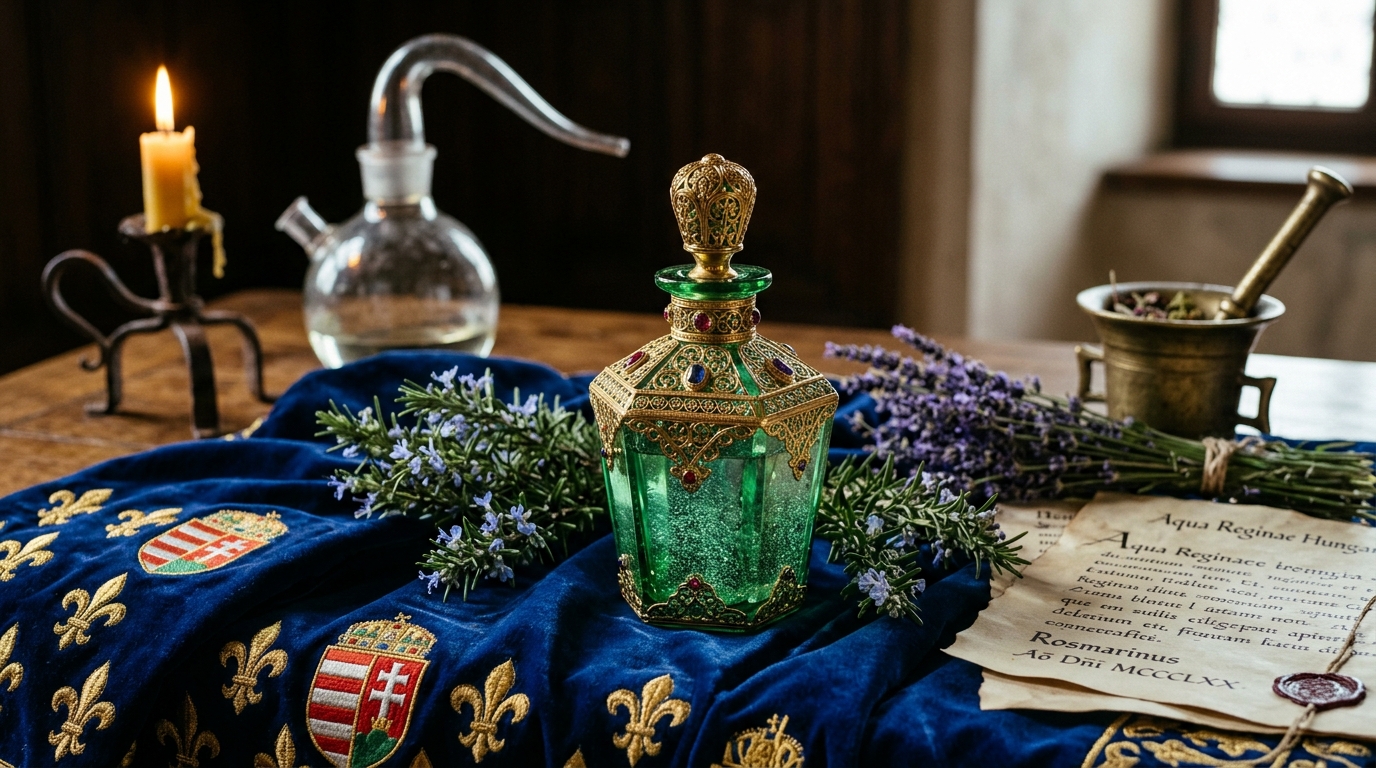
The crowning achievement of European alchemical perfumery was the formulation, around 1370, of the Queen of Hungary’s Water (Aqua Reginae Hungariae). Celebrated as the first recorded alcohol-based perfume in European history, it serves as the direct ancestor of 18th-century Eau de Cologne and modern fine fragrance.
The Royal Legend of Queen Elisabeth
Legend attributes the miraculous formula to a hermit alchemist who presented it to Queen Elisabeth of Poland (1305–1380), Queen Consort of Hungary and mother to King Louis I the Great. As the story circulated across European courts, the queen—approaching seventy years of age and severely crippled by gout and rheumatism—used the spirit both topically and internally.
Not only did her joint afflictions vanish, but her youthful beauty and radiant complexion returned with such astonishing vigor that the young King of Poland was smitten by her appearance and formally proposed marriage.
An imperial pharmacopeia recorded the queen’s purported declaration:
“I, Donna Elisabeth, Queen of Hungary, being seventy-two years old, sick and gouty, used for an entire year this recipe given to me by an anchorite hermit […] and it restored my strength and beauty so marvelously that all deemed me fair, and the King of Poland sought my hand in marriage…”
The Master Formulation
Stripped of romantic court folklore, Queen of Hungary’s Water represented a brilliant convergence of botanical chemistry and distillation technology:
- Key Botanical: Fresh flowering tops of Wild Rosemary (Rosmarinus officinalis), harvested in early spring when secretory peltate glands are laden with alpha-pinene, camphor, 1,8-cineol, and borneol.
- Herbal Accents: Flowering thyme (Thymus vulgaris), garden sage, and lavender blossoms.
- Solvent: Triple-distilled high-proof grape spirit (aqua vitae rectificata).
The fresh botanicals macerated in alcohol within a sealed glass cucurbit before gentle distillation in an alembic still. The distillate emerged crystal clear, bracing, camphoraceous, fresh, and profoundly uplifting.
Unlike the heavy, narcotic animal musks of Eastern caravans, Queen of Hungary’s Water offered an invigorating clarity that cleared the mind and refreshed tired limbs. Its fame was so enduring that it held absolute dominance over European courts for more than four centuries, until the advent of Jean Marie Farina’s Eau de Cologne in 1709.
6. Venetian Spice Routes & The Birth of the Perfumer-Glovers (Gantiers-Parfumeurs)
While monastic still-rooms distilled alpine herbs in central Europe, international maritime commerce flourished under the supremacy of the Italian seafaring republics, led by the Republic of Venice (La Serenissima).
Venice: The Golden Gate of the Levant
Through exclusive trade treaties with the Byzantine Empire and the Mamluk Sultanates of Egypt and Syria, Venetian merchant galleys controlled the sea terminals of the ancient Spice Route. In the bustling port of the Rialto, Venetian cargo ships unloaded vast stores of exotic treasures:
- Black pepper from the Malabar coast and Ceylon cinnamon.
- Cloves from the Moluccas and nutmeg from the Banda Islands.
- Sumatran camphor, Indian sandalwood, and Arabian frankincense.
- Authentic Himalayan deer musk, ambergris, and Siam benzoin.
Venetian apothecaries (spezieri) transformed these raw imports into world-renowned elixirs. Among them was Theriac (Theriaca Andromachi), a mythical universal antidote containing over sixty ingredients—including dried viper flesh, opium, cinnamon, and myrrh—compounded publicly in bronze cauldrons before government magistrates to guarantee absolute purity.
The Problem of Tanned Leather and the Scented Glove
As the late medieval merchant class accumulated wealth, fine leather gloves (crafted from kidskin, lamb, or deerskin) became the supreme symbol of aristocratic status. Yet medieval tanning was notoriously offensive. Leather hides were soaked in slaked lime, fermented human urine (for ammonia degreasing), canine feces, and bitter oak bark tannins.
The resulting leather emitted a sickening, putrid stench that lingered for months. Kissing the hand of an aristocratic patron wearing freshly tanned gloves could induce immediate nausea.
                      ┌────────────────────────────────────────┐
                      │    THE TANNED LEATHER CRISIS & THE     │
                      │     BIRTH OF THE SCENTED GLOVE         │
                      └──────────────────┬─────────────────────┘
                                         │
                    Medieval Tanning with Urine, Feces & Tannins
                                         │
                                         ▼
                            Nauseating, Putrid Leather Stench
                                         │
                      ┌──────────────────┴──────────────────┐
                      ▼                                     ▼
             VENETIAN MASTERY                      THE RISE OF GRASSE
          Prolonged soaking in baths              Intensive cultivation of jasmine,
         of rosewater, ambergris,                  roses, and orange blossom to feed
        musk, civet, and orris root.              local tanning manufactories.
                      │                                     │
                      └──────────────────┬──────────────────┘
                                         ▼
                     CORPORATION DES GANTIERS-PARFUMEURS
               Scented gloves become the ultimate emblem of royal
                 elegance, aristocratic seduction, and status.
To solve this olfactory crisis, master leatherworkers in Venice and Provence (most notably in the small tannery town of Grasse) developed an ingenious synergy: scented glove-making.
Gloves were cured for weeks in aromatic pastes containing civet, ambergris, musk, orange blossom water, and powdered Florentine orris root (Iris florentina), whose powdery violet scent possessed the unique ability to mask animalic odors. Scented gloves (guanti profumati) became the rage among European monarchs.
This commercial triumph led to the establishment of the prestigious Corporation des Maîtres Gantiers-Parfumeurs (later chartered by the French crown). Without the challenge of foul medieval tanneries, Grasse would never have transformed from a leather town into the undisputed perfume capital of the world.
7. Master Reference Matrix: The Medieval Olfactory Lexicon
The following reference matrix outlines the essential historical terms, chemical entities, and cultural artifacts that defined medieval European fragrance:
| Historical Term | Linguistic / Material Origin | Key Compounds & Chemical Profile | Olfactory Profile | Historical, Medical & Social Function |
|---|---|---|---|---|
| Pomander (Pomme d’ambre) | Old French (apple of amber) / Gold or silver filigree | Ambergris, deer musk, civet, cloves, cinnamon, storax | Warm, resinous, dark balsamic, animalic | Portable olfactory armor; protected kings and nobility from airborne plague miasmas. |
| Queen of Hungary’s Water | Medieval Latin / Hungarian court (c. 1370) | Distillate of rosemary tops (Rosmarinus officinalis) in wine spirit | Bracingly herbal, camphoraceous, pine-fresh | First documented alcohol-based European perfume; youth-restoring medicinal and toilet water. |
| Hortus Conclusus | Latin (enclosed garden) / Monastic tradition | Benedictine beds: sage, rue, rosemary, lavender, mint | Green aromatic, medicinal, camphoraceous, herbal | Monastic garden of simples; sanctuary of classical botanical knowledge and healing. |
| Miasma | Classical Greek (pollution, stain) | Galenic humoral theory; foul air from organic putrefaction | Rancid, cadaverous, suffocating, foul | Feared plague vector; spurred the abandonment of hot baths and the rise of dry cleansing. |
| Aqua Vitae (Spiritus Vini) | Medieval Latin (water of life) / Salerno & Montpellier | 90%+ ethyl alcohol obtained through fractional distillation | Volatile, neutral, sharp, instantly evaporating | Alchemical solvent that replaced fatty oils and founded modern fine perfumery. |
| Four Thieves Vinegar | French (Vinaigre des 4 Voleurs) | Wine vinegar infused with rosemary, sage, wormwood, lavender, camphor | Pungent acidic, intensely herbal, camphoraceous | Topical antiseptic and natural flea-repellent wash used by looters during epidemics. |
| Gantiers-Parfumeurs | French / Guilds of Venice and Grasse | Fine leather treated with ambergris, musk, neroli, and orris root | Sweet leather, powdery violet, animalic amber | Guild that masked the stench of tanned hides; laid the foundations of Grasse perfumery. |
| Theriac (Theriaca Andromachi) | Greek / Venetian medieval synthesis | Electuary of 60+ botanicals, opium, myrrh, cinnamon, dried viper | Bitter spicy, heavy balsamic, deeply resinous | Legendary universal antidote prepared publicly under strict civic supervision in Venice. |
| Ambergris (Ambra Grisea) | Old French / Arabic (Anbar) | Oxidized sperm whale secretion; rich in ambrein and ambrox | Salty-oceanic, warm tobacco, sun-warmed skin | Supreme fixative in luxury pomanders; symbolized incorruptible aristocratic refinement. |
| Rosewater (Eau de Rose) | French / Damascene & Persian heritage | Rosa damascena hydrosol; phenylethyl alcohol, geraniol | Clean floral, velvety, dewy, sweet | Used for dry hand-washing at royal banquets and disinfecting monastic infirmary wards. |
Conclusion: The Enduring Medieval Legacy in Modern Perfumery
The European Middle Ages was never the olfactory wasteland of popular myth. It was, in truth, the crucible where modern perfumery was forged. Without the quiet monastic cloisters that preserved the virtues of rosemary, lavender, and sage, and without the daring alchemists who isolated aqua vitae to liberate fragrance from greasy animal fats, the art of scent as we know it today could not exist.
Whenever we mist a fine fragrance and experience the clean, weightless evaporation of alcohol on warm skin, whenever we appreciate the crisp elegance of a rosemary-forward cologne, or whenever a modern niche perfume combines cuir accords with powdery Florentine iris and smoky resins, we are participating in an unbroken tradition. We are inhaling the living legacy of the Benedictine herbalists, the alchemical brilliance of Queen Elisabeth’s still-room, and the audacious craftsmanship of the medieval perfumer-glovers who defied the shadows of their world with the enduring beauty of scent.