For anyone stepping into a master perfumer’s atelier for the first time, no workstation evokes as much wonder, romance, and artistic reverence as the perfumer’s organ (l’orgue à parfum). With its tiered semi-circular amphitheater of dark wooden shelves laden with hundreds of glass apothecary bottles, precision pipettes, and leather-bound formula ledgers, it immediately calls to mind the majestic console of a grand cathedral pipe organ.
Yet the organ is neither a romantic antique prop nor a mere shelving unit: it is the externalized physical interface of the perfumer’s olfactory mind. It is where abstract ideas, poetic harmonies, and imaginary chords are systematically converted into precise, reproducible chemical formulas.
Whether you are aspiring to transition from passionate fragrance collector to hands-on amateur formulator, or seeking to understand the daily lab craftsmanship taught in the elite schools of Grasse and Versailles, this comprehensive guide lays out the complete blueprint: from spatial ergonomics and the foundational 100-material apprentice palette, to dilution chemistry, bottle preservation, and the rigorous protocol of analytical weighing.
1. The Altar of the Nose: From Literary Myth to Working Laboratory
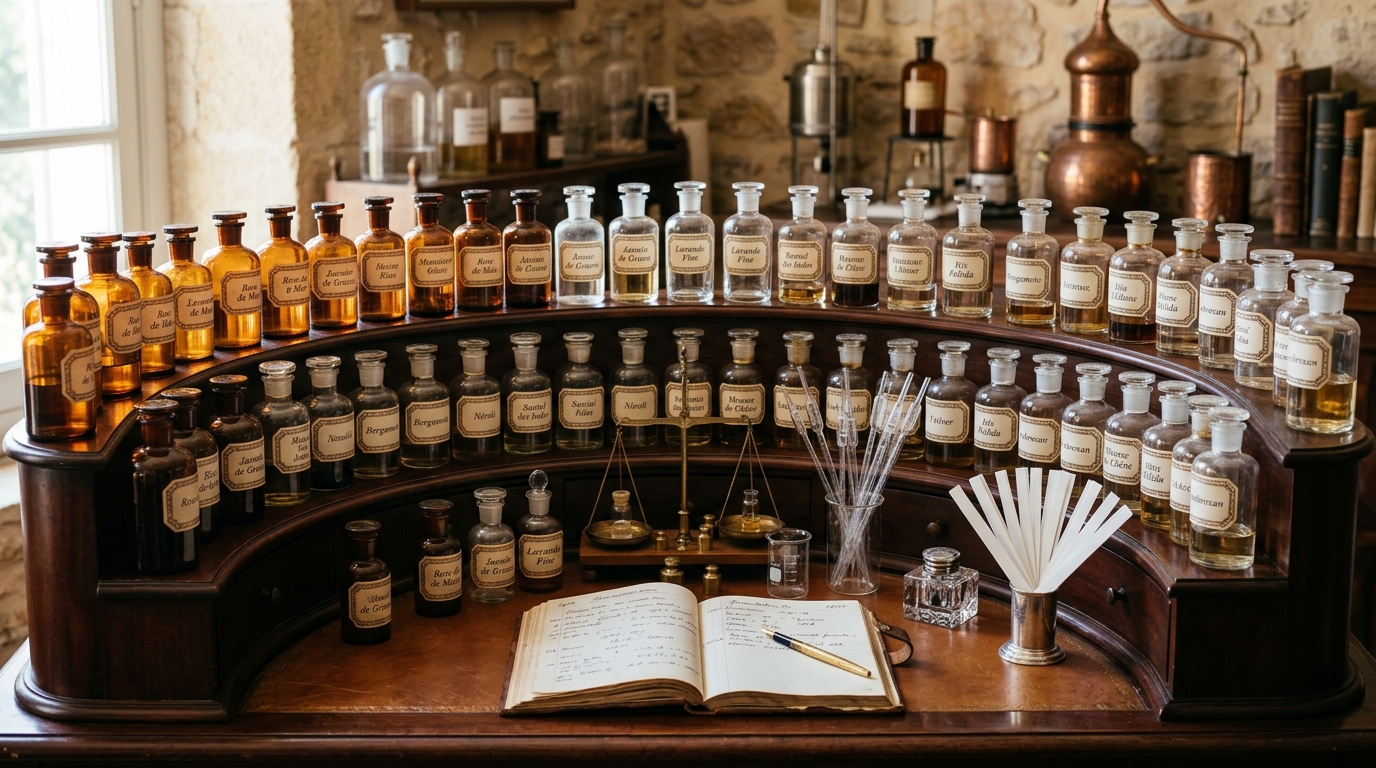
Curiously, the concept of the perfumer’s organ was not born inside a chemical plant or among the jasmine terraces of Provence. It originated on the pages of a seminal 19th-century French decadent novel: À rebours (Against Nature, 1884) by Joris-Karl Huysmans.
In the novel, the reclusive aesthetician Jean des Esseintes retreats from Parisian society to consecrate his life to pure sensory luxury. Among his eccentric inventions, he constructs a semi-circular console lined with vials of aromatic essences, which he plays like musical stops on an organ:
“Perfumery seemed to him one of the subtlest arts; it had its own harmonic keyboard where each essence answered to a musical note, allowing him to perform olfactory symphonies of astonishing nuance and complexity.”
This musical metaphor was rooted in an earlier theoretical treatise published in 1857 by the British chemist and perfumer G.W. Septimus Piesse (The Art of Perfumery). Piesse introduced an olfactory gamut—an odophone—mapping heavy base materials like civet and patchouli to low bass octaves on a musical scale, while airy, volatile notes like peppermint and bergamot occupied the high treble register.
Inspired by Huysmans and Piesse, master cabinetmakers across Grasse and Paris began handcrafting stepped mahogany and oak desks for perfume houses. What started as poetic literature quickly hardened into the indispensable physical instrument of the profession.
2. Organ Ergonomics: How to Architect Your Workspace
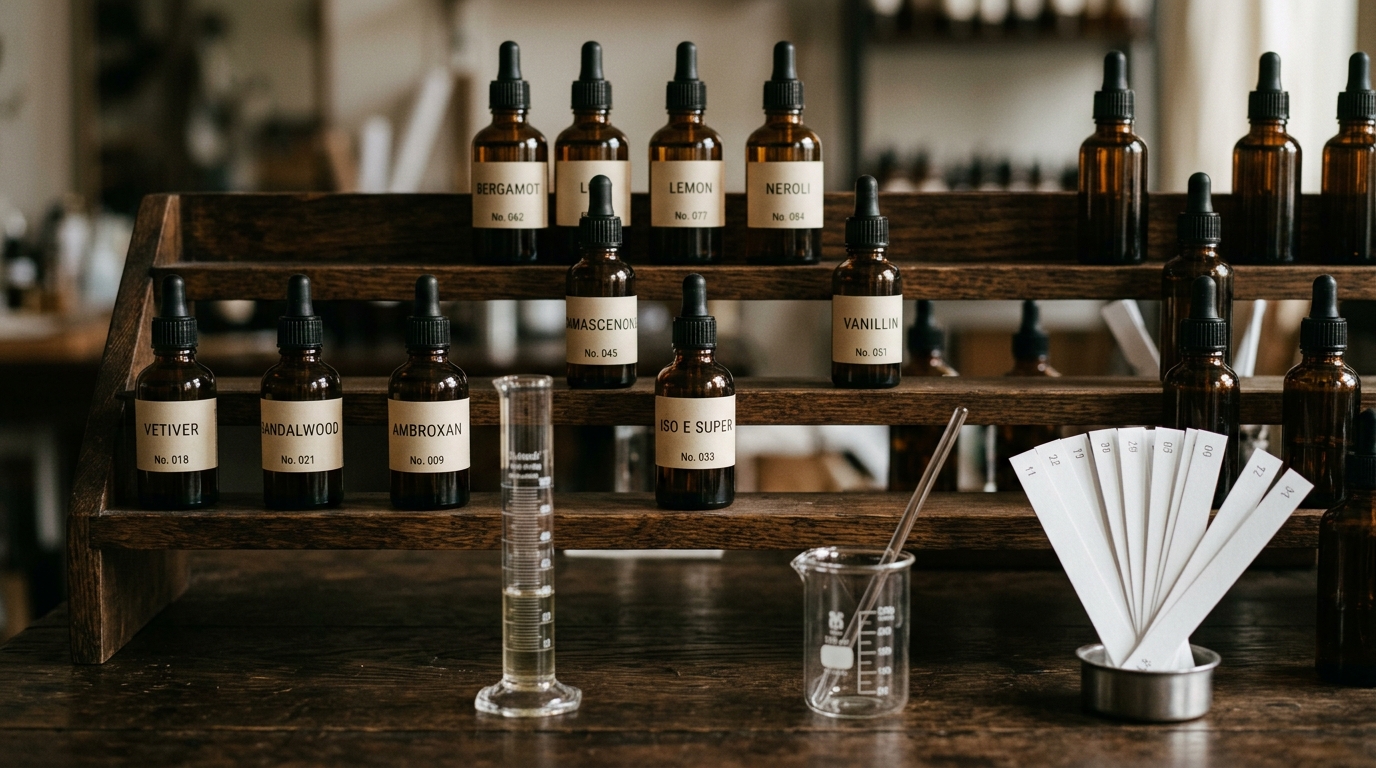
A disorganized organ paralyzes creative workflow. When an intricate formula requires dosing thirty materials within a narrow compounding window, eyes and fingers must locate every single bottle by sheer muscle memory.
Over the 20th century, two foundational organizational philosophies emerged:
1. The Vertical Paradigm: Evaporation Volatility (The Jean Carles Method)
Developed in the 1940s by Jean Carles—founder of the Roure Perfumery School (now Givaudan) and creator of legendary masterpieces like Miss Dior and Ma Griffe—this method arranges shelves vertically according to the molecular evaporation rate of the materials:
graph TD
    subgraph Upper_Tier["Upper Tier: Top Notes (High Volatility)"]
        A["Sparkling Citrus (Bergamot, Lemon, Grapefruit)"]
        B["Herbal & Fresh Aromatics (Lavender, Mint, Cis-3-Hexenol)"]
        C["Aliphatic Aldehydes (C-10, C-11, C-12)"]
    end

    subgraph Middle_Tier["Middle Tier: Heart Notes (Moderate Volatility)"]
        D["Florals (Rose, Jasmine, Geranium, Linalool, Hedione)"]
        E["Warm Spices (Cardamom, Cinnamon, Nutmeg)"]
        F["Fruity Synthetics & Lactones"]
    end

    subgraph Lower_Tier["Lower Tier & Bench: Base Notes (Low Volatility)"]
        G["Heavy Woods (Cedar, Vetiver, Sandalwood, Iso E Super)"]
        H["Resins & Balsams (Frankincense, Myrrh, Benzoin, Vanillin)"]
        I["Ambery Molecules & Musks (Ambroxan, Galaxolide, Habanolide)"]
end- Top Tier (Top Notes): Lightweight molecules with high vapor pressure ($<2$ hours tenacity on a smelling strip). Citrus, fresh greens, aliphatic aldehydes, and cooling herbs.
- Middle Tier (Heart Notes): The architectural core of the perfume ($2$ to $8$ hours). Florals, mid-weight spices, fruity lactones, and soft aromatics.
- Lower Tier / Bench Surface (Base Notes): Heavy, dense molecules with low vapor pressure ($8$ hours to several weeks). Dry woods, balsams, resins, crystalline gourmands, and macrocyclic musks.
2. The Horizontal Paradigm: Olfactory Family Sectors
From left to right across the semi-circle, bottles are clustered by chemical and descriptive affinity:
- Sector 1 (Far Left): Citrus and herbal aromatics (bergamot, mandarin, petitgrain, rosemary).
- Sector 2: Fresh florals and aldehydes (rose, muguet, lily, PEA, linalool).
- Sector 3: Narcotic florals and warm spices (jasmine, tuberose, ylang-ylang, clove, pink pepper).
- Sector 4: Dry woods and earthy roots (cedar, vetiver, patchouli, cypriol).
- Sector 5 (Far Right): Balsams, ambers, gourmands, and musks (vanilla, tonka, habanolide, ambroxan).
Active Palette vs. Library Storage
In modern compounding studios, perfumers do not keep all 3,000 raw materials on their desktop. They work with an active palette of 150 to 300 core bottles positioned within immediate arm’s reach. The secondary library resides in dark, climate-controlled, or refrigerated storage rooms.
3. The Curated Apprentice Palette: The Core 100 Raw Materials
Building a personal perfumery organ does not require thousands of bottles. Master perfumer Jean-Claude Ellena famously composed minimalist masterpieces using a tightly curated palette of approximately two hundred materials. For an apprentice or serious formulator, a 100-material palette split evenly between natural extracts and foundational aroma chemicals represents the perfect creative foundation:
The 50 Essential Naturals (Essential Oils, Absolutes & Resins)
- Citrus: Bergamot FCF (bergapten-free), Sicilian Lemon, Sweet Orange, Red Mandarin, Pink Grapefruit, Petitgrain Paraguay.
- Aromatics & Greens: French Lavender Maillette, Lavandin Grosso, Clary Sage, Rosemary cineole, Peppermint, Galbanum resinoid.
- Noble Florals: Rose Damascena Absolute, Rose Centifolia Absolute, Jasmine Sambac Absolute, Jasmine Grandiflorum Absolute, Ylang-Ylang Extra, Tunisian Neroli, Orange Blossom Absolute, Bourbon Geranium.
- Spices: Madagascar Black Pepper, Pink Peppercorn (CO2), Guatemalan Cardamom, Ceylon Cinnamon Bark, Nutmeg, Clove Bud.
- Woods, Roots & Mosses: Virginian Cedarwood, Atlas Cedarwood, Haitian Vetiver, Javanese Vetiver, Patchouli Heart (fractionated/decolored), New Caledonian Sandalwood, Guaiacwood, Cypriol (Nagarmotha).
- Balsams, Resins & Gourmand: Omani Frankincense (Boswellia carterii), Somalian Myrrh, Benzoin Siam, Labdanum Absolute, Tolu Balsam, Tonka Bean Absolute, Madagascar Vanilla Absolute.
The 50 Foundational Synthetics & Isolates
- Super-Diffusers & Volume Architects: Hedione (methyl dihydrojasmonate, adds radiance and space), Iso E Super (velvety cedar aura and transparent sillage), Ambroxan (radiant modern ambergris), Cashmeran (warm woody-musky cashmere), Timbersilk.
- Musk Complex (Macro & Polycyclic): Galaxolide (clean, white-shirt musk), Habanolide (metallic, waxy, diffusive), Ethylene Brassylate (sweet, powdery, floral musk), Helvetolide (modern, pear-tinged musk), Ambrettolide (rich, botanical musk).
- Floral Sculptors & Building Blocks: Phenethyl Alcohol (PEA, fresh rosewater heart), Geraniol, Citronellol, Synthetic Linalool, Linalyl Acetate, Benzyl Acetate (jasmine sparkle), Florol, Mayol, Hydroxycitronellal, Benzyl Salicylate, Damascenone (rose jam nuance), Rose Oxide.
- Greens, Aquatics & Fruit Notes: Cis-3-Hexenol (hyper-realistic cut grass), Triplal (sharp green leaf), Helional (fresh air and hay), Calone 1951 (marine ozone and watermelon rind), Melonal, Gamma-Undecalactone (peach skin), Manzanate.
- Aliphatic Aldehydes: Aldehyde C-10 (waxy citrus zest), Aldehyde C-11 Oceanic (crisp laundry sparkle), Aldehyde C-12 MNA (frosty, metallic winter air).
- Dry Woods, Gourmands & Leathers: Coumarin crystals (sweet hay and tonka), Ethyl Vanillin (warm vanilla x4), Ethyl Maltol (caramelized sugar / cotton candy), Norlimbanol (atomic dry timber), Evernyl / Veramoss (clean oakmoss substitute), Safraleine (leathery saffron), Isobutyl Quinoline (IBQ, bitter tanned leather).
4. The Science of Dilutions & Solvent Chemistry
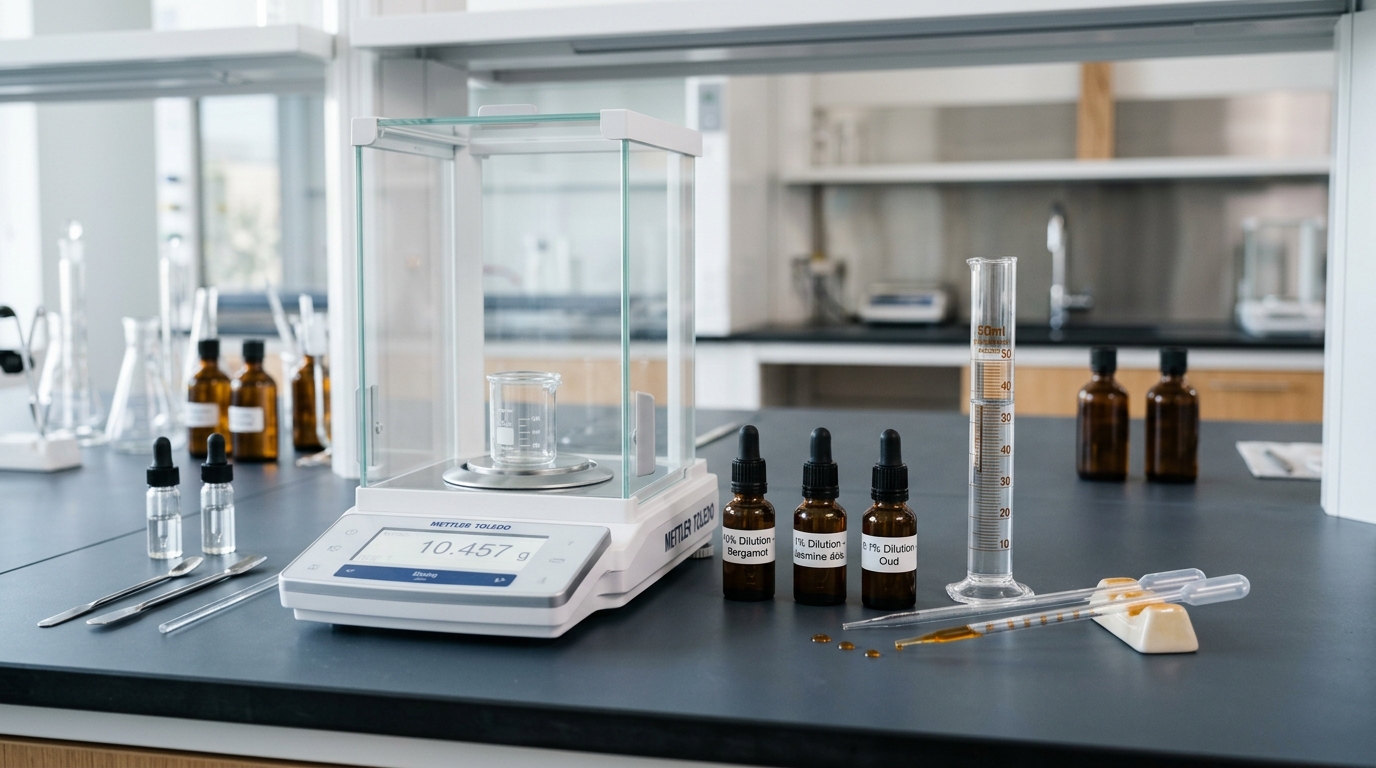
The cardinal mistake of beginning formulators is attempting to compose with pure, undiluted (neat) materials. Working neat saturates the olfactory receptors within minutes, skews balance, and rapidly exhausts expensive absolutes.
Why Perfumers Formulate in Dilution
- Preventing Olfactory Fatigue (Anosmia): Pure extracts overload sensory cilia. Evaluating materials at 10% concentration allows for hours of continuous compounding without sensory burnout.
- Taming Super-Impact Molecules: Molecules like damascenone, pyrazines, and birch tar smell foul, suffocating, or abrasive at 100%. Only when diluted to 1% or 0.1% do they reveal their mouthwatering, delicate nuances.
- Accurate Evaporation Modeling: An aroma dissolved in alcohol mimics the exact surface tension, capillary action, and evaporation rate that a finished perfume exhibits on human skin.
Solvents Compared
| Solvent | Chemical Profile | Evaporation & Texture | Optimal Studio Role |
|---|---|---|---|
| Denatured Alcohol (96% / 190 Proof) | Ethanol with trace bitrex/t-butanol | Ultra-fast flash-off; zero oiliness | The Gold Standard. Mandatory for testing on smelling strips and trial sprays. |
| Dipropylene Glycol (DPG) | Odorless, hydrophilic glycol | Moderate viscosity; non-volatile | Ideal for heavy musks, incense bases, and non-alcoholic oil perfumes. |
| Triethyl Citrate (TEC) | Eco-friendly biodegradable ester | Fluid, odorless, low toxicity | Superior solvent for stubborn resinoids, balsams, and natural certified formulas. |
| Isopropyl Myristate (IPM) | Lightweight fatty acid ester | Dry, silky, oil-like skin feel | Perfect for roll-on perfume oils and body mist formulations. |
The Three Standard Working Tiers
- 10% (The Standard Workhorse Tier): 80% of your active organ bottles should be prepared at 10% in perfumer’s alcohol (1g neat material + 9g alcohol).
- 1% (High-Impact Modifiers): Aliphatic aldehydes, birch tar, geosmin, civet synthetics, indole, and rose oxide.
- 0.1% (Trace Super-Molecules): Damascenone, pyrazines (roasted hazelnut/coffee), sulfur isolates (cassis), and buchu.
5. Storage Chemistry, Packaging & Preservation Science
The raw materials sitting on your organ are dynamic organic chemicals subject to degradation if improperly handled.
The Fatal Trap of Rubber Droppers
Many beginners buy amber bottles with built-in rubber dropper pipettes and leave them permanently installed on their organ. This destroys your collection:
- Alcohol and essential oil vapors dissolve the synthetic rubber polymers in the bulb.
- Plasticizers and sulfur compounds leach down into the oil, permanently contaminating the fragrance profile.
- Alcohol evaporates microscopically through the porous rubber; within six months, a 10% dilution will silently reconcentrate to 30%, invalidating every formula you blend.
- The Professional Standard: Store all materials in glass bottles sealed with Polycone (phenolic cone-lined) caps. Use separate disposable glass transfer pipettes for compounding.
The Four Environmental Enemies
- Ultraviolet Light (Photolysis): Cleaves chemical double bonds and oxidizes delicate aromatics. Amber glass is far superior to cobalt blue or green, filtering out over 90% of harmful UV and visible wavelengths between 300 and 500 nm.
- Oxygen (Autoxidation): Citrus monoterpenes (limonene, pinene) react with air to form skin-sensitizing hydroperoxides that destroy freshness. Purge headspaces in half-empty bottles with inert argon or nitrogen gas spray.
- Heat (Thermal Degradation & Ester Hydrolysis): Accelerates the decomposition of delicate esters like linalyl acetate. Store citrus oils and pine extracts in a dedicated mini-fridge at 10–12°C.
- Humidity: Promotes hydrolytic rancidity and clouds alcohol solutions.
Beware of Schiff Bases
When an aldehyde encounters a primary amine (for instance, Methyl Anthranilate from orange blossom reacting with Hydroxycitronellal or citral), a spontaneous condensation reaction occurs, producing water and a Schiff Base (such as Aurantiol). The mixture rapidly deepens into a vivid yellow, orange, or deep red hue while thickening in viscosity. This is not spoilage—it is classic organic chemistry that must be documented in your formulation ledger.
6. Studio Tooling & The Daily Compounding Protocol
The Golden Rule: Everything by Weight, Never by Drops
In amateur perfumery recipes, one often reads “add 3 drops of bergamot and 2 drops of vetiver.” In professional perfumery, drops are strictly forbidden:
- Surface tension and liquid density vary enormously: a drop of ethanol weighs approximately 0.015g, whereas a viscous drop of vetiver, labdanum, or benzoin can weigh over 0.045g—three times as much!
- Drop size fluctuates wildly based on room temperature, pipette bore diameter, and delivery angle.
- Mandatory Tool: A digital precision milligram scale with 0.001g resolution and a glass draft shield.
The Scent Strip (Mouillette) Tasting Protocol
To train your nose and record the true behavior of materials:
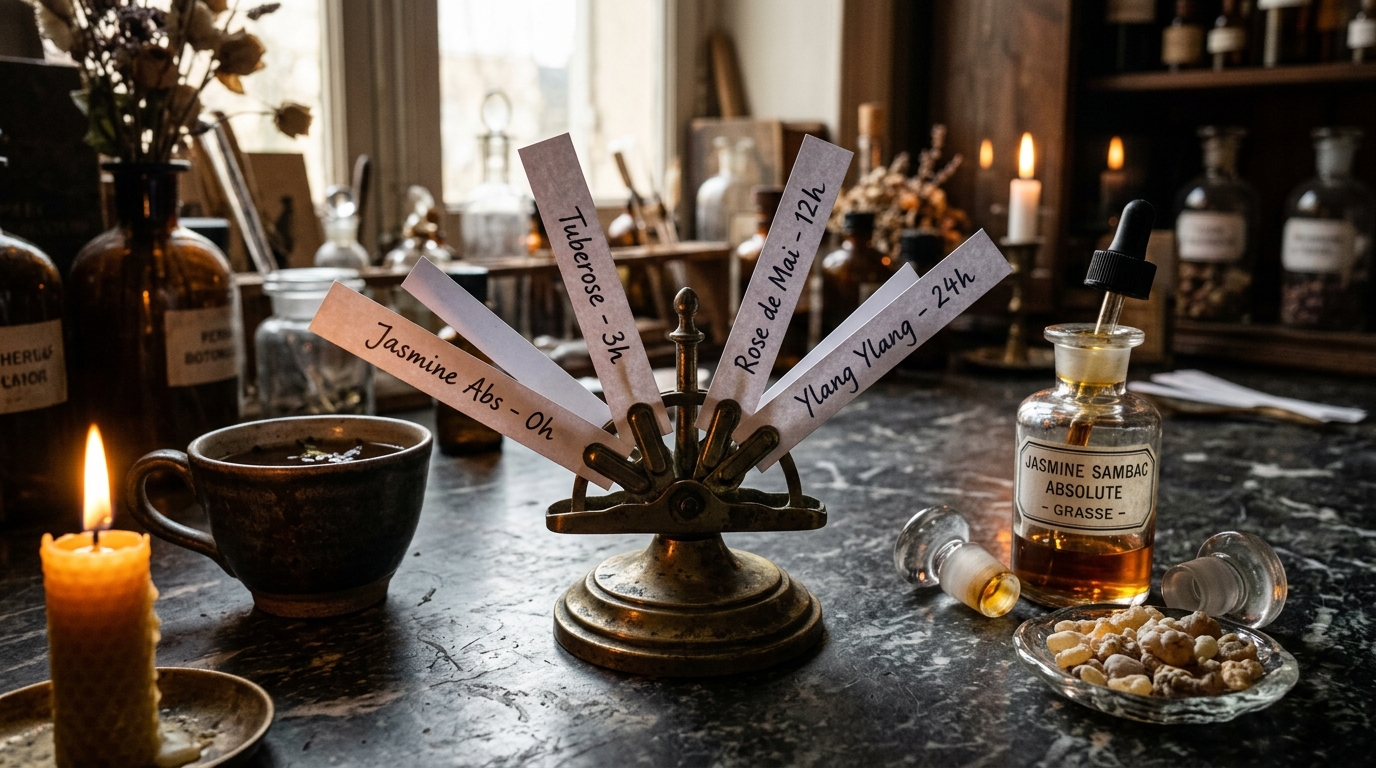
- Preparation: Fold a 14 cm neutral blotter strip (mouillette) lengthwise down the center to give it rigidity and prevent the wet tip from touching the bench surface when laid flat.
- Dipping: Immerse exactly 1 cm of the tapered tip into your 10% dilution.
- Labeling: Write the material name, dilution percentage (%), and exact timestamp on the dry end using a pencil (ink can bleed and add solvent odors).
- Checkpoints:
- 0 minutes: Initial impact and flash-off of solvent fumes.
- 15 minutes: Pure top note character free of alcohol interference.
- 1 hour: Transition into the heart accord.
- 4 hours: Structural body in full projection.
- 12 hours: Emergence of the deep drydown.
- 24 to 48 hours: Objective assessment of tenacity and baseline substantivity.
7. The Apprentice Reference Matrix: Core Blending Guide
To streamline your organ layout, use this quick reference matrix for core starter materials:
| Raw Material | Olfactory Family | Volatility Tier | Working Dilution | Primary Role & Blending Behavior |
|---|---|---|---|---|
| Bergamot FCF | Citrus | Top | 10% | Sparkling sunny opening; harmonizes seamlessly with all floral hearts. |
| Cis-3-Hexenol | Green | Top | 1% or 10% | Hyper-realistic freshly mown grass; use with extreme restraint. |
| Aldehyde C-11 | Aldehydic | Top | 1% | Clean soapy flash, frosty sparkle, and vintage haute-couture lift. |
| Hedione | Transparent Floral | Heart | 10% | “The wind of perfumery”; adds diffusion, space, and dewiness without sweetness. |
| PEA (Phenethyl Alcohol) | Floral | Heart | 10% | Pure fresh rosewater petals with soft honey facets; irreplaceable floral core. |
| Linalool | Floral / Woody | Top/Heart | 10% | Universal bridge linking citrus openings to floral bouquets; crisp and clean. |
| Iso E Super | Woody | Heart/Base | 10% | Velvety transparent cedarwood; expands projection and smooths harsh edges. |
| Virginian Cedarwood | Woody | Base | 10% | Sharp pencil-shaving dryness; clean architectural spine for woods. |
| Fractionated Patchouli | Earthy / Woody | Base | 10% | Warm dark earthy depth without dirty or camphoraceous top notes. |
| Ambroxan | Ambery | Base | 10% | Luminous mineral dryness, phenomenal fixation, and sensual ambery radiance. |
| Galaxolide | Musk | Base | 10% | Pristine freshly ironed white shirt; softens rough accords and adds volume. |
| Coumarin | Balsamic | Base | 10% | Sweet hay, warm tobacco, and almond; the historical cornerstone of the fougère. |
8. Conclusion: From the Organ to Critical Connoisseurship
Understanding the inner workings of the perfumer’s organ fundamentally elevates how you experience fragrance as a collector and critic. The next time you test a complex perfume on your wrist, you will no longer perceive an impenetrable cloud of scent. Instead, your mind will visualize the tiers of the organ: the bright flash of high-volatility molecules tumbling down from the top shelf, yielding to the floral architecture of the middle tier, before sinking into the enduring embrace of heavy woods and musks below.
Whether you set up your own compounding studio with a milligram scale and fifty amber bottles, or simply cultivate a deeper appreciation for the art, the perfumer’s organ stands as proof that olfactory poetry achieves its greatest heights only when anchored in the disciplined rigor of science.
- To continue building your olfactory vocabulary, explore our comprehensive Perfume Notes Directory and dive into our guide on Olfactory Families.
- Curious about how perfume concentrate ratios translate into projection and sillage? Read our definitive guide on Concentration Myths: EDT vs. EDP vs. Extrait.