Sources checked: 12 October 2026.
You buy a new bottle of your usual perfume. The opening seems brighter, the base less dark, and when you turn the box over, you find a longer ingredient list. A familiar explanation soon follows: “They reformulated it because of IFRA.”
That is possible. But the phrase brings together several different things: industry standards, legal obligations, labelling changes and formulation decisions. A different box does not, on its own, prove that the liquid has changed.
To understand what happens inside the bottle, it helps to separate three questions: what can be used, in what quantity, and what must be disclosed to the consumer. From there, the acronyms begin to make sense.
1. What IFRA is and its role in perfumery
The International Fragrance Association, known as IFRA, represents the fragrance industry and maintains a system of standards for ingredient use. Its Code of Practice requires members to comply with the code and applicable legislation. It is an international framework for industry self-regulation; the law in each market retains its own authority. Source: IFRA Code of Practice.
IFRA standards can prohibit a use, restrict a concentration or set specifications, such as purity requirements. “Regulated by IFRA” therefore does not automatically mean “removed from every perfume”. You need to check the specific standard and how it applies. Source: update to IFRA’s safe use programme.
Think of the perfumer’s organ as a palette of colours. A restriction may require the perfumer to use less of a raw material, rebuild part of an accord or choose a different combination. The creative challenge is to preserve the perfume’s identity within those conditions.
2. IFRA, European legislation and labels: three different levels
In Spain, perfume intended to scent the body falls within the European framework for cosmetic products. Regulation (EC) No 1223/2009 sets out obligations concerning safety, the responsible person, manufacturing, documentation and labelling. Source: European Cosmetics Regulation.
The practical distinction is as follows:
| Level | Question it helps answer | Reference document |
|---|---|---|
| IFRA standards | What conditions of use apply to this ingredient or mixture? | Applicable IFRA standard and documentation |
| Cosmetics legislation | What does the market where the product is sold require? | European regulation and its amendments |
| Labelling | What information must appear on the packaging? | Legal requirements for consumer information |
These levels complement one another. An IFRA declaration of conformity is not enough to demonstrate that a perfume meets every obligation for being placed on the market.
3. What an IFRA certificate confirms
The certificate of conformity is prepared by the supplier that formulates the fragrance mixture. IFRA does not issue certificates or authorise organisations to certify on its behalf. The document declares conformity for specified uses; it does not replace a safety assessment. Source: official questions about IFRA certificates.
When reviewing it, you need to identify the mixture, the document version, the uses covered and their maximum concentrations. A figure without context can mislead: using a fragrance in a body product requires consideration of its specific application.
For a small brand, a useful question for the supplier would be: “Does this documentation cover the exact mixture I intend to use and the product I want to make?” Downloading a certificate for a similar scent does not answer that question.
4. The dose is calculated in the finished product
Fine fragrance falls within category 4 of the IFRA guidance. Limits must be interpreted for the relevant use and in the finished product, also taking into account contributions of restricted substances from other raw materials. Source: guidance for the use of IFRA Standards.
Consider a hypothetical example, using percentages by mass:
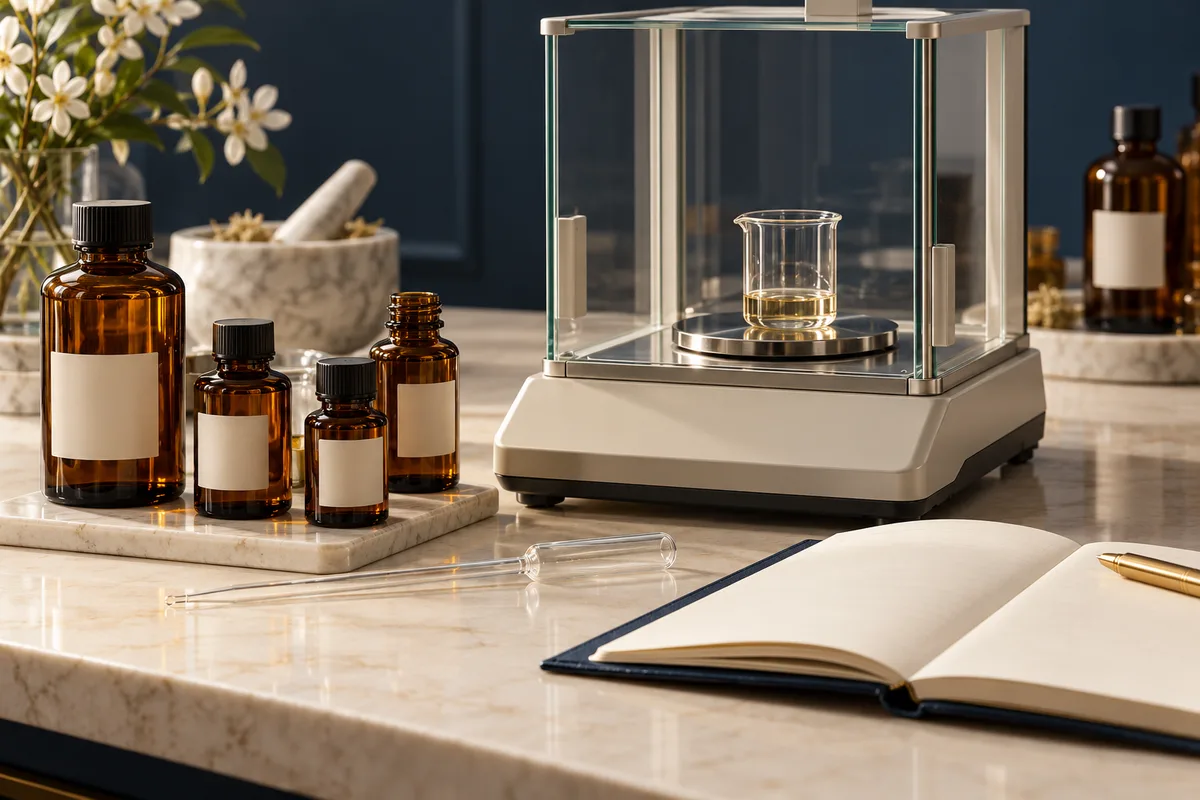
- You prepare 100 grams of perfume containing 20% fragrance concentrate.
- One raw material makes up 2% of that concentrate.
- Its concentration in the finished perfume is
0.20 × 0.02 = 0.004, equivalent to 0.4%.
If the applicable limit were 0.3%, that formula would exceed it. The 0.3% figure is invented to explain the calculation, not a limit attributed to a real ingredient.
The mathematical consequence matters: increasing the concentrate from 20% to 30% also increases the dose of its components. Turning a formula into an extrait requires reviewing those quantities.
5. Natural and synthetic: origin does not settle safety
An essential oil is a mixture of substances. IFRA points out that its components may be subject to restrictions and that their contributions to the formula must be considered. The absence of a specific standard does not amount to general safety approval, either. Source: IFRA clarifications on raw materials and components.
This changes how we look at a palette. “Oil from a plant” describes an origin; “synthetic substance” describes a method of production. Neither expression, by itself, tells us the appropriate dose, the full composition or the conditions of use.
When we discuss perfumery ingredients, the aim is precisely to understand what each material contributes: its smell, its function and its limitations. Sensory richness and technical rigour can coexist in the same formula.
6. Why more allergens appear on perfume boxes
Regulation (EU) 2023/1545 extends individual labelling to 56 additional fragrance allergens and updates other entries. For the substances covered, disclosure is required when the concentration exceeds 0.001% in leave-on products or 0.01% in rinse-off products. Source: European Commission, fragrance allergens labelling.
A perfume applied to the skin is an example of a leave-on product. A concentration of 0.001% is equivalent to 10 parts per million: a small amount that can trigger an information requirement.
Two things need to be distinguished: a disclosure threshold tells you when a name must appear; a use limit tells you how much may be used. Reading one as though it were the other would lead to mistaken conclusions.
The Commission clarifies that an ingredient appearing on the list does not mean the product is unsafe. Labelling particularly helps people who are sensitised identify substances they need to avoid. Source: European Commission.
A longer list may therefore reflect more detailed disclosure. On its own, it cannot reveal the formula or prove that a perfume has been reformulated.
7. The 2026 and 2028 dates: what they actually mean
As of this review, the first deadline has already passed. The Commission summarises the transition as follows: products that do not meet the new labelling requirements can no longer be placed on the EU market from 31 July 2026. Those placed on the market before that date can continue to be made available until 31 July 2028, subject to the regulation’s conditions. Source: European Commission timetable.
The key is the difference between placing a product on the market for the first time and continuing to supply stock already on the market. The transition is conditional; it does not authorise the manufacture of any product with an old label until 2028. Source: transitional provisions of Regulation (EU) 2023/1545.
For perfume enthusiasts, this explains why packaging with different ingredient lists may coexist for a time. That coexistence is not enough to determine which bottle contains an earlier formula, either.
8. An example of a legal ban: Lilial
Lilial, identified on labels as Butylphenyl Methylpropional, has been banned in cosmetics in the European Union since 1 March 2022, in connection with its classification as toxic to reproduction. It is an example of a legal prohibition that should not be confused with a simple requirement to declare an allergen. Source: Polish public health authority.
The lesson for anyone learning to formulate is clear: a raw material mentioned in an old book or a historical formula needs to be checked against current requirements before being included in a project.
9. What a brand needs beyond a good formula
Within the European framework, placing a product on the market requires, among other obligations, a responsible person, a safety assessment and report, a product information file and compliance with good manufacturing practice. The labelling must correspond to the actual product. Source: Regulation (EC) No 1223/2009, Articles 4, 8, 10, 11 and 19.
There is also a requirement for prior notification through the CPNP, the European Cosmetic Products Notification Portal. This is a notification system; it should not be presented to consumers as a seal of approval for the perfume from the European Commission. Source: official description of the CPNP.
For a workshop, this means traceability: knowing what has been weighed, which supplier it came from, which version of the formula is being manufactured and what documentation accompanies it. The perfumer’s notebook thus connects creation with responsibility for the product.
10. How to discuss reformulations thoughtfully
If two bottles smell different to you, begin by describing the difference: a more citrusy opening, a less floral heart, a drier base. Then separate the observation from the explanation.
“This batch smells less mossy to me” is an observation. “The brand removed an ingredient because of a particular standard” is a claim that needs evidence. A statement from the manufacturer or verifiable documentation provides more than attributing every change to IFRA.
For a comparison, use similar quantities and conditions, record your evaluation times and repeat the test. If you also have information about a regulatory change, check that it applies to the substance, use and period you are investigating.
Understanding these rules adds another dimension to enjoying perfume. Behind a bergamot opening or a velvety base lie decisions about balance, dosage, information and preserving an olfactory identity. Knowing about them helps you read the box more carefully and ask better questions about the liquid.
To continue exploring the creative side, visit the guide to the perfumer’s organ and the fragrance pyramid.