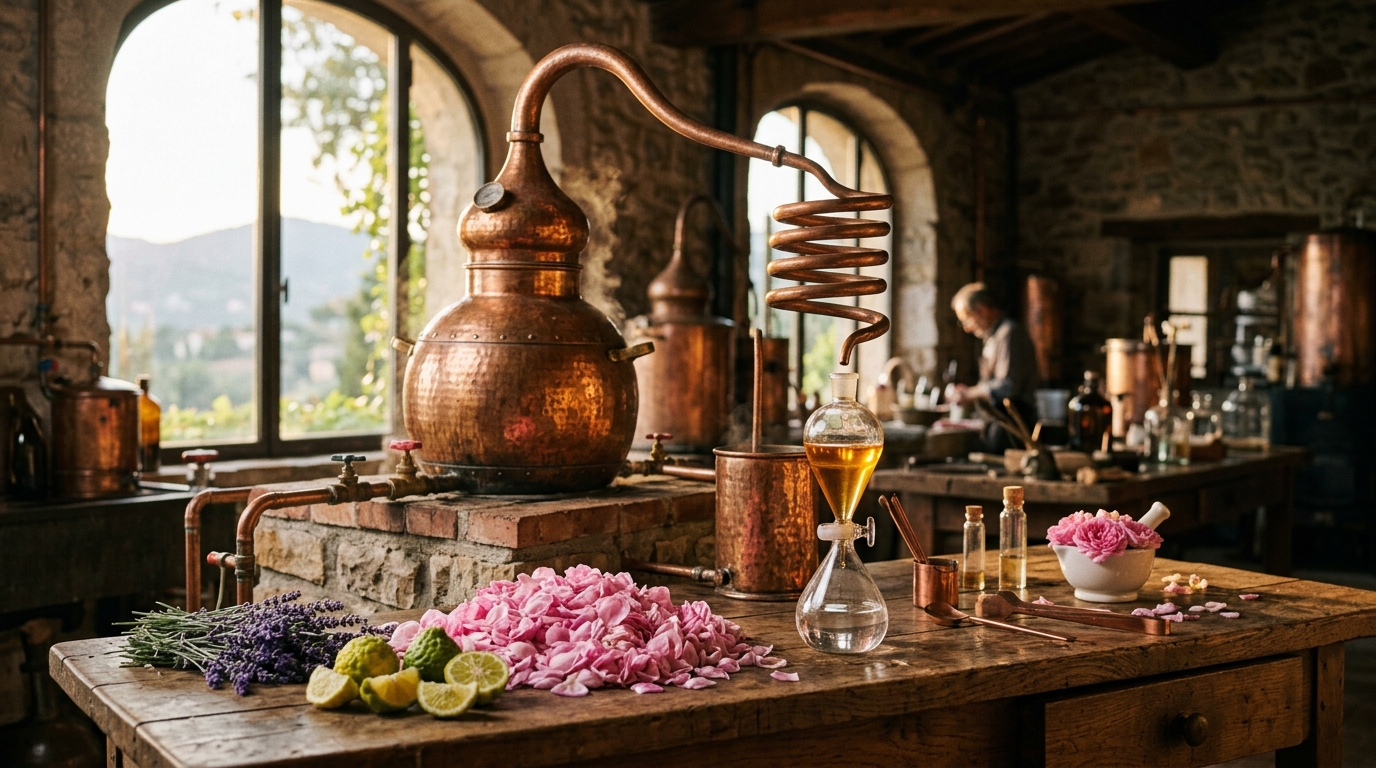
To anyone holding a finished bottle of haute parfumerie, fragrance appears as an ethereal, weightless spirit suspended in crystal-clear alcohol. Yet behind every drop of precious botanical extract lies one of the most sophisticated battlegrounds in applied chemistry, thermodynamic physics, and agricultural discipline: the extraction of aromatic raw materials.
The plant kingdom does not manufacture scent for human pleasure. Flora synthesizes volatile organic compounds (VOCs) as secondary metabolites designed for evolutionary survival: attracting specialized pollinators, deterring predatory herbivores, or protecting tender tissues against fungal and bacterial pathogens. Guarded within glandular trichomes, microscopic secretory cavities, or deep resiniferous canals, these fragrant molecules are intensely elusive.
Extracting them without altering or destroying their fragile chemical architecture is a monumental undertaking. In industrial and artisanal perfumery, no extraction technique is chemically inert: every method acts like an optical lens with its own chromatic aberration, capturing certain chemical families with supreme fidelity while stripping others away, decomposing delicate functional groups through thermal stress, or leaving heavy, insoluble fractions behind.
In this authoritative masterclass, we explore the six foundational families of natural extraction—from the historical copper alembics of Persia and Provence and the painstaking cold enfleurage of Grasse, to modern supercritical $CO_2$ extraction and frontier acoustic cavitation. We analyze their underlying physics, molecular transformations, and direct influence on the architecture of iconic fragrances.
1. The Thermodynamics of Botanical Volatiles and the Extraction Dilemma
To understand why a freshly cut blossom rarely smells identical to its essential oil on a perfumer’s blotter, one must first dissect the physicochemical reality of botanical volatiles. The aromatic matrix of a living plant is never a uniform fluid; it is a complex mosaic comprising hundreds of discrete chemical entities with drastically divergent molecular weights, polarities, and vapor pressures:
- Monoterpene Hydrocarbons ($C_{10}H_{16}$): Ultralight, non-polar hydrocarbons ($136.23\text{ g/mol}$) such as limonene, $\alpha$-pinene, myrcene, and sabinene. Characterized by high vapor pressures and low boiling points ($150^\circ\text{C}\text{—}180^\circ\text{C}$), they provide the immediate, effervescent burst of top notes.
- Oxygenated Monoterpenoids: Derived alcohols, aldehydes, ketones, and esters ($C_{10}H_{18}O$, $C_{10}H_{16}O$) including linalool, geraniol, citronellol, and citral. These form the indispensable structural pillars of citrus, herbal, and transparent floral accords.
- Sesquiterpenes ($C_{15}H_{24}$) and Oxygenated Sesquiterpenoids ($C_{15}H_{26}O$): Heavier, denser architectures ($204.35\text{ g/mol}$ to $>220\text{ g/mol}$) such as $\beta$-caryophyllene, santalol, cedrol, and patchoulol. Possessing low volatility and high boiling points ($250^\circ\text{C}\text{—}300^\circ\text{C}$), they serve as nature’s fixatives in precious woods, barks, and roots.
- Phenylpropanoids and Benzenoid Aromatics: Benzene-ring derivatives with distinctive functional groups, such as eugenol (clove), cinnamaldehyde (cinnamon bark), and phenethyl alcohol (rose).
- Thermally Fragile Esters: Delicate molecules such as linalyl acetate and methyl anthranilate, responsible for airy, sweet, and uplifting floral-fruity facets.
       Monoterpenes (C10H16)            Sesquiterpenes (C15H24)
        [High Volatility]                  [Low Volatility]
                │                                  │
                ▼                                  ▼
      Fresh / Sparkling Top               Earthy / Woody Base
                │                                  │
                └───────────────┬──────────────────┘
                                │
                                ▼
                     Thermodynamic Dilemma:
             How do we volatilize heavy base notes
             without hydrolyzing fragile esters?
The Thermodynamic Dilemma: Heat vs. Molecular Integrity
Virtually all aromatic compounds are thermolabile. When thermal energy is introduced to overcome intermolecular forces and drive vaporization, severe collateral degradation pathways are triggered:
- Ester Hydrolysis: Under the joint influence of elevated temperature and water vapor ($100^\circ\text{C}$), esters undergo hydrolytic cleavage. Linalyl acetate—the quintessential signature of fine lavender and bergamot—breaks down into free linalool and acetic acid: $$\text{Linalyl acetate} + H_2O \xrightarrow{\Delta} \text{Linalool} + \text{Acetic acid}$$ This reaction strips the natural oil of its crisp, fruit-tinged elegance while acidifying the distillation medium, promoting further secondary decompositions.
- Aldehyde Oxidation and Terpene Isomerization: Aliphatic aldehydes react with trace dissolved oxygen to yield sour carboxylic acids, while acyclic monoterpenes like myrcene rapidly isomerize or polymerize into odorless, resinous dimers.
Every extraction process represents an engineered compromise: applying sufficient thermodynamic force to liberate volatile molecules from the cellular vacuole without shattering their delicate covalent bonds.
2. Steam Distillation and Hydrodistillation (La Distillation à la Vapeur d’Eau)
Steam distillation is the foundational cornerstone upon which classical perfumery was built. Perfected by Persian polymaths such as Ibn Sina (Avicenna) in the 10th century and systematically scaled in the valleys of Grasse and Haute-Provence, it remains the most widespread industrial extraction technology on Earth.
Physical Foundations: Dalton’s Law of Partial Pressures
Unlike miscible liquids, essential oils and water are virtually immiscible. According to Dalton’s Law of Partial Pressures, in a mixture of non-miscible liquids, each component exerts its own vapor pressure completely independent of the quantity of the other. The total vapor pressure of the two-phase system ($P_{\text{total}}$) is simply the direct sum of their individual saturation pressures:
$$P_{\text{total}} = P^\circ_{\text{water}} + P^\circ_{\text{oil}}$$
Boiling occurs the instant $P_{\text{total}}$ equals atmospheric pressure ($1\text{ atm} \approx 101.3\text{ kPa}$). Because water supplies the overwhelming majority of the vapor tension, the heterogeneous mixture co-distills at a temperature below the boiling point of pure water—routinely between $95^\circ\text{C}$ and $98^\circ\text{C}$.
Consequently, heavy sesquiterpenic molecules like santalol or vetiverol—whose normal boiling points approach $300^\circ\text{C}$ at atmospheric pressure—are vaporized and carried away in the ascending steam current without suffering catastrophic pyrolytic charring.
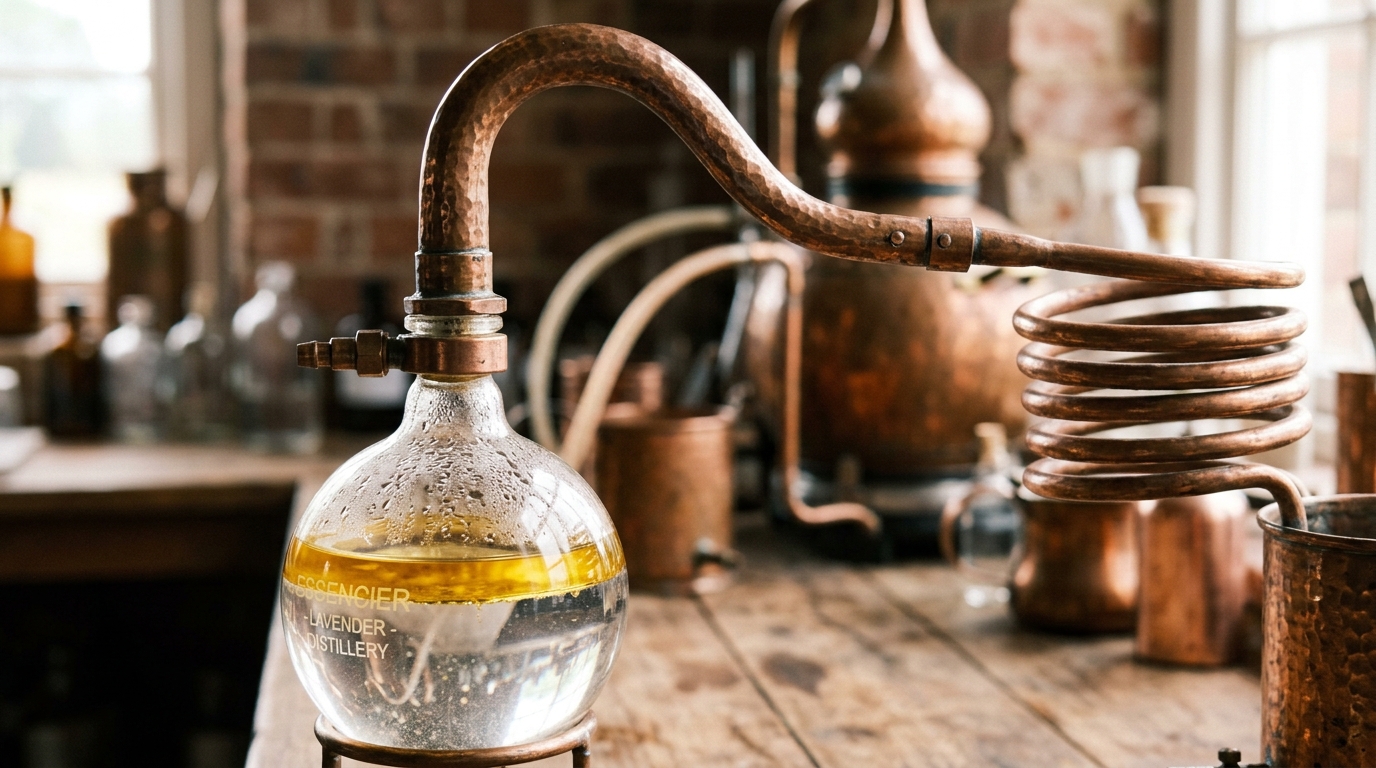
Anatomy of the Traditional Copper Alembic (Alambic Charentais)
The traditional alembic comprises four critical structural stages:
- The Cucurbit (Cucurbite): The hammered copper boiler housing the water and plant biomass. (In true steam distillation, steam is injected from an external boiler through a perforated grid to avoid immersing delicate leaves in boiling water). Copper is not chosen for aesthetic charm: it acts as an essential chemical scavenger and catalyst, reacting with and neutralizing volatile sulfur compounds (such as dimethyl sulfide) generated when plant proteins break down under heat.
- The Chapiter (Chapiteau) and Swan Neck (Col-de-Cygne): The spherical or onion-shaped dome and sweeping curved pipe where vapors ascend, undergo initial partial dephlegmation, and drop entrained liquid droplets back into the pot.
- The Condenser Coil (Serpentin): A multi-loop copper coil submerged in a continuous counter-current cooling water bath, transforming hot vapors back into a dual-phase liquid condensate.
- The Florentine Flask (Essencier): The separation vessel where liquid phases spontaneously segregate based on relative density.
Separation Kinetics: Light vs. Heavy Essential Oils
The vast majority of botanical essential oils exhibit a specific gravity lower than water ($\rho < 1.0\text{ g/cm}^3$). Lavender ($\rho \approx 0.885\text{ g/cm}^3$) and rosemary ($\rho \approx 0.900\text{ g/cm}^3$) float on the aqueous surface; the oil is decanted continuously via an upper outlet while water drains through a lower syphon.
However, certain raw materials rich in dense aromatic derivatives reverse this physical behavior:
- Clove Bud Oil (Syzygium aromaticum): Dominated by heavy eugenol, with a density ranging from $1.04$ to $1.06\text{ g/cm}^3$.
- Cinnamon Bark Oil (Cinnamomum verum): Heavily concentrated in cinnamaldehyde ($\rho \approx 1.03\text{ g/cm}^3$).
- Wintergreen Oil (Gaultheria procumbens): Consisting of nearly pure methyl salicylate ($\rho \approx 1.18\text{ g/cm}^3$).
In these instances, the precious essential oil sinks to the bottom of the essencier, demanding specialized receivers equipped with bottom-drain valving to prevent product loss.
Hydrosols and the Stripping of Phenethyl Alcohol in Rose Otto
The aqueous phase decanted from the Florentine receiver is the hydrosol (eau florale), a saturated aqueous solution carrying dissolved hydrophilic aromatic fractions and suspended micro-droplets.
The most dramatic consequence of water solubility occurs during the distillation of the Damask rose (Rosa damascena): Phenethyl alcohol (PEA), the primary molecule imparting the rich, sweet, honeyed warmth of a living rose bloom, possesses significant aqueous solubility (nearly $20\text{ g/L}$ at room temperature). When rose petals undergo steam distillation, nearly all the natural PEA dissolves into the rosewater hydrosol, leaving only trace quantities in the floating essential oil, known as Rose Otto.
As a result, Rose Otto possesses a piercing, fresh, lemony, and geraniol-dominated profile (rich in citronellol, geraniol, and nerol), yet lacks the deep, velvety richness of the flower in the field. To recover this lost heart, distillers subject the hydrosol to cohobation (cohobation): redistilling the floral water in a continuous closed loop to strip out and recombine the dissolved PEA into the oil.
Thermal Artifacts: The Genesis of Indigo Chamazulene
Distillation can also generate beneficial chemical artifacts that do not exist inside the living plant. In German chamomile (Matricaria chamomilla), the fresh flowering heads contain an uncolored sesquiterpene lactone termed matricin. During steam distillation, the combination of heat and acidity drives spontaneous dehydration and decarboxylation, transforming matricin into chamazulene:
$$\text{Matricin (Colorless)} \xrightarrow{\Delta, -H_2O, -CO_2} \text{Chamazulene (Deep Indigo Blue)}$$
Chamazulene imparts an extraordinary sapphire-blue tint and potent soothing properties to distilled chamomile oil—a striking example of a pyrosynthetic artifact celebrated in perfumery and pharmacology alike.
3. Volatile Solvent Extraction: From Concretes to Absolutes
By the late 19th century, Grasse’s perfumers faced an insurmountable botanical barrier: delicate blossoms like jasmine, tuberose, orange blossom, and mimosa collapse under steam distillation. The high thermal energy cooks their petals, boiling away fragile top notes while releasing unpleasant cooked-vegetable odors.
To extract these fragile flowers, industrial chemists developed volatile solvent extraction, an elegant two-stage thermodynamic process that revolutionized modern fragrance creation.
graph TD
    A[Fresh Botanical Flowers: Jasmine, Tuberose, Rose] -->|Non-Polar Solvent Wash: Hexane| B[Organic Micellar Solution]
    B -->|Reduced Pressure Evaporation| C[CONCRETE: Fragrant Oils + Plant Waxes]
    C -->|Ethanolic Wash at 96°| D[Alcoholic Solution with Suspended Waxes]
    D -->|Winterization Glaçage at -10°C to -20°C| E[Crystallized Cerides & Waxes Precipitate]
    E -->|Buchner Vacuum Filtration| F[Pure Alcoholic Aromatic Filtrate]
    F -->|Low-Temperature Solvent Recovery| G[PURE ABSOLUTE: 100% Soluble in Perfume Alcohol]
Phase 1: Non-Polar Maceration and the Concrete (Concrète)
Fresh flowers are loaded into perforated baskets inside sealed static or rotary extractors. A highly non-polar organic solvent—historically petroleum ether, and today technical hexane ($C_6H_{14}$)—is pumped through the biomass at room temperature ($20^\circ\text{C}\text{—}25^\circ\text{C}$).
The non-polar solvent selectively dissolves:
- Aromatic lipophilic volatile molecules.
- Cuticular waxes and fatty cerides protecting the outer plant epidermis.
- Liposoluble plant pigments (chlorophylls, carotenoids).
After multiple gentle wash cycles, the saturated solvent solution is evaporated under mild vacuum ($40^\circ\text{C}\text{—}45^\circ\text{C}$). The solvent vapors are condensed and recycled, leaving behind the concrete (concrète): a dense, fragrant, semi-solid waxy mass.
However, the concrete cannot be used directly in fine fragrance compounding. Its heavy, long-chain plant waxes are insoluble in $96^\circ$ perfumer’s ethanol. If blended into an alcoholic perfume, the waxes would immediately precipitate, turning the juice cloudy and permanently clogging spray atomizers.
Phase 2: Ethanolic Refining, Winterization (Glaçage), and the Absolute
To separate the pure odorants from the insoluble waxes, the concrete undergoes multi-stage cold refining:
- Ethanolic Solvation: The concrete is vigorously agitated in mechanical jacketed vats with pure $96^\circ$ ethanol. The alcohol dissolves the polar and semi-polar fragrance volatiles, leaving the heavy cuticular waxes partially suspended.
- Winterization (Glaçage): The warm alcoholic mixture is pumped into refrigerated chilling tanks and maintained at temperatures between $-10^\circ\text{C}$ and $-20^\circ\text{C}$ for 24 to 48 hours. Under deep freeze, the dissolved waxes, cerides, and stearins crystallize and coalesce into dense precipitates.
- Vacuum Filtration: The ice-cold suspension is pulled through Buchner filters or filter presses to separate the solid wax cake from the clear liquid.
- Desolventization: The crystal-clear alcoholic filtrate is routed to low-temperature vacuum evaporators ($<40^\circ\text{C}$) to gently distill away the ethanol carrier.
The resulting product is the absolute (absolue): an intensely rich, viscous extract that is $100%$ soluble in perfumer’s alcohol. Unlike steam-distilled oils, absolutes retain heavy polar molecules—such as phenethyl alcohol in rose and animalic indole in jasmine—delivering an opulent, true-to-nature, and three-dimensional sensory profile.
Regulatory Rigor: IFRA and REACH Hexane Residue Thresholds
Because commercial hexane is a neurotoxic hydrocarbon, international bodies enforce stringent analytical purity standards. Under IFRA guidelines and European REACH mandates, all commercial absolutes must undergo Headspace Gas Chromatography-Mass Spectrometry (HS-GC-MS) verification to ensure residual hexane concentrations fall strictly below $1\text{ ppm}$ ($<1\text{ mg/kg}$), guaranteeing absolute dermatological safety.
4. Supercritical Carbon Dioxide ($CO_2$) Extraction (SFE)
Commercialized at industrial scale in the closing decades of the 20th century, Supercritical Fluid Extraction (SFE) represents the greatest technological leap in green chemistry applied to luxury perfumery.
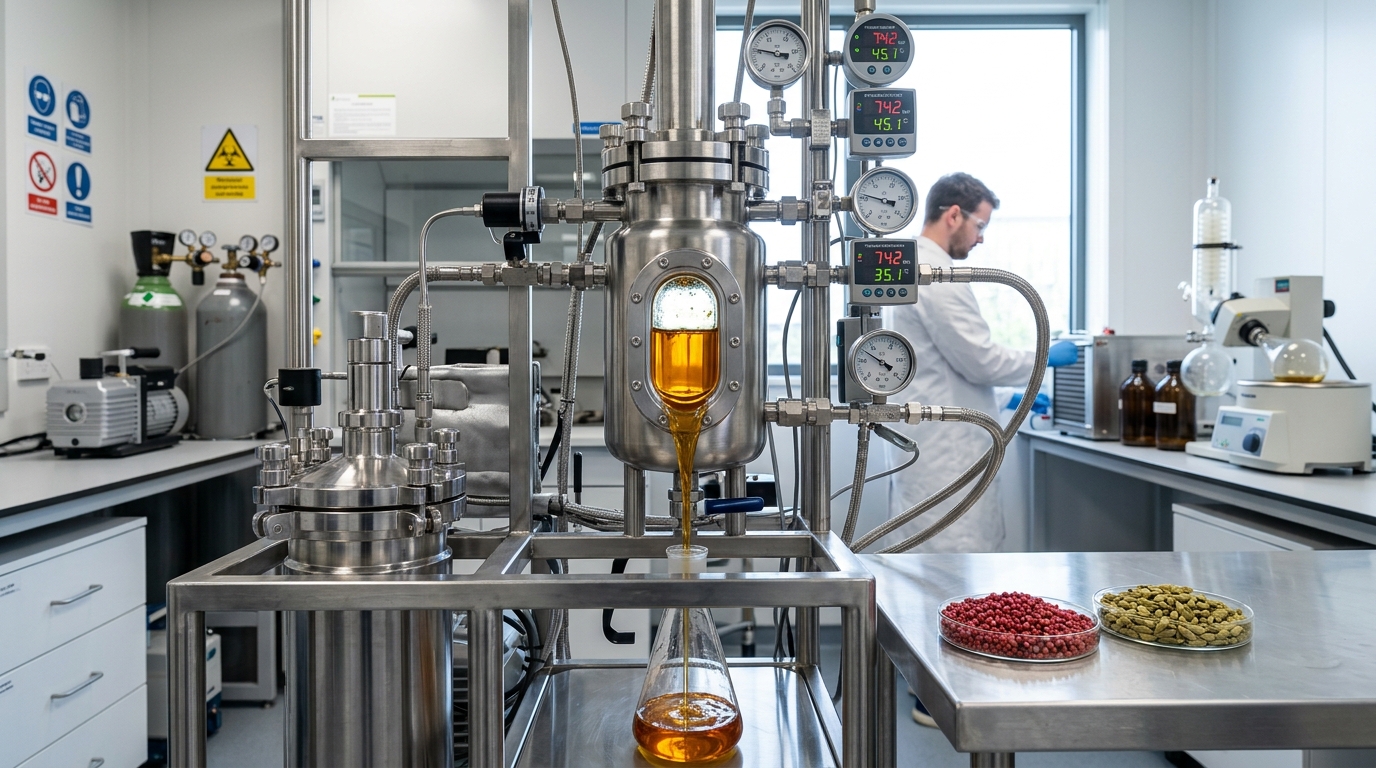
Physicochemical Principles: The Critical Point of $CO_2$
Every pure substance transitions into a supercritical state when heated and compressed beyond its unique thermodynamic critical coordinates:
- Critical Temperature ($T_c$): $31.1^\circ\text{C}$
- Critical Pressure ($P_c$): $73.8\text{ bar}$
In the supercritical state, the physical boundary between liquid and gas ceases to exist. The fluid exhibits the high density of a liquid ($0.6\text{—}0.9\text{ g/cm}^3$), endowing it with formidable solvent power, alongside the low viscosity and zero surface tension of a gas, enabling it to penetrate instantly into deep, dense botanical structures (seeds, roots, hard barks, and beans).
Subcritical Liquid vs. Dense Supercritical $CO_2$
By finely tuning temperature and pressure inside the extraction autoclave, engineers modulate the fluid’s density and dielectric properties:
- Subcritical Liquid $CO_2$ ($0^\circ\text{C}\text{—}10^\circ\text{C}$, $50\text{—}70\text{ bar}$): Exhibits lower density; acts as an ultra-selective solvent extracting top-note volatiles and heat-sensitive monoterpenes without co-extracting heavy lipids.
- Dense Supercritical $CO_2$ ($35^\circ\text{C}\text{—}45^\circ\text{C}$, $150\text{—}350\text{ bar}$): Exhibits high density and elevated solvating power; dissolves heavy resins, sesquiterpenoids, and complex lipophilic compounds with exceptional yields.
”Total” vs. “Select” Extracts
Industrial $CO_2$ botanical extracts are classified into two distinct technical grades:
- Total $CO_2$ Extract: Produced at high pressures ($>280\text{ bar}$), this process extracts the full spectrum of aromatics alongside natural botanical waxes, pigments, and triglycerides. Total extracts are semi-solid or buttery pastes requiring pre-dispersion.
- Select $CO_2$ Extract: Produced through cascade fractional depressurization. After exiting the extraction vessel, the fluid enters a primary separator set at $120\text{—}150\text{ bar}$, where density decreases just enough to precipitate heavy waxes and fats. The fluid then enters a second separator operating at $50\text{ bar}$, where $CO_2$ transitions toward the gaseous phase, dropping pure, wax-free essential oils ready for immediate alcoholic dilution.
Olfactory Virtues: The Sovereign Realm of Cold Spices
The sensory advantages of supercritical $CO_2$ extraction are unparalleled:
- Zero Thermal Degradation: Operating at a gentle $35^\circ\text{C}\text{—}40^\circ\text{C}$, fragile esters, aldehydes, and monoterpenes remain entirely pristine.
- Zero Petrochemical Residues: Upon depressurization to $1\text{ atm}$, carbon dioxide spontaneously turns to gas and is collected for closed-loop recycling ($95%\text{—}98%$ recovery rate), leaving an analytically pure botanical extract free of solvent traces.
- Hyper-Realistic Spice Profiles: $CO_2$ extraction is the gold standard for pink pepper (Schinus terebinthifolia), Guatemalan green cardamom, and fresh ginger. Steam-distilled ginger often smells medicinal and flat; ginger $CO_2$ preserves the zesty, pungent gingerols and shogaols with mouthwatering realism.
This ultra-modern transparency and hyper-vibrant spice definition forms the core architecture of high-concentration modern masterworks, evident in the electric spicy intensity of Dior Sauvage Elixir and the crystalline mineral-aromatic facets of Marc-Antoine Barrois Ganymede.
5. Cold Expression (Expression à Froid) and Citrus Chemistry
Citrus peel oils (bergamot, lemon, sweet orange, mandarin, grapefruit, and lime) represent a unique class of aromatic raw materials. Unlike blossoms or roots where scent is produced in internal parenchyma or floral glands, citrus essences are locked inside oval secretory vesicles embedded in the colored outer rind: the flavedo.
              Cross-Section of a Citrus Pericarp
              ══════════════════════════════════
              ┌────────────────────────────────────────┐
              │        FLAVEDO (Colored outer rind)    │
              │   (o)   (o)   (o)   (o)   (o)   (o)  │ ◄── Secretory oil cavities
              └────────────────────────────────────────┘     (90-95% Monoterpenes)
              ┌────────────────────────────────────────┐
              │        ALBEDO (White spongy mesocarp)  │
              └────────────────────────────────────────┘
              ┌────────────────────────────────────────┐
              │        ENDOCARP (Juice vesicles/pulp)  │
              └────────────────────────────────────────┘
These oil cavities consist of up to $90%\text{—}95%$ light monoterpene hydrocarbons, primarily $D$-limonene. Thermal distillation utterly destroys their fresh, juicy sparkle: heat hydrolyzes delicate fruit esters and oxidizes limonene into harsh, terpene-like off-notes reminiscent of turpentine. Consequently, citrus oils are obtained exclusively via mechanical cold expression.
Abrasion Mechanics: From the Écuelle à Piquer to Modern Pelatrice Machines
- The Historical Écuelle à Piquer: In 18th- and 19th-century Calabria and Sicily, artisans rotated fruit inside a shallow brass bowl lined with sharp brass pins (écuelle à piquer). As the spikes punctured the flavedo, the released oil was absorbed into natural sea sponges placed at the base, which were periodically wrung out into clay collection basins (conche).
- Industrial Continuous Systems: Today, automated continuous Pelatrice machines abrade the rinds of whole fruits between rotating rasping cylinders under a fine water mist that washes away the expelled oil as a dilute aqueous emulsion, while Torchi or Brown presses simultaneously extract the internal juice.
Centrifugal Clarification
The raw emulsion of oil, water, and cellular debris is immediately routed to industrial disk-stack centrifuges spinning at $5,000\text{ to }8,000\text{ rpm}$. High centrifugal acceleration cleanly splits the phases by specific gravity in seconds, yielding a brilliant, crystal-clear, virgin cold-pressed essential oil.
Phototoxicity and Furocoumarins: The Bergapten (5-MOP) Hazard
Virgin cold-pressed citrus oils harbor a dangerous biological hazard: they naturally extract non-volatile furocoumarins (linear psoralens), most notably bergapten (5-methoxypsoralen or 5-MOP), found in high concentrations in bergamot (Citrus bergamia) and cold-pressed lime.
When exposed to solar ultraviolet radiation (UVA wavelengths, $320\text{—}400\text{ nm}$), bergapten molecules intercalate directly between adjacent base pairs of epidermal cellular DNA. UVA photon absorption triggers photochemical cyclization, forming covalent cross-links between the psoralen and thymine bases. This cellular damage triggers Berloque dermatitis: severe chemical-like phototoxic burns, blistering, and intense, long-lasting hyperpigmentation spots that can persist on human skin for months.
Molecular Vacuum Fractional Rectification: FCF Citrus Oils
To eliminate phototoxicity, IFRA standards mandate that bergapten concentration in leave-on consumer fragrances must not exceed $15\text{ ppm}$ ($0.0015%$).
Because raw, cold-pressed Calabrian bergamot oil typically contains between $2,000$ and $4,000\text{ ppm}$ of natural 5-MOP, it cannot be safely used in modern perfumery without purification. The raw oil is subjected to molecular vacuum fractional distillation. Because furocoumarins possess heavy molecular weights and negligible vapor pressures, they remain trapped in the non-volatile distillation residue, while sparkling limonene, linalool, and linalyl acetate distill cleanly overhead.
The resulting product is FCF Bergamot Oil (Furocoumarin-Free, or debergaptenized bergamot): an analytically safe, sparkling botanical material that drives the iconic bitter-citrus opening of timeless masterworks like Terre d’Hermès and the clean, mineral-aquatic radiance of Acqua di Giò Profondo.
6. Traditional Grasse Enfleurage (L’Enfleurage à Froid)
Cold enfleurage is the most revered, poetic, and labor-intensive extraction technique in the history of fragrance. Refined across Grasse in the 18th and 19th centuries, this artisanal method established Provence as the world’s undisputed capital of high perfumery.
Botanical Physiology: Climacteric vs. Non-Climacteric Blossoms
The technical rationale for enfleurage lies in plant physiology:
- Many aromatic botanicals (lavender, peppermint, geranium) store their essential oils in static, pre-formed epidermal glands. Once harvested, synthesis stops immediately.
- In contrast, delicate flowers such as jasmine (Jasminum grandiflorum) and tuberose (Polianthes tuberosa) exhibit non-climacteric post-harvest volatile biosynthesis: their living floral tissues remain biochemically active, continuing to synthesize and exhale aromatic molecules for 24 to 48 hours after being plucked.
Subjecting freshly harvested jasmine blossoms to hot steam or boiling solvents halts enzymatic activity instantly, destroying ongoing synthesis and releasing foul, grassy breakdown notes. Enfleurage was devised specifically to capture the continuous fragrant exhalations of living flowers as they slowly respire.
The Operational Protocol of the Châssis
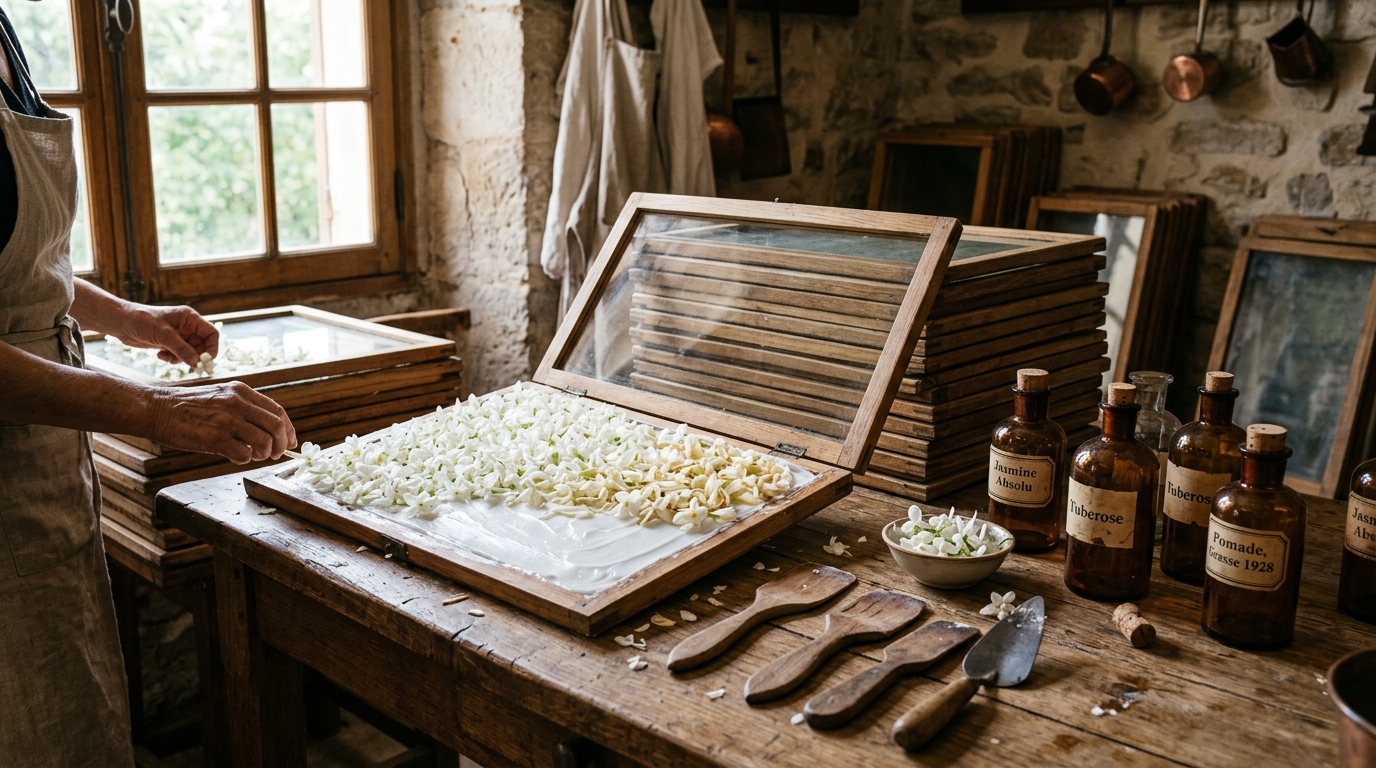
Enfleurage relies on large rectangular wooden frames fitted with clear glass panes (châssis):
- Pomade Preparation: Both sides of each glass pane are coated with an even layer of purified, odorless fat pomade. Historically, this consisted of a carefully deodorized blend of two parts lard and one part beef tallow, stabilized with benzoin resin; contemporary boutique ateliers utilize stabilized vegetable lipids like refined shea or coconut butter.
- Flower Inoculation (Enfleurage): Jasmine blossoms harvested at daybreak are hand-scattered onto the lipid layer.
- Stacking and Molecular Diffusion: The wooden chassis are stacked into airtight columns. Maintained in cool cellars at $15^\circ\text{C}\text{—}18^\circ\text{C}$, the living blossoms exhale their volatile scent, which is steadily absorbed by the lipid matrix via lipophilic diffusion.
- Deflowering (Défleurage): After 24 hours, the exhausted, brown blossoms are carefully removed by hand using tweezers to avoid tearing the delicate fat bed.
- Cyclic Replenishment: A fresh batch of morning flowers is immediately spread across the pomade. This labor-intensive cycle is repeated every single day for 30 to 60 consecutive days, until the lipid matrix is completely saturated with fragrance, creating the perfumed pomade (pommade parfumée).
The Enfleurage Absolute and Modern Boutique Revival
To extract the fragrant essence from the saturated pomade, the fat is washed with pure $96^\circ$ ethanol in mechanical churns (batteuses). The alcohol extracts the botanical odorants (extrait d’enfleurage), is chilled to precipitate trace fatty acids, and is gently vacuum-evaporated to yield the legendary enfleurage absolute.
Due to the immense manual labor required—demanding thousands of artisan hours and pushing production costs past $30,000\text{—}50,000\text{ per kilogram}$—enfleurage was largely abandoned after the industrial development of hexane extraction. Today, however, it is experiencing a luxurious renaissance among boutique artisan perfumers for its peerless olfactory character: an extraordinarily pure, airy, and crystalline floral profile entirely free of the indolic heaviness and solvent traces common to chemical absolutes.
7. Frontier Technologies and Green Extraction
The modern pursuit of sustainable, energy-efficient, and true-to-nature botanical raw materials has sparked groundbreaking technological innovations that are transforming botanical extraction:
graph TD
    subgraph Frontier_Technologies["Green Chemistry & Advanced Botanical Processing"]
        A["Ultrasound-Assisted Extraction (UAE)<br>• Acoustic cavitation (20-100 kHz)<br>• Micro-jet mechanical cell wall rupture<br>• Room temperature processing"]
        B["Solvent-Free Microwave Extraction (SFME)<br>• Dielectric heating of in-situ cell water<br>• Zero added water or chemical solvents<br>• Extraction completes in minutes"]
        C["Short-Path Molecular Distillation<br>• Ultra-high vacuum (10⁻³ mbar)<br>• Mean free path exceeds gap<br>• Thermal-free isolation of noble hearts"]
    end
1. Ultrasound-Assisted Extraction (UAE)
UAE harnesses the physical mechanics of acoustic cavitation. High-frequency ultrasound waves ($20\text{—}100\text{ kHz}$) propagated through a liquid medium generate microscopic cavitation bubbles. These bubbles expand and violently collapse within nanoseconds, producing localized micro-jets with shockwave pressures exceeding $1,000\text{ bar}$ and localized shear forces.
These micro-jets mechanically tear open botanical cell walls at ambient temperatures ($20^\circ\text{C}\text{—}25^\circ\text{C}$), releasing trapped essential oils in minutes rather than hours while drastically slashing solvent requirements.
2. Solvent-Free Microwave Extraction (SFME)
In SFME, fresh botanical biomass is placed inside a dedicated microwave reactor ($2.45\text{ GHz}$) without adding external water or chemical solvents. The electromagnetic radiation couples directly with the permanent dipoles of the plant’s internal cellular water.
This in-situ dielectric heating causes localized superheating: the internal water rapidly boils and vaporizes, generating intense internal pressure that bursts secretory glands from the inside out—a phenomenon known as the cellular popcorn effect. The escaping internal steam co-distills the essential oils into an external chilled condenser, yielding pure, unaltered botanical extracts in a fraction of the time required by traditional methods.
3. Short-Path Molecular Vacuum Distillation
Operating under extreme ultra-high vacuum ($10^{-3}\text{ to }10^{-4}\text{ mbar}$), short-path molecular distillation eliminates vapor resistance. At these ultra-low pressures, the mean free path of vapor molecules exceeds the physical distance between the evaporating surface and the internal condensing coil.
Compounds vaporize and condense at temperatures drastically below their normal boiling points ($<80^\circ\text{C}$), allowing master distillers to fractionate and isolate pristine “molecular hearts”—such as Patchouli Heart (stripped of earthy iron and camphor facets) or Clear Labdanum (purified of bitter, burnt tars)—with zero pyrolytic degradation.
8. Case Studies and Master Comparative Matrix
To appreciate how extraction methodology dictates the olfactory character of a finished perfume, consider how identical botanicals diverge across different technologies:
Case 1: The Damask Rose (Rosa damascena)
- Rose Otto (Steam Distillation): Bright, citrusy, geranic, fresh, and airy; virtually devoid of phenethyl alcohol (stripped into rosewater).
- Rose Absolute (Hexane + Ethanol): Opulent, velvety, warm, honeyed, and carnal; retains $60%\text{—}70%$ natural phenethyl alcohol.
- Rose $CO_2$ (Supercritical Fluid): Photorealistic and seamlessly balanced; marries the dewy green freshness of the living petal with deep, true floral volume.
Case 2: Royal Jasmine (Jasminum grandiflorum)
- Concrete: Dense, waxy, earthy paste; rich in cuticular waxes and insoluble in perfumer’s alcohol.
- Absolute: Narcotic, warm, solar, fruity, and indolic; the structural backbone of classical floral perfumery.
- Enfleurage: Luminous, pure, and crystalline; captures the ethereal breath of the living morning flower without solvent heaviness.
Case 3: Calabrian Bergamot (Citrus bergamia)
- Cold-Pressed (Virgin): Bitter, sparkling, and intensely realistic, but severely phototoxic due to natural bergapten content.
- Distilled: Safe from furocoumarins, but flat and dull, with boiled-leaf off-notes.
- FCF Rectified: Luminous and aristocratically bitter, preserving citrus sparkle while meeting strict IFRA safety limits.
Master Comparative Matrix of Botanical Extraction Methods
| Botanical Raw Material | Preferred Extraction Method | Typical Yield (kg plant / kg extract) | Key Marker Molecules | Resulting Olfactory Profile | Perfumery Compounding Function |
|---|---|---|---|---|---|
| Damask Rose (Bulgaria / Turkey) | Steam Distillation (Rose Otto) | $3,500\text{—}4,500\text{ kg}$ | Citronellol ($35%$), Geraniol ($20%$), Nerol | Sparkling, lemony, green, geranic, diffusive | Radiant floral openings and luminous hearts |
| Damask Rose (Grasse / Turkey) | Volatile Solvents (Absolute) | $400\text{—}500\text{ kg}$ (prior concrete) | Phenethyl alcohol ($60\text{—}70%$), Citronellol | Opulent, honeyed, rich, velvety, carnal | Deep floral core; orientals and chypres |
| Grandiflorum Jasmine (Grasse / India) | Volatile Solvents (Absolute) | $700\text{—}1,000\text{ kg}$ | Benzyl acetate ($25%$), Linalool, Indole ($2\text{—}5%$) | Narcotic, warm, solar, indolic, fruity | Indispensable floral anchor and heart builder |
| Grandiflorum Jasmine (Artisanal Grasse) | Cold Enfleurage (Absolute) | $>2,000\text{ kg}$ (labor intensive) | Benzyl acetate, pure delicate esters | Ethereal, crystalline, pure, zero indolic decay | High-end botanical perfumery and bespoke niche |
| Calabrian Bergamot (Italy) | Cold Expression + FCF Molecular Distillation | $200\text{—}250\text{ kg}$ | $D$-Limonene ($40%$), Linalyl acetate ($30%$) | Aristocratic citrus, bitter, Earl Grey tea lift | Signature top-note sparkle; fougère & colognes |
| Pink Pepper (Réunion / Brazil) | Supercritical $CO_2$ Extraction (Select) | $30\text{—}50\text{ kg}$ | $\alpha$-Phellandrene, Myrcene, $\beta$-Caryophyllene | Cold spicy, effervescent, dry resinous, vibrant | Dynamic, modern sparkling spicy openings |
| Green Cardamom (Guatemala) | Supercritical $CO_2$ Extraction (Select) | $20\text{—}35\text{ kg}$ | Terpinyl acetate ($45%$), 1,8-Cineole ($30%$) | Refined spicy, clean camphoraceous, cooling | Volumetric expansion in noble spicy architectures |
| Olibanum Frankincense (Oman / Somalia) | Slow Steam Hydrodistillation | $15\text{—}25\text{ kg}$ | $\alpha$-Pinene ($40%$), Octyl acetate, Incensole | Clean resinous, citrus-terpenic, meditative | Mystical heart and base; woody and ambery blends |
| Patchouli (Indonesia) | Steam Distillation + Molecular Fractionation | $30\text{—}45\text{ kg}$ | Patchoulol ($35%$), Norpatchoulenol | Dry woody, velvety dark cocoa, clean earth | Structural fixative; modern chypres and woods |
| Fine Lavender AOP (Haute-Provence) | Direct Steam Distillation | $120\text{—}150\text{ kg}$ | Linalyl acetate ($40\text{—}45%$), Linalool ($30%$) | Wild aromatic, sweet floral, clean balsamic | Backbone of the classical fougère accord |
The masterful synergy between these refined botanical extracts and state-of-the-art synthetic aromachemicals represents the pinnacle of contemporary perfumery. In landmark compositions like Baccarat Rouge 540, the harmonious interplay between cedarwood, purified saffron, and radiant amber molecules demonstrates how modern olfactory poetry relies upon the absolute chemical precision of its botanical foundations.
9. Critical Connoisseurship, Labeling, and the Future of Naturals
The modern fragrance consumer frequently encounters a seductive marketing narrative: the claim that “$100%$ natural” perfumes are inherently superior, safer, and more authentic than fragrances featuring laboratory-synthesized molecules. A rigorous examination of botany, toxicology, and ecology reveals a far more nuanced reality.
                 The Natural Extraction Paradox

           Consumer Demand for "100% All-Natural"
                            ▲
                            │
        4,000 kg Fresh Roses  ──►  1 kg Rose Otto
                            │
                            ▼
           Ecological Limits: Arable Land & Water
                            │
                            ▼
                 Contemporary Balance:
       Green Extraction (CO2 / UAE) + Clean Synthetics
Olfactory Pyramids and the ISO 9235 Standard
When a luxury perfume pyramid lists notes of “lily of the valley,” “peony,” or “freesia,” these rarely represent bottled botanical extracts:
- Many celebrated flowers are mute flowers (fleurs muettes), including lily of the valley, lilac, sweet pea, gardenia, and violet blossoms: their natural extraction yields either zero fragrant oil, or their delicate scent molecules degrade instantly upon harvest. Their aromas can only be captured through head-space analysis and molecular synthesis.
- To protect consumers and enforce truth in advertising, international commerce relies upon the ISO 9235 standard (Aromatic natural raw materials):
- Essential oils must be obtained exclusively through steam distillation, hydrodistillation, or citrus cold expression.
- Absolutes must be derived via alcoholic washing of concretes or resinoids obtained through approved botanical or purified solvents.
- $CO_2$ extracts must be classified as supercritical fluid extracts without petrochemical adulteration.
- Fragrances claiming natural certification cannot contain synthetic nature-identical isolates or undisclosed petrochemical carriers.
The Ecological Footprint and Agricultural Economics
Procuring natural extracts demands staggering agricultural acreage and human labor:
- Damask Rose: Producing a single kilogram of Rose Otto requires between $3,500$ and $4,500\text{ kilograms of fresh petals}$—over one million roses harvested entirely by hand before the morning sun evaporates the dew.
- Orange Blossom (Neroli): Yields require over $1,000\text{ kilograms of freshly picked blossoms}$ to distill a single liter of essential oil.
- Orris Butter (Iris pallida): The rhizomes must grow in the ground for three full years, followed by three additional years of slow warehouse drying and enzymatic oxidation, before distillation yields tiny quantities of precious irones costing in excess of $50,000\text{—}80,000\text{ per kilogram}$.
The preservation of historic agricultural terroirs in Grasse, Calabria, and Madagascar requires fair trade wages, water conservation, and sustainable farming practices that cannot support unchecked mass-market overconsumption.
Conclusion: The Symbiosis of Nature and Science
Contemporary perfumery is not a binary contest between nature and synthesis. Rather, it is a magnificent artistic symbiosis. Advanced green extraction technologies ($CO_2$, acoustic cavitation, molecular short-path rectification) capture the unfathomable micro-molecular complexity and emotional soul of living botanicals. Simultaneously, high-purity synthetic molecules provide crystalline diffusion, technical longevity, and ecological protection for endangered plant and animal species.
The science of natural extraction is the enduring bridge where botany, physics, and art join hands to capture, drop by drop, the living aromatic spirit of the Earth.
Recommended Reading & Technical Masterclasses
- The Perfumer’s Organ: Practical Atelier Guide, Essential Palette, and Laboratory Compounding
- The Definitive Oud Guide: History, Origins, and Chemistry
- The History of Perfume: From Mesopotamia to Modern Chemistry
- Perfumery Molecules: Ambroxan, Iso E Super, and the Science of Anosmia
- Olfactory Families and Accords
- Perfume Notes and Ingredients Directory